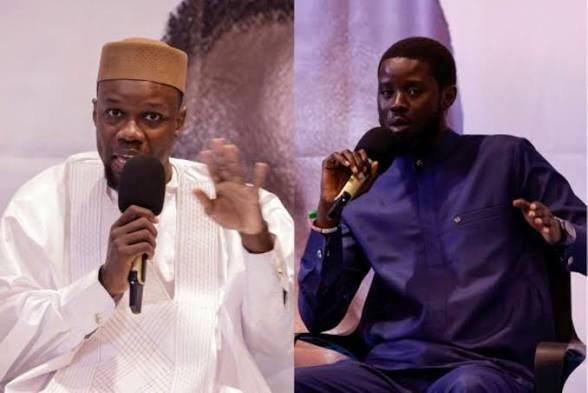
Senegal President Bassirou Diomaye Faye Dismisses Prime Minister Ousmane Sonko, Dissolves Government
Key Takeaways
- President Bassirou Diomaye Faye dismissed Prime Minister Ousmane Sonko and dissolved the government.
- All ministers were dismissed; the outgoing government will handle daily affairs.
- Move follows months of tensions amid Senegal's debt crisis and ongoing IMF talks.
Faye dissolves government
Senegal President Bassirou Diomaye Faye dismissed Prime Minister Ousmane Sonko and dissolved the government after months of tensions between the two leaders, with the decision announced late Friday through a presidential decree broadcast on state television.
“Senegal President Bassirou Diomaye Faye has dismissed Prime Minister Ousmane Sonko and dissolved the government, a move that risks deepening uncertainty in a nation already grappling with a debt crisis and drawn-out talks with the International Monetary Fund”
A presidential aide read out a decree saying Faye "ended the duties of Ousmane Sonko and consequently those of the ministers and secretaries of state who are members of the government," leaving no immediate replacement for Sonko as of the time of filing.

The split deepened uncertainty in a country facing mounting economic pressure, with public debt reaching the equivalent of 132% of its GDP, according to the International Monetary Fund (IMF).
The IMF froze its $1.8bn lending programme with Senegal as a result of the debt crisis, and the BBC reported that Sonko’s dismissal followed a parliamentary session on Tuesday when he openly criticised Faye for his approach to the debt crisis.
In Dakar, several hundred students demonstrated on the streets declaring their support for Sonko after the parliamentary session, as the feud played out against the backdrop of IMF talks.
Sonko’s response
Sonko responded to his dismissal by posting on social media that he would "sleep with a light heart," a line repeated across coverage as his way of framing the rupture with Faye.
The BBC reported that Sonko’s dismissal followed a parliamentary session on Tuesday during which the prime minister openly criticised Faye for his approach to the debt crisis, while the BBC also noted that Faye was in the unusual situation of owing his position in large part to Sonko’s popularity.

In a statement read out by a presidential aide on state media, Al Jazeera said the outgoing government was tasked with handling day-to-day affairs after Faye dismissed all ministers.
Al Jazeera also tied the political move to the debt crisis, saying the IMF froze a $1.8bn lending programme after the discovery of misreported debt hidden by the previous government and that the move raised the risk of further delays in reaching a new agreement with the IMF.
RFI warned that the dismissal raises the possibility of a power struggle ahead of presidential elections in 2029, quoting Maurice Soudieck Dione of Senegal's Gaston-Berger University about conflict between presidential and parliamentary majorities.
IMF talks and 2029
The immediate political stakes centered on how Senegal would manage day-to-day affairs while consultations within the ruling coalition proceeded ahead of appointing a new prime minister and cabinet, with no replacement named as of the time of reporting.
“Senegalese President Bassiro Dioumaï Faye announced the dismissal of Prime Minister Ousmane Sonko and the dissolution of the government, in a surprise move that capped months of rising tensions and public confrontation between the former allies, worsening the political crisis in this debt-ridden West African country”
Al Jazeera reported that Finance Minister Cheikh Diba told parliament the government expects to resume talks with the IMF in the week of June 8 and hopes to reach an agreement on key points by June 30.
RFI framed the broader consequence as a potential power struggle between a presidential majority and a parliamentary majority, warning that elections on the horizon—local elections in 2027 and the presidential election in 2029—could make governance harder.
The BBC added that no details had been provided on the appointment of a new prime minister, while also noting that tensions between Sonko and Faye had been on display for months.
In the background of the political rupture, Al Jazeera said Senegal’s end-2024 debt level was pushed to 132 percent of its economic output after misreported debt was discovered, and it described the risk that Faye’s move could deepen uncertainty during ongoing IMF talks.
More on Africa
Western Aid Cuts Leave Democratic Republic of Congo Ebola Response Under-Resourced, Oxfam Says
14 sources compared

Angry Residents Burn Ebola Treatment Tent in Eastern Democratic Republic of the Congo, 18 Suspected Patients Escape
56 sources compared
%2Fdepartment-of-communications-(dco)%2Fdigital-social-visual-(dsv)%2Fwho-logo-at-headquarters.tmb-1200v.jpg%3Fsfvrsn%3D34ba81d2_6&w=3840&q=75)
WHO Raises Ebola Risk to Very High in Democratic Republic of Congo Nationally
52 sources compared

German Police Kill Escaped Tiger After Attacking 73-Year-Old Man Near Leipzig
10 sources compared