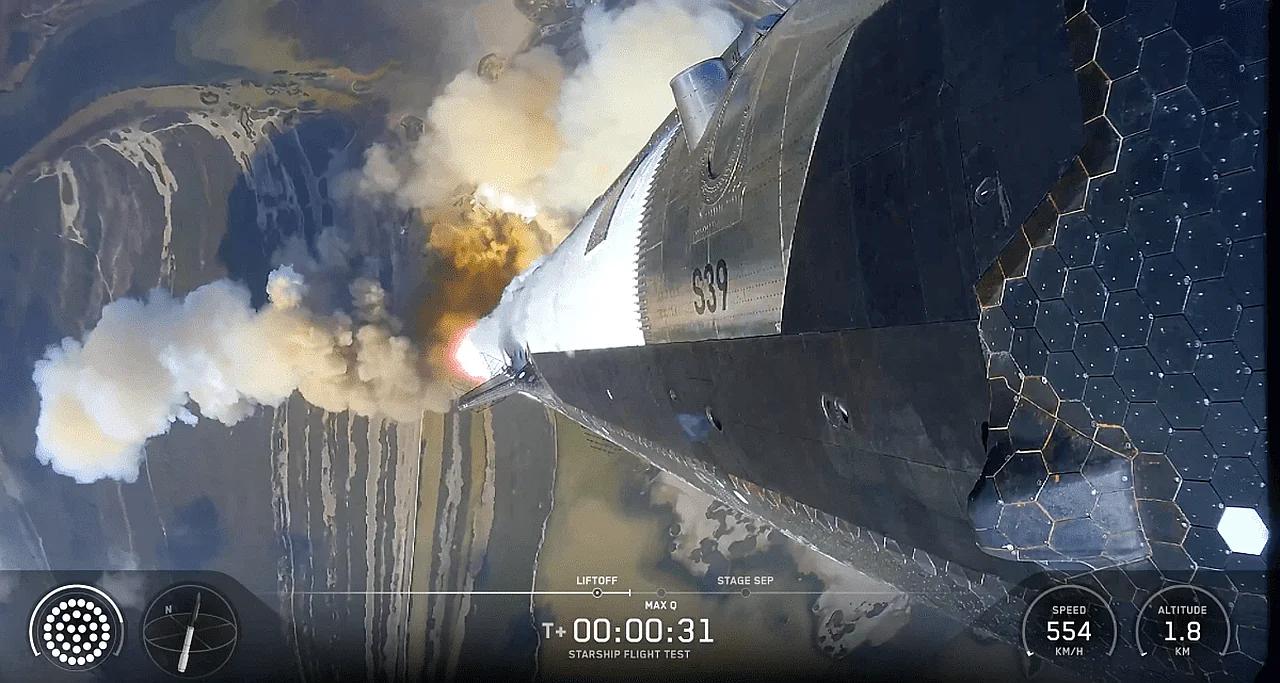
SpaceX Launches Starship V3 From Starbase, Texas, Loses Super Heavy Booster In Gulf Of Mexico
Key Takeaways
- Starship V3 launched from Starbase, Texas, on first test flight.
- One engine shut down early; additional engines failed during ascent.
- Starship released mock satellites during suborbital flight.
Flight 12 Debut
SpaceX launched Starship V3 for the first time on May 22, completing most of the test objectives planned for the suborbital Flight 12, after the company scrubbed an earlier Flight 12 attempt when a hydraulic pin in the launch tower failed to retract.
“SpaceX has successfully launched its upgraded Starship V3 rocket for the first time, although the test included some challenges for Elon Musk's space exploration firm”
The launch lifted off from Starbase, Texas, at 6:30 p.m. Eastern, with the Super Heavy booster firing its 33 Raptor 3 engines for the initial ascent before one engine shut down about one minute and 40 seconds after liftoff.

Two and a half minutes after liftoff, the Starship upper stage ignited its six engines and separated from Super Heavy, but the booster’s “boostback” burn did not go as planned and the booster made a hard splashdown in the Gulf of Mexico.
SpaceX deployed 20 Starlink mass simulators and two modified “Dodger Dogs” spacecraft, and the vehicle made a soft splashdown in the planned landing zone in the Indian Ocean about 66½ minutes after liftoff, tipping over and exploding as expected.
The Federal Aviation Administration said it was assessing the “anomaly” during the boostback burn and activated a debris response area for the booster anomaly, stating the booster fell in that zone.
Musk, Huot, and the Scrutiny
On the webcast, SpaceX spokesperson Dan Huot said, “It does look like we are within bounds of what we analyzed” if one of the vacuum-optimized Raptor engines failed, adding, “I wouldn’t call it nominal orbital insertion, but we’re on a trajectory that we had analyzed, and it’s within bounds.”
SpaceX CEO Elon Musk posted on X, “You scored a goal for humanity,” after the splashdown, while the mission also included a skipped planned engine relight test because of the earlier engine problem.

The Federal Aviation Administration said it had not yet determined if the boostback anomaly rose to the level of mishap that would require an investigation, even as it assessed the anomaly and placed the booster in a debris response area.
CNN described the test as mixed success, noting Starship managed a controlled splashdown in the Indian Ocean despite operating without one of its engines and that the test was the Starship program’s first since October.
Scientific American quoted Joseph Gonzalez saying, “V3 is taller, exceeds 18 million pounds of total thrust and introduces the new Raptor 3 engines,” framing the V3 changes as substantial ahead of the launch attempt.
What Comes Next
SpaceX said in its prospectus filed with the Securities and Exchange Commission May 20 that it expected to begin orbital payload delivery missions with Starship in the second half of this year, as the company prepared for an IPO projected to raise around $75 billion.
“SpaceX launched a Friday on a flight to test more powerful engines, enhanced control systems and a host of other upgrades needed to streamline operations and improve safety and reliability”
CNN reported SpaceX is racing to get Starship ready to launch satellites and carry humans into deep space, and it said the company hopes to fulfill NASA’s plan to use the vehicle to land its astronauts on the moon by 2028.
NASA Administrator Jared Isaacman watched the Flight 12 webcast, telling SpaceX employees, “we’re all rooting for you, and we’re looking forward to meeting up next year in Earth orbit,” while referring to plans for Artemis 3.
NBC News said NASA is paying SpaceX billions of dollars and Blue Origin to provide lunar landers for Artemis astronauts, and it described a moon landing by two astronauts—Artemis IV—could follow as soon as 2028 using either Starship or Blue Moon.
In the immediate aftermath, SpaceX said it did not disclose a timeline for the next Starship launch or when it would be ready for the first orbital flight after 12 suborbital test flights, even as the flight deployed 22 mock satellites and two camera-equipped “Dodger Dogs” to inspect Starship’s heat shield.
More on Technology and Science

Gavin Newsom Declares State Of Emergency After GKN Aerospace Tank Overheats In Garden Grove
17 sources compared

xAI Powers Data Centers With Natural Gas as SpaceX Pitches Space-Based Solar
16 sources compared
Three Red Cross Volunteers Die From Suspected Ebola in Democratic Republic of the Congo's Ituri
15 sources compared

US Health Authorities Temporarily Bar Green-Card Holders Returning From Ebola-Affected Congo, Uganda, South Sudan
27 sources compared