Airports Adjust Arrival-Time Guidance as TSA Chaos Continues
Key Takeaways
- TSA staffing shortages are driving longer wait times nationwide.
- Extended security queues at multiple U.S. airports.
- Travelers face missed flights due to longer security wait times.
Nationwide Airport Chaos
Airports across the United States are experiencing unprecedented chaos as Transportation Security Administration (TSA) staffing shortages trigger widespread disruptions to air travel.
“In air travel, uncertainty reigns”
The crisis stems from a partial government shutdown that has left the Department of Homeland Security without funding since February, resulting in approximately 50,000 TSA officers going without paychecks for over a month.
This financial hardship has caused hundreds of officers to quit their positions entirely, with NBC News reporting that more than 400 TSA officers have departed since the shutdown began.
The impact is felt by millions of travelers, who face canceled flights, missed connections, and increasingly long security lines as airports struggle to maintain normal operations during what is typically a busy travel period.
Airport Impact Variations
The severity of the crisis varies significantly across different airports, with some locations experiencing dramatically higher rates of TSA officer call-outs than others.
According to Department of Homeland Security data obtained by TODAY, the call-out rate across all airports reached 11.76% on March 22, with over 3,450 TSA officers absent from work that day.
The most affected airports include Louis Armstrong International in New Orleans with a 42.3% call-out rate, Hartsfield-Jackson Atlanta International at 41.5%, George Bush Intercontinental in Houston at 39.1%, and Baltimore/Washington International at 38.1%.
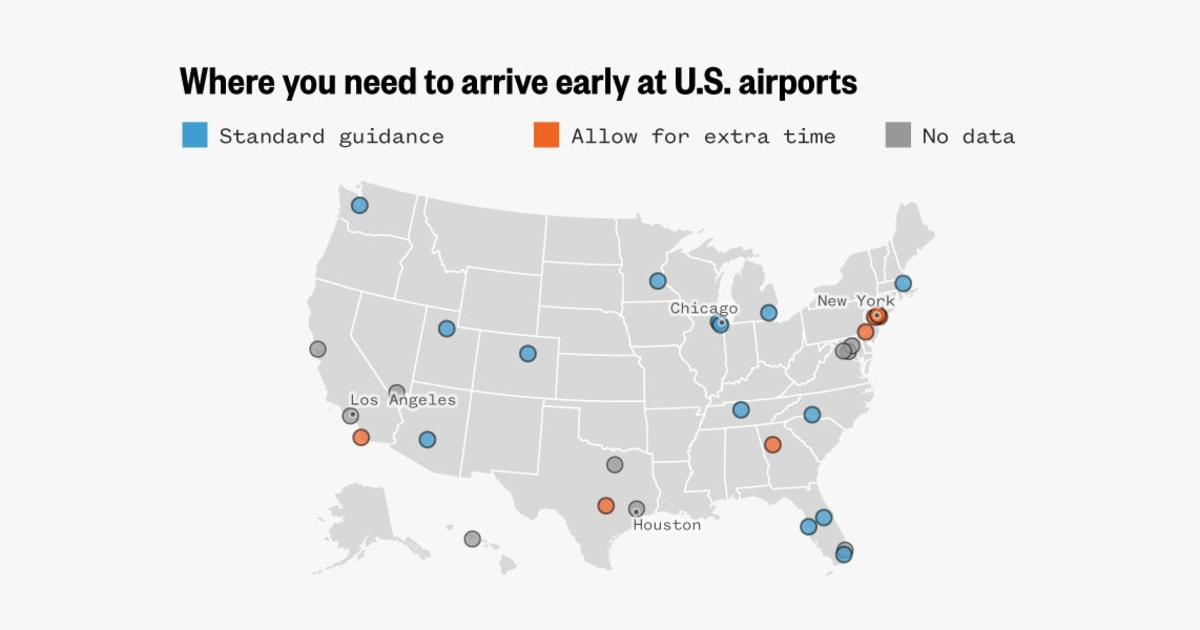
In response to these disruptions, many airports have adjusted their arrival time guidance, with seven major airports serving an average of 450,000 departing travelers daily now recommending arrival times ranging from 2.5 to 4 hours early, effectively doubling the standard recommendations.
Traveler Distress
The human impact of the TSA staffing crisis is evident in airports across the country, with travelers experiencing extreme frustration and emotional distress.
“Larissa Malkaysan waited in the security line at New York City’s John F”
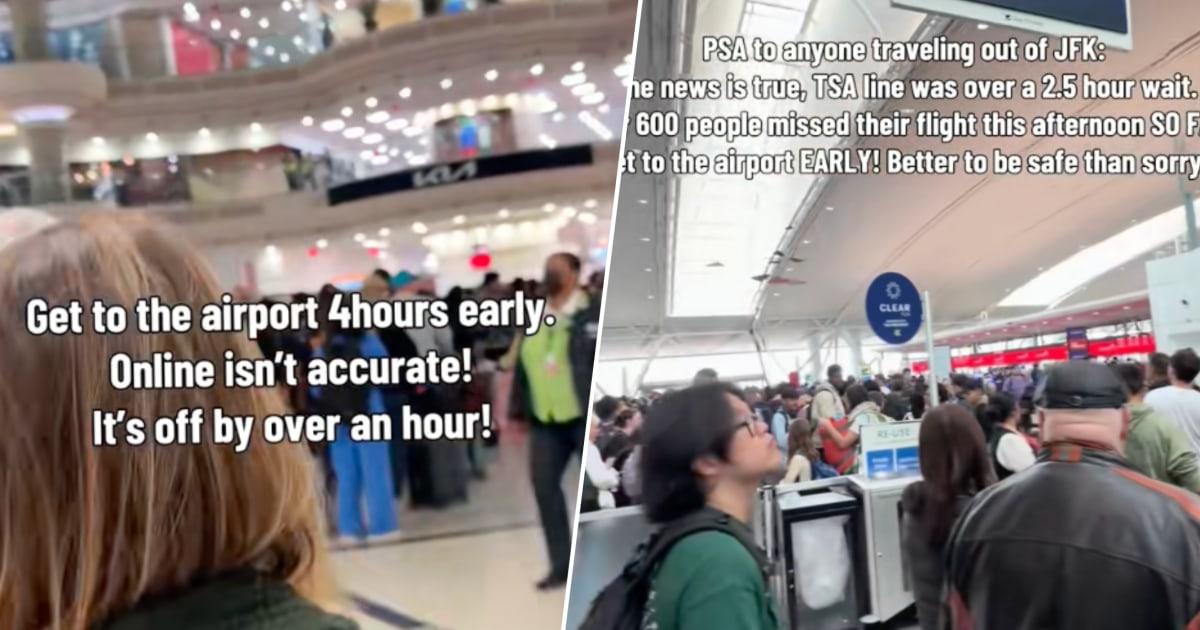
At John F. Kennedy International Airport in New York, passenger Larissa Malkaysan documented a chaotic scene where she waited in a security line for 90 minutes before even reaching the 'start' of the line area.
She witnessed multiple passengers reduced to tears as they actively missed their flights due to the lengthy delays.
'Everyone was frustrated and there were multiple people crying in line as they actively missing their boarding and plane departures,' Malkaysan reported to TODAY.
The situation was so dire that TSA agents told her over 600 people had already missed their flights that afternoon and evening, leading desperate passengers to try to 'remove ropes and bleed into lines to get ahead of it.'
Even the premium Clear access lane became overwhelmed as travelers sought any advantage to avoid missing their flights.
ICE Deployment Response
In response to the escalating crisis, President Donald Trump announced on March 21 that Immigration and Customs Enforcement (ICE) agents would be deployed to airports nationwide to assist TSA officers beginning March 23.
'ICE will do the job far better than ever done before!' Trump wrote on Truth Social.
White House border czar Tom Homan explained that ICE agents would initially be sent to large airports experiencing the longest wait times, covering security points and conducting line control duties.
However, senior ICE officials clarified that these agents are not trained to operate the X-ray machines screening bags, which will continue to be handled by TSA officers.
By March 25, ICE had been deployed to 14 airports across the country.
This federal intervention represents an unusual expansion of ICE's traditional role, as the agency typically focuses on immigration enforcement rather than airport security operations.
Travel Recommendations
As travelers navigate the current chaos, airports and travel experts are providing updated guidance on arrival times to help passengers avoid missing their flights.
“Opens in a new window Opens an external website Opens an external website in a new window <”
Most major airports continue to recommend the standard two hours in advance for domestic flights and three hours in advance for international travel, though several severely affected locations have increased their recommendations to 2.5-4 hours early.
Katy Nastro from the travel app Going advises travelers to give themselves 2.5 to 3.5 hours before boarding time, with additional buffer time for international flights and peak travel periods like Friday afternoons and Sunday mornings.
Dr. John Rose, chief risk advisor at corporate travel management company Altour, recommends three hours before domestic flights as a good rule of thumb.
He also suggests checking airport wait times two days prior to flights, one day ahead, and then again on the day of travel, noting that 'almost all airports have the real-time TSA waits on their websites.'
Looking ahead, Rose warns that even when funding is restored to DHS, the situation may not immediately improve due to the TSA officers who have permanently quit during the shutdown.
Regional Impact Differences
The impact of the TSA staffing crisis varies significantly by region and airport size, with some facilities experiencing minimal disruption while others face severe operational challenges.
Seattle-Tacoma International Airport (Sea-Tac) has reported relatively manageable conditions with TSA wait times of only 10-15 minutes, and the airport has maintained its standard recommendations of two hours for domestic flights and three hours for international travel.
Perry Cooper, Sea-Tac's media relations manager, attributed this relative stability to the airport having fewer TSA agent call-outs, having worked on checkpoint efficiency improvements over the years due to its smaller footprint, and not yet entering its busy season when spring break travelers typically arrive.
In contrast, smaller airports like Bellingham International have experienced 'only minimal' shutdown-related disruptions, with no ICE assistance deployed there.
The regional disparities highlight how different airports are uniquely positioned to handle the crisis based on their size, operational efficiency, and current travel patterns.
More on USA

U.S. Prepares to Deploy 1,000 82nd Airborne to West Asia to Seize Airfields
17 sources compared

Democrat Emily Gregory flips Trump-carried Palm Beach House seat, defeating Trump-backed Jon Maples
12 sources compared

President Donald Trump Threatens National Guard Deployment to U.S. Airports
14 sources compared
GOP excludes ICE enforcement in DHS funding plan, leaving TSA workers unpaid and airports strained
17 sources compared