Britain22 March, 20264 min read
Britain's Nuclear Powered HMS Anson Arrives in Arabian Sea, Ready to Strike Iran
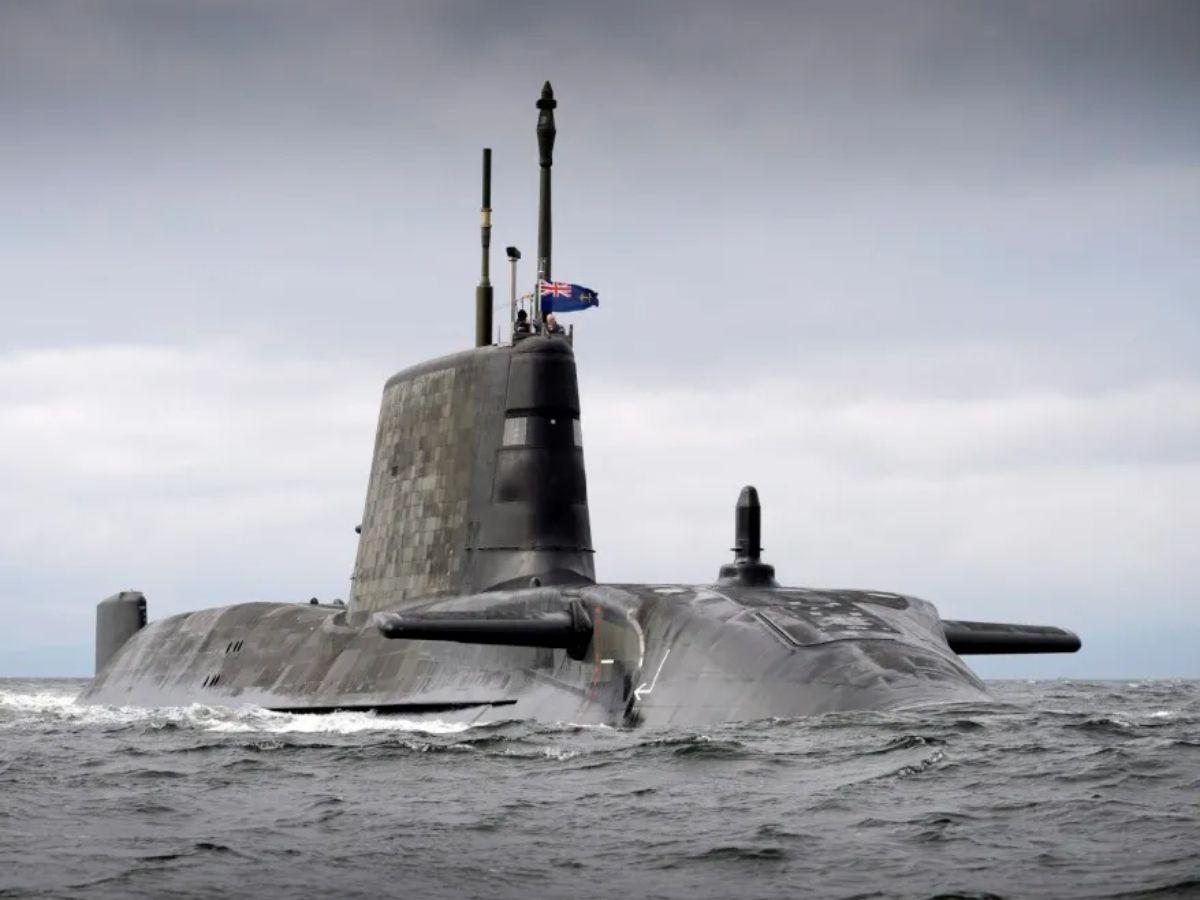
HMS Anson, an Astute-class nuclear submarine, has arrived in the Arabian Sea. Equipped with Tomahawk Block IV missiles, it can strike targets in Iran.
Submarine Deployment
Britain has deployed the nuclear-powered submarine HMS Anson to the Arabian Sea, positioning it within striking distance of Iran amid escalating Middle East tensions. The Astute-class submarine, described as the largest, most advanced and most powerful attack submarine ever operated by the UK Navy, departed from Perth, Australia earlier this month and traveled approximately 5,500 miles to reach the region. HMS Anson is equipped with Tomahawk Block IV land-attack missiles with a range of up to 1,000 miles (1,600 km) and Spearfish heavyweight torpedoes, giving British forces the capability to launch long-range strikes on Iranian targets if the conflict escalates further.
“HMS Anson, nuclear-powered submarine, left Perth earlier this month and travelled roughly 5,500 miles to the region, the Daily Mail reported. A British Navy submarine, armed with Tomahawk cruise missiles, has reportedly been deployed in the Arabian Sea amid the ongoing conflict in the Middle East, now in its third week.”
Strategic Positioning
The HMS Anson's deployment represents a significant strategic positioning by Western military forces in response to heightened tensions between the United States and Iran. According to military sources, the submarine is believed to be positioned in the deep waters north of the Arabian Sea, where it can operate undetected while maintaining the capability to strike Iranian targets.
The vessel's stealth capabilities and endurance allow it to remain submerged for extended periods, making it a formidable asset in the region's escalating conflict dynamics. This move comes amid ongoing hostilities in West Asia and signals an expansion of Western naval presence in strategically important waters.

Command Procedures
The operational procedures surrounding HMS Anson involve strict command and control mechanisms, with any potential missile launch requiring authorization from the highest levels of the UK government.
“A source told the newspaper, 'The Anson submarine will lie quietly hidden. The Prime Minister and the Chief of Naval Operations will be informed of its location, and of course the Submarine Service, but its location will not be widely known.' Defence sources said that Lieutenant General Nick Perry, Britain's Chief of Joint Operations, would order the firing if he receives authorization from the Prime Minister, at which point the HMS Anson would rise to the surface and launch a volley of four missiles.”
According to reports, the submarine surfaces periodically to communicate with the UK's Permanent Joint Headquarters in Northwood, where launch orders would be authorized by the Prime Minister and conveyed by the Chief of Joint Operations.
A military source told the Daily Mail that 'The Anson submarine will lie quietly hidden. The Prime Minister and the Chief of Naval Operations will be informed of its location, and of course the Submarine Service, but its location will not be widely known.'
This secretive approach underscores the sensitive nature of the deployment and the potential gravity of any military action involving the vessel.
Policy Context
The HMS Anson deployment is directly connected to recent policy changes by the UK government regarding support for US military operations against Iran. Downing Street announced on Friday that Prime Minister Keir Starmer agreed to allow the United States to use British bases to strike Iranian sites targeting the Strait of Hormuz, expanding previous permissions that had been limited to defensive operations. This development follows Iran's March 2 firing of two intermediate-range ballistic missiles at Diego Garcia, a joint US-UK military base in the Indian Ocean.
While one missile failed and the other was intercepted, this marked Iran's first operational use of IRBMs and a significant escalation in the conflict. The UK's decision to broaden the scope of US operations to include 'defensive operations to degrade the missile sites and capabilities being used to attack ships in the Strait of Hormuz' provides the strategic context for positioning HMS Anson in the region.

International Response
The deployment of HMS Anson is part of a broader international response to escalating tensions in the Middle East, with multiple countries coordinating efforts to protect strategic maritime routes. A joint statement last Thursday expressed readiness by six countries—including Britain, France, Germany, Italy, the Netherlands, and Japan—to join 'appropriate efforts' to ensure safe passage through the Strait of Hormuz.
“In a joint statement last Thursday, six countries expressed readiness to join the 'appropriate efforts' to ensure safe passage through the Strait of Hormuz, including Britain, France, Germany, Italy, the Netherlands, and Japan.”
These nations condemned Iranian attacks on commercial shipping and called for an immediate halt to strikes on oil and gas infrastructure, while pledging support for affected states through the United Nations. The international response comes amid ongoing military escalation between Iran and Israel, alongside U.S. involvement, creating a complex geopolitical landscape that Britain's nuclear submarine deployment aims to address through both deterrence and potential strike capabilities.

AUKUS Alliance
The HMS Anson's journey from Australia to the Arabian Sea highlights the strategic importance of the AUKUS security alliance in global military positioning. The submarine had arrived in Australia in recent weeks as part of joint defense cooperation under AUKUS, a trilateral pact aimed at strengthening security ties and military capabilities among Australia, the UK, and the United States. This alliance appears to be providing operational flexibility for Western powers to rapidly deploy military assets to different regions of strategic importance.
The movement of HMS Anson from its Australian deployment to the Middle East demonstrates the alliance's ability to coordinate forces across vast distances, though it also raises questions about the limits of Britain's naval capacity amid multiple global crises. Military analysts suggest that even close allies may face capacity constraints when responding to simultaneous conflicts in different regions.