Asia25 March, 20263 min read
Cambodian and Thai forces damage Preah Vihear Temple in border clashes.
This article is an automated aggregation of coverage from news outlets. Our editorials offer in-depth analysis curated by the NewsCord team.
Preah Vihear, a UNESCO World Heritage temple, sustained major damage during the border clashes. Three months after a ceasefire, site remains at risk with unexploded ordnance hindering restoration.

Temple Damage Overview
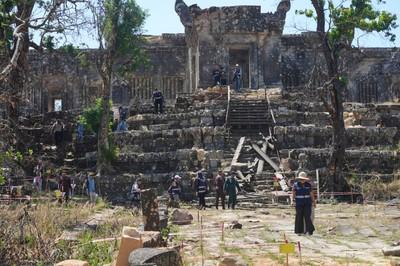
The Preah Vihear Temple, once a revered UNESCO World Heritage Site, now stands as a scarred testament to the devastating impact of border clashes between Cambodia and Thailand. Tourists who once admired the weather-beaten structure's elaborate carvings and magnificent views over Cambodian plains now encounter stone debris, artillery craters, and the ashes of burnt vegetation. The temple's five notable gateway pavilions have suffered extensive damage, with three almost beyond recognition according to Cambodia's Culture Ministry.
“Where tourists once admired the weather-beaten structure's elaborate carvings and a magnificent view over the Cambodian plains, there is now stone debris, artillery craters, and the ashes of burnt vegetation.”
A comprehensive damage assessment reveals the temple was hit at 142 locations during July fighting and sustained damage at 420 more points during heavier combat in December. The sacred structure now faces the risk of collapse during the upcoming monsoon season as weakened sections continue to deteriorate.
Historical Dispute Context
The conflict surrounding Preah Vihear Temple represents a decades-long territorial dispute dating back to the 1950s between Cambodia and Thailand. In 1962, the International Court of Justice ruled definitively that the temple and its surrounding area belong to Cambodia, a decision the Court reaffirmed in 2013. Despite these legal rulings, tensions have periodically escalated into armed clashes, often fueled by heightened nationalism and domestic political pressures.
The temple's designation as a Cambodian UNESCO World Heritage site in 2008 intensified Thai nationalist sentiment. This contributed to sporadic armed conflicts in 2008 and 2011 that set the stage for the more recent devastating clashes.

Mutual Accusations
Both Cambodia and Thailand have engaged in a bitter blame game over responsibility for the temple's destruction, with each side accusing the other of violating international norms. Cambodian authorities vehemently deny that their military ever used the temple, insisting it remains under civilian control with security forces present solely to protect the cultural heritage site. In contrast, Thai forces maintain they directed their fire strictly at military targets, claiming the temple premises had been used for military purposes.
“Cambodia denies that its military ever used the temple, with its Ministry of Culture writing in a statement that the temple is under civilian control and that any security forces present were there only to protect the cultural heritage site.”
Cambodia's Information Minister Neth Pheaktra has gone further, accusing the Thai military of relying on false information to justify incursions. He described the temple as a heritage site that 'belongs to all humankind' and accused Thai forces of deliberately damaging it.
Human Impact
The human cost of the border conflict extends far beyond the temple's physical destruction, with hundreds of thousands of civilians displaced and the once-vibrant tourism industry completely halted. Cambodia has reported that more than 640,000 people were displaced from border regions during the fighting, with almost 37,000 still unable to return to their homes. The temple closure has created a stark contrast between past and present - where tourists once gathered to admire ancient architecture, warning signs and barricades now dominate the landscape.
The site remains closed due to unstable structures and the persistent danger of unexploded ordnance and landmines. These hazards are particularly familiar to Cambodians from decades of civil conflict that ended in the late 1990s.

Restoration Challenges
Restoring the centuries-old temple presents an urgent yet daunting challenge, complicated by security concerns and the approaching rainy season. Hem Sinath, an archaeologist and deputy director-general of the National Authority for Preah Vihear, warns that weakened structures could collapse during the upcoming monsoon season, which typically begins in late May or early June. Previous renovation efforts involving India, China, and the United States have been on hold since fighting broke out, leaving critical preservation projects suspended.
“Restoring the temple will be a major challenge. Hem Sinath fears that weakened structures could collapse during the rainy season, which normally begins in late May or early June and continues through October.”
Sinath expressed both urgency and frustration, stating that new and urgent projects needed to prevent further deterioration are being hindered by safety and security concerns while the ceasefire remains fragile. He emphasized the complex relationship between cultural preservation and geopolitical stability, saying 'We have a plan; we want to do a repair - the sooner the better, but as you see, it depends on the situation along the border.'