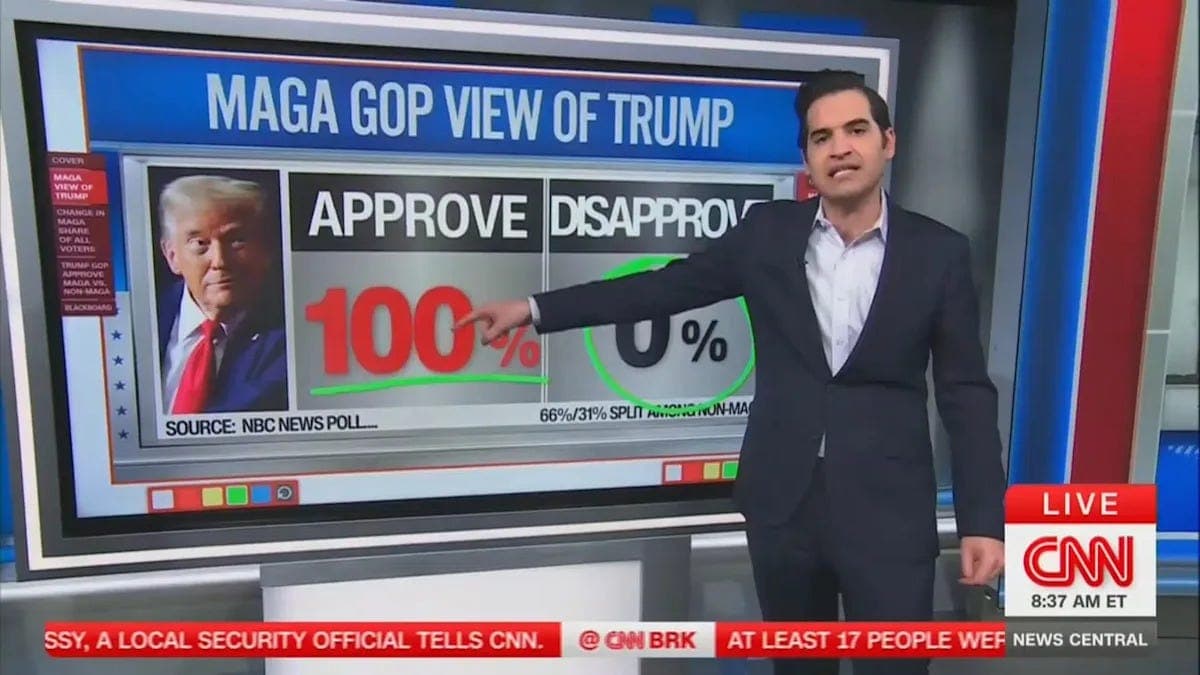
CNN's "100% MAGA Trump approval" segment omits key nuance for virality
Key Takeaways
- CNN aired a viral segment claiming unanimous Trump approval, omitting nuance.
- Voters overwhelmingly oppose boots on the ground in Iran.
- Harry Enten led the segment.
Viral claim and flaw
Strength In Numbers argues that CNN’s viral segment featuring Harry Enten claiming '100% of self-identified MAGA Republicans approve of Trump' is a misleading tautology that hides the real erosion in Trump’s coalition.
“CNN's "100% MAGA Trump approval" segment omits key nuance for virality Plus, voters overwhelmingly oppose putting boots on the ground in Iran”
The White House celebrated the number, with Trump repeating it to reporters on Friday, illustrating how a clip can boost a narrative while ignoring dissent among non-MAGA Republicans and the Tucker Carlson–Steve Bannon–Megyn Kelly wing of the party.
Self-identification vs erosion in base
Crucially, the piece explains that 'MAGA' is a self-identification that clusters the most loyal supporters, so the 100% figure omits disaffection from the Tucker Carlson–Steve Bannon–Megyn Kelly wing and other Republicans who have drifted away.
According to Economist/YouGov polling data, 59% of Republicans identify as MAGA supporters, but the other 40% of the party is where the slippage is: YouGov reported last May that net approval of Trump among non-MAGA Republicans was down 40 points since inauguration day, and that figure is probably even larger now.
About 27% of non-MAGA Republicans now hold a somewhat or very unfavorable view of Trump.
YouGov has consistently found MAGA approval of Trump around 97%, not 100%, so the 100% figure is an outlier.
With roughly 200 MAGA Republicans in the NBC poll, even a few dissenters can disappear in the weighting, but the result is viral nonetheless.
Iran numbers contradict 100% claim
On the Iran war, the article argues that the 100% figure is an outlier and hides meaningful nuance.
“CNN's "100% MAGA Trump approval" segment omits key nuance for virality Plus, voters overwhelmingly oppose putting boots on the ground in Iran”
For example, in the Economist/YouGov poll (March 13-16), 87% of MAGA supporters approved of Trump’s handling of Iran and 78% supported the war; only 35% favored sending ground troops, 30% said the U.S. should try to end the war quickly, while 58% said to keep fighting until all objectives are achieved.
Navigator Research finds that while 84% of MAGA Republicans support the operation, non-MAGA Republicans are split: 48% support, 40% oppose.
On the question of $50 billion in additional war funding, 43-42.
A March 18 Quincy Institute/American Conservative poll found that 79% of Trump voters would support him declaring victory and ending the war quickly.
Among Trump voters ages 18 to 29, support for the war was just +8 points, compared with +53 overall.
Strength In Numbers/Verasight found that 68% of Republicans called the Iran war a good use of taxpayer dollars, but only 35% said “very good.”
Media framing vs real story
Conclusion: The piece argues CNN asked the right question on whether the Iran war fractures MAGA, but delivered the most clip-friendly data rather than the most informative.
A responsible segment would have led with 52% of registered voters who oppose the war, or with the MAGA/non-MAGA gap on Iran, or the fact that MAGA identification has dropped six points in a year.
The article contends the real story is independents and soft partisans turning against the war, and that framing this as a MAGA split misleads voters and fuels a White House public-relations narrative.
It warns that the cycle of attention-based, monetized polling distorts coverage and emphasizes focusing on the broader public mood rather than a single viral number.
More on USA

Trump Delays Strikes on Iranian Energy Infrastructure Amid Talks With Iran.
43 sources compared

Senate confirms Markwayne Mullin as Homeland Security secretary
13 sources compared

Supreme Court appears poised to limit late-arriving mail-in ballots.
23 sources compared
US Senate confirms Mullin as Secretary of the Department of Homeland Security
24 sources compared