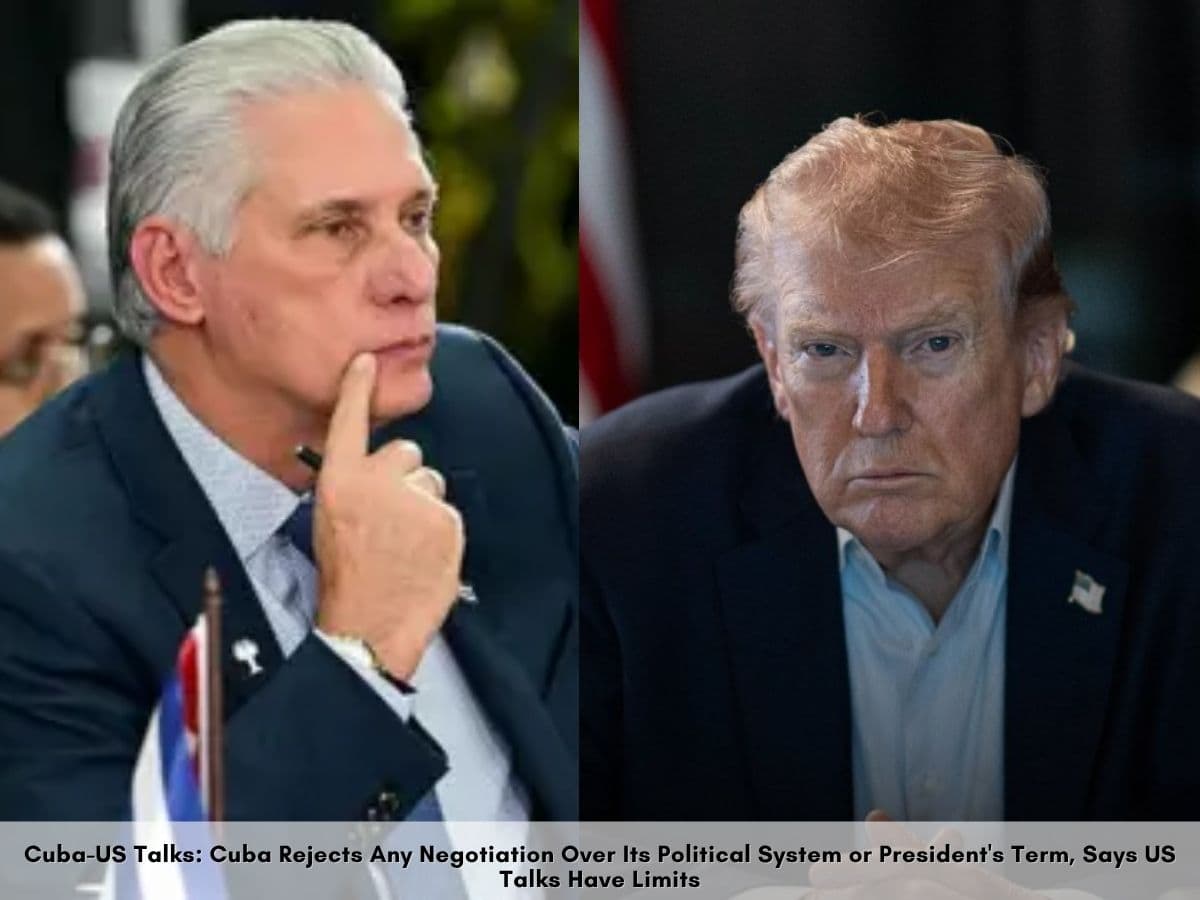
Cuba refuses to discuss political system or presidency with the United States
Key Takeaways
- Cuba rejects negotiating its political system with the United States.
- Cuba rejects negotiating the term of its president with the United States.
- The stance comes amid ongoing Cuba–U.S. talks.
Cuba's Sovereignty Stance
Cuba has firmly rejected any negotiations regarding its political system or presidency with the United States.
“Trending: West Asia war Energy sites Trump-Netanyahu ties Fifa World Cup 2026 Dhurandhar box office advertisement ‘Not up for negotiation’: Cuba refuses to discuss political system or presidency with US FP News Desk _•_ March 21, 2026, 00:55:49 IST advertisement Cuba on Friday firmly rejected suggestions that its political system or the term of its president could be subject to negotiation in talks with the US, after reports that Washington had sought to remove Cuban president from power Advertisement”
This rejection followed reports that Washington sought to remove Cuban President Miguel Díaz-Canel from power.
Vice Foreign Minister Carlos Fernandez de Cossio declared that 'the political system of Cuba is not up for negotiation.'
He also stated that 'neither the president nor the position of any official in Cuba is subject to negotiation with the United States.'
This categorical rejection reflects Cuba's determination to maintain its sovereignty in the face of US pressure.
Economic Crisis Context
The diplomatic tensions emerged amid a deepening economic crisis in Cuba.
This crisis is caused by a US oil blockade imposed by President Donald Trump.
Cuba acknowledged entering talks with the US government last week.
The Communist-run nation faces mounting economic challenges from the blockade.
Trump has stated he can do 'anything I want' with Cuba, calling it a 'sovereign neighbor.'
Despite mutual interests in trade and compensation claims, Cuba maintains non-negotiable internal affairs.
US Removal Strategy
US media reports revealed the Trump administration planned economic deals with Cuba.
“Trending: West Asia war Energy sites Trump-Netanyahu ties Fifa World Cup 2026 Dhurandhar box office advertisement ‘Not up for negotiation’: Cuba refuses to discuss political system or presidency with US FP News Desk _•_ March 21, 2026, 00:55:49 IST advertisement Cuba on Friday firmly rejected suggestions that its political system or the term of its president could be subject to negotiation in talks with the US, after reports that Washington had sought to remove Cuban president from power Advertisement”
These deals would include an explicit 'off-ramp' for Díaz-Canel.
The administration sought to remove him from power despite years remaining in his term.
The New York Times reported they wanted to push Díaz-Canel out with two years left as president.
He also has five years remaining as Communist Party leader.
The US proposal would leave the family of Fidel and Raúl Castro untouched.
This mirrors previous US interventions in Venezuela, where Maduro was deposed on January 3.
Diplomatic Significance
Analysts see the talks as a significant shift in US-Cuba relations.
This represents one of the most significant shifts in years during regional tensions.
De Cossio provided no details on the bilateral discussions' location or timing.
Cuba rejected interference in internal political affairs.
The government acknowledged potential dialogue areas including the US economic embargo.
Longstanding compensation claims between the nations could also be discussed.
The situation shows Cuba's balancing act for economic relief while maintaining independence.
Sovereignty Defense
Cuba's firm rejection shows its commitment to maintaining its political system.
“Trending: West Asia war Energy sites Trump-Netanyahu ties Fifa World Cup 2026 Dhurandhar box office advertisement ‘Not up for negotiation’: Cuba refuses to discuss political system or presidency with US FP News Desk _•_ March 21, 2026, 00:55:49 IST advertisement Cuba on Friday firmly rejected suggestions that its political system or the term of its president could be subject to negotiation in talks with the US, after reports that Washington had sought to remove Cuban president from power Advertisement”
This occurs amidst mounting economic pressure from the US oil blockade.
By refusing to negotiate sovereignty issues, Cuba draws a clear distinction.
Economic discussions are separate from political interference.
Complex bilateral issues require dialogue but only on terms respecting Cuban independence.
The situation tests diplomatic relations as Cuba seeks economic relief.
Cuba resists what it views as unwarranted external interference in domestic affairs.
More on USA

Trump threatens to deploy ICE agents to US airports amid DHS funding standoff
46 sources compared

ICE Detainee Royer Perez-Jimenez Dies in Florida Detention Center; Officials Suspect Suicide
10 sources compared
Elon Musk Offers to Pay TSA Salaries During Partial Government Shutdown
50 sources compared

California lawmakers rename Cesar Chavez Day to Farmworkers Day amid sexual abuse allegations.
17 sources compared