Technology and Science20 April, 20266 min read
Deezer Says 44% of Daily Song Uploads Are AI-Generated, Nearly 75,000 Tracks Per Day
AI-generated tracks constitute 44% of Deezer's daily uploads, about 75,000 per day. AI uploads account for 1-3% of total streams on Deezer.

Deezer’s 44% AI Upload Claim
Deezer says AI-generated tracks now represent 44% of all new music uploaded to its platform each day, a figure the company links to nearly 75,000 AI-generated tracks per day and more than two million per month. TechCrunch reports that Deezer’s announcement comes after the platform said it was receiving around 60,000 AI tracks per day in January, up from 50,000 in November, 30,000 in September, and just 10,000 in January 2025 when it first launched its AI-music detection tool. The Verge similarly frames the change as Deezer receiving nearly 75,000 AI-generated song submissions each day, accounting for about 44% of all daily uploads, while also stressing that Deezer removes AI-generated music from its recommendation algorithm.
In parallel, Billboard describes the same core disclosure as roughly 44% of daily uploads being fully AI-generated—equivalent to 75,000 every day, or over 2 million per month—while noting that consumption remains low at 1-3% of total streams. Decrypt adds that Deezer’s proprietary detection technology has identified 85% of streams from AI-generated tracks as artificial plays, which Deezer demonetizes. Across the coverage, Deezer’s CEO Alexis Lanternier is quoted emphasizing the scale and the company’s intent to protect rights, saying, “AI-generated music is now far from a marginal phenomenon and as daily deliveries keep increasing, we hope the whole music ecosystem will join us in taking action to help safeguard artists’ rights and promote transparency for fans,” and also arguing, “Thanks to our technology and the proactive measures we put in place more than a year ago, we have shown that it’s possible to reduce AI-related fraud and payment dilution in streaming to a minimum.”

Fraud, Streams, and Demonetization
Deezer’s disclosure repeatedly ties the AI-upload surge to fraud and royalty manipulation, while also insisting that listening behavior for AI tracks is limited. TechCrunch says consumption of AI-generated music on the platform is still very low, at 1-3% of total streams, and that 85% of these streams are detected as fraudulent and demonetized by the company. Digital Trends similarly reports that AI-generated tracks account for only about 1% to 3% of total streams, while describing Deezer’s concerns about fraud through bots to manipulate royalties.
PCMag adds that Deezer says many of the streams themselves, up to 85% in 2025, are fraudulent, meaning they’re demonetized due to manipulation, and it describes Deezer’s approach as labeling AI-generated tracks and excluding them from its recommendation algorithms. Decrypt states that Deezer’s proprietary detection technology has identified 85% of streams from AI-generated tracks as artificial plays, which the company has subsequently demonetized, and it also claims the platform deployed its patent-pending AI music detection tool in January 2025 with “99.8% accuracy.” The Verge describes Deezer as demonetizing AI-generated songs and stopping storage of high-resolution versions of them, while also saying the platform continues to remove AI-generated music from its recommendation algorithm.

Tagging, Recommendations, and Hi-Res Storage
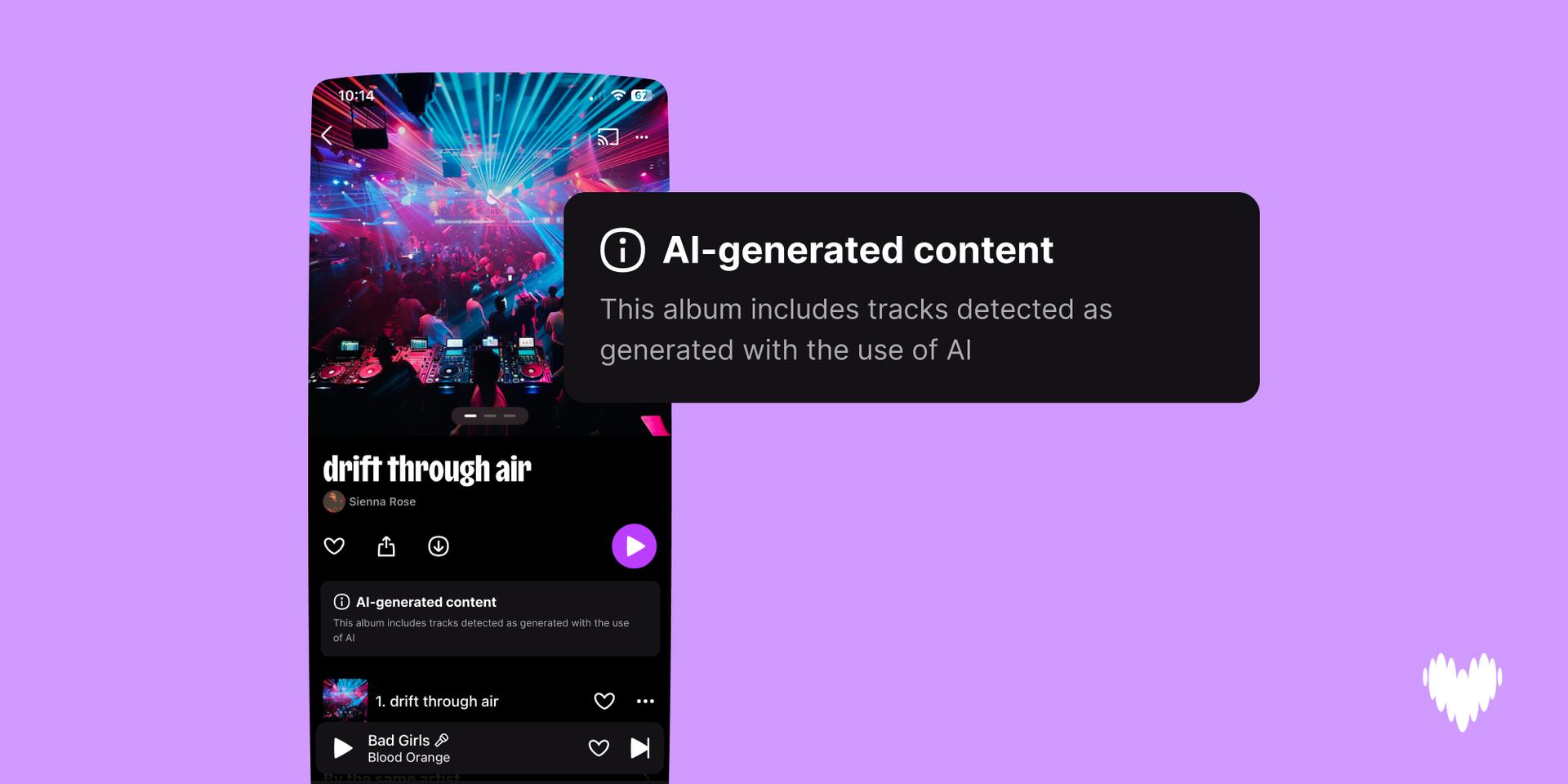
Beyond fraud detection, Deezer says it is changing how AI tracks appear—or do not appear—across the platform. TechCrunch reports that songs tagged as AI-generated on Deezer are automatically removed from algorithmic recommendations and not included in editorial playlists, and it adds that Deezer announced it will no longer store hi-res versions of AI tracks. Digital Trends describes Deezer’s response as introducing tools to detect and label AI-generated tracks, remove them from recommendation algorithms, and, in some cases, demonetize them.
“Songs tagged as AI-generated on Deezer are automatically removed from algorithmic recommendations and not included in editorial playlists.”
The Verge similarly notes that Deezer positions its tool as setting an “industry standard,” and it says the service is the “only” music streaming service tagging AI-generated tracks while demonetizing AI-generated songs and stopping storage of high-resolution versions. Ars Technica adds that Deezer has developed technology to detect AI uploads and that it is one of the few streamers to explicitly label such content, while describing a Deezer survey where listeners taking a Deezer survey listened to three songs, two of which were AI. Decrypt provides additional detail on Deezer’s survey, stating that a blind study commissioned by Deezer surveyed 9,000 participants across eight countries and found 97% could not distinguish between AI-generated and human-created tracks, while also reporting that 80% agreed fully AI-generated music should carry clear labels.
Survey Results and Listener Transparency
Deezer’s update also leans on survey findings to argue that listeners struggle to distinguish AI-generated music and that labeling matters. TechCrunch says Deezer conducted a survey last November that found that 97% of participants couldn’t tell the difference between fully AI-generated music and human-made music, and it adds that 52% of respondents said 100% AI-generated songs shouldn’t be included in charts alongside human-made songs in the main charts. TechCrunch further reports that 80% said 100% AI-generated music should be clearly labeled for listeners, and it describes Deezer as starting tagging AI tracks at the platform level in June 2025, becoming the first streaming platform to do so.
Decrypt similarly describes a blind study commissioned by Deezer, saying 97% could not distinguish between AI-generated and human-created tracks, and it reports that 80% of respondents agreed that fully AI-generated music should carry clear labels for transparency. Ars Technica provides a different framing of the same survey result, stating that listeners taking a Deezer survey listened to three songs, two of which were AI, and that “A whopping 97 percent were unable to tell the difference between the AI songs and the one made by a human.” The TechCrunch report ties the survey to policy choices, stating that songs tagged as AI-generated are removed from algorithmic recommendations and not included in editorial playlists, and it also says Deezer will no longer store hi-res versions of AI tracks.
Industry Reactions and Divergent Framing
While Deezer’s numbers are consistent across multiple outlets, the surrounding narrative differs in emphasis—especially around what Deezer is doing and what it means for the broader industry. TechCrunch highlights that Deezer is “receiving almost 75,000 AI-generated tracks per day” and that it “will no longer store hi-res versions of AI tracks,” while also stating that songs tagged as AI-generated are “automatically removed from algorithmic recommendations and not included in editorial playlists.” Decrypt frames the disclosure as the “first comprehensive data disclosure from a major streaming platform about artificial content proliferation,” and it adds that Deezer’s detection tool is “patent-pending” and that it achieved what the company reports as “99.8% accuracy.”
In contrast, Digital Trends emphasizes the mismatch between supply and listening, saying AI-generated tracks currently account for only about 1% to 3% of total streams, and it connects the issue to fraud, originality, and copyright debates. The Verge adds a competitive landscape description, saying Spotify announced new policies to clamp down on AI-generated music, Apple Music is asking artists and record labels to label songs made with AI, Bandcamp has banned AI music altogether, and Qobuz has started automatically detecting and labeling AI music as well. Meanwhile, TechCrunch also reports that in February French streaming service Qobuz announced plans to tag AI-generated content on its platform, and it notes that other major streaming services such as Spotify and Apple Music take different approaches, often combining filters with transparency efforts left up to the distributors.