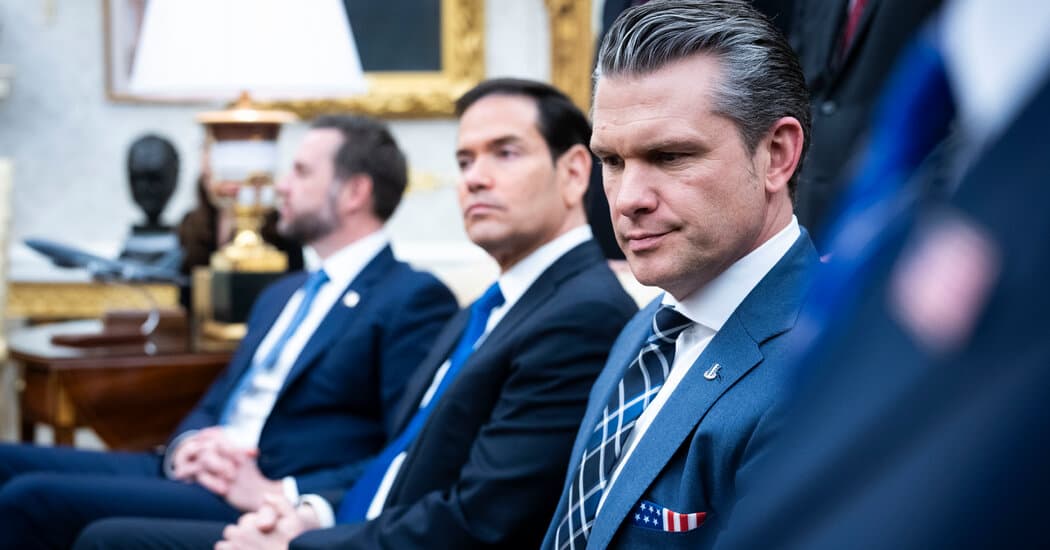
Defense Secretary Pete Hegseth Frames U.S. Military Actions as Divinely Sanctioned
Key Takeaways
- Hegseth frames U.S. military actions as divinely sanctioned.
- Military actions are described with a Christian moral underpinning.
- Hegseth is the central figure advancing this narrative.
Hegseth's Religious Rhetoric
Defense Secretary Pete Hegseth has sparked significant controversy by explicitly framing U.S. military actions in religious terms.
“March 20, 2026 at 2:49 pm EDTByTaegan GoddardLeave a Comment New York Times: “More than any top American military leader in recent history, Mr”
He called for Americans to pray 'in the name of Jesus Christ' for victory in battle and troop safety during a period of U.S. and Israeli military operations against Iran.
Hegseth's remarks made at the Pentagon represented a stark departure from traditional secular military rhetoric.
He imbued U.S. military actions with a Christian moral underpinning that suggests they are divinely sanctioned.
The timing drew particular attention as U.S. and Israeli militaries were dropping thousands of bombs on Iran, a majority-Shiite Muslim nation.
This religious framing of warfare has raised concerns about separation of church and state and the perception of U.S. military actions as religiously motivated.
Divine Sanction Framework
Hegseth's explicit invocation of Christian religious language represents a significant departure from traditional American military rhetoric.
His remarks draw criticism for potentially blurring the lines between religious conviction and state power.
He spoke of 'overwhelming force' and the U.S. military's ability to rain 'death and destruction from above' on 'apocalyptic' Iranian foes.
This combined with his call for Christian prayer creates a framework framing military violence as divinely sanctioned.
This approach mirrors the broader Christian nationalist influence within the Trump administration.
The explicitly Christian nature of his wartime call stood out sharply given U.S. operations against a Muslim-majority nation.
Political Contradictions
The political context reveals congressional Republicans have abdicated constitutional war-making powers to President Trump.
“March 20, 2026 at 2:49 pm EDTByTaegan GoddardLeave a Comment New York Times: “More than any top American military leader in recent history, Mr”
They've granted him 'wide latitude to wage war on Iran with no congressional approval or limits.'
This deference has created an environment where religious rhetoric can more easily find its way into military pronouncements.
The Trump administration has pursued contradictory policies toward Iran.
They're conducting military operations while also easing sanctions to stabilize global oil markets.
This inconsistency has left observers confused about the administration's true intentions toward Iran.
Some suggest Trump may be 'completely freaked out by the possibility of more attacks from either side on the region's' escalating tensions.
International Implications
Hegseth's religious framing carries implications for how America's wars are perceived domestically and internationally.
It potentially reinforces narratives of Western religious crusades against Muslim-majority nations.
His call for prayer 'in the name of Jesus Christ' during operations against Iran comes amid Trump's assertions about regime change.
Trump said it would take Iran '10 years to rebuild' and that 'toppling the hardline theocratic regime should be the ultimate goal.'
This combination of religious rhetoric and regime change objectives raises concerns about conflicts being perceived as religiously motivated.
The contradiction between military action and economic engagement further complicates U.S. messaging.
This may contribute to regional instability as adversaries and allies struggle to understand U.S. intentions.
More on USA

Trump threatens to deploy ICE agents to US airports amid DHS funding standoff
46 sources compared

ICE Detainee Royer Perez-Jimenez Dies in Florida Detention Center; Officials Suspect Suicide
10 sources compared
Elon Musk Offers to Pay TSA Salaries During Partial Government Shutdown
50 sources compared

California lawmakers rename Cesar Chavez Day to Farmworkers Day amid sexual abuse allegations.
17 sources compared