
Donald Trump Announces New U.S. Sanctions Targeting Cuba’s Security Apparatus And Foreign Banks
Key Takeaways
- Trump signed executive order expanding sanctions to target entities and individuals supporting Cuba’s security apparatus.
- New measures also target foreign banks and third-country actors doing business with the regime.
- The actions aim to increase economic and security pressure amid Cuba's ongoing crisis.
New Cuba sanctions announced
President Donald Trump announced on Friday new U.S. sanctions against Cuba, saying the island “continue de mener des politiques et pratiques visant à nuire aux Etats-Unis” and targeting entities and people who “soutiennent l'appareil sécuritaire du régime cubain, se rendent complices de la corruption gouvernementale ou de violations graves des droits de l'homme”.
“Buenos Aires, May 1 (NA) — The president of the United States, Donald Trump, signed this Friday an executive order that 'imposes sanctions on those responsible for repression in Cuba and for threats to the national security and the foreign policy of the United States”
The measures were laid out in a presidential decree published on the White House website, and the decree said Trump’s “mesures décisives” are meant to “s'attaque aux menaces pour la sécurité nationale que représente le régime communiste cubain pour tenir ce régime, ainsi que ceux qui le soutiennent pour responsables de leur appui à des acteurs hostiles, au terrorisme et à l'instabilité régionale”.
Reuters reported that Trump expanded sanctions on the Cuban government and affiliates, while the Miami Herald said Trump signed an executive order that “significantly hardens sanctions on the Cuban government” and authorizes sanctions on foreign companies and banks that do business with Cuba.
The Hill described the executive order as expanding the scope to target “agents, officials, or material supporters of the Cuban government,” including those who support Cuba’s security apparatus and those “are complicit in government corruption or serious human rights violations.”
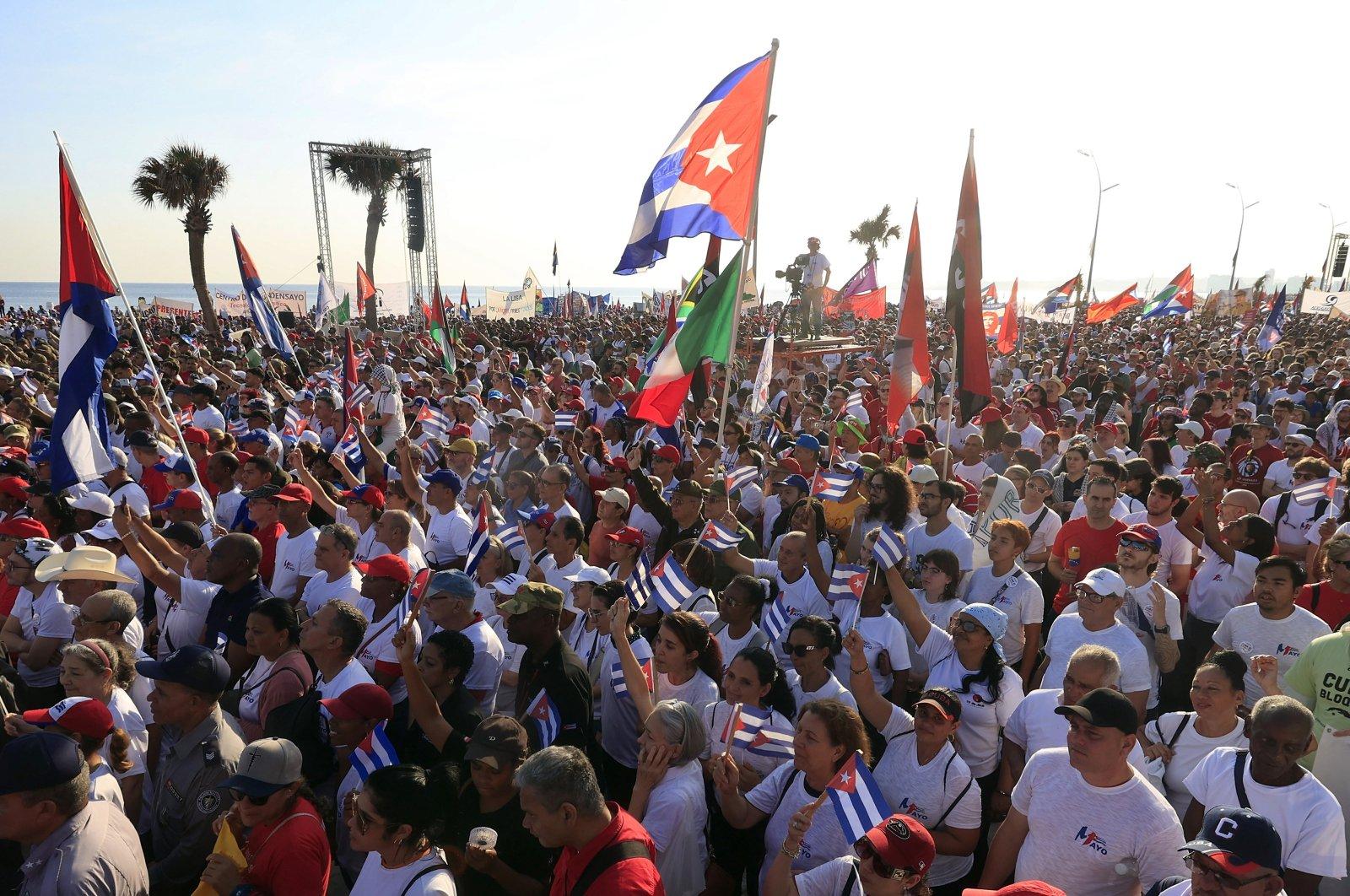
Multiple outlets tied the timing to Cuba’s May 1 Workers Day events, with La Prensa noting the sanctions were ordered on Friday as Cuba held a May 1 demonstration “para «defender la patria» y denunciar las amenazas de agresión militar estadounidense” in Havana.
In Washington, EL PAÍS characterized the U.S. action as “asfixia petrolera a Cuba” through an executive order that threatens tariffs on countries that supply crude to Havana, framing it as an effort to force the “caídadel régimen castrista” after the end of oil supplies from Venezuela.
Secondary sanctions and banking
A central feature of the new U.S. approach is the expansion of “secondary” sanctions aimed at foreign banks and companies, a shift the Miami Herald said marks the first time the prohibitions would reach beyond U.S. persons and entities.
The Miami Herald wrote that “for the first time, the new executive order threatens sanctions on foreign companies and banks from other countries found to be helping the Cuban government,” and it described the order as using a new legal authority under the International Emergency Economic Powers Act.
The order, the Miami Herald said, authorizes blocking the U.S. assets of “any foreign person” operating in key Cuban economic sectors such as energy, defense, mining and financial services, and it gives the secretaries of the Treasury and the State Department authority to add other sectors.
It also warned that “for the first time, foreign banks worldwide that conduct or facilitate transactions for the Cuban government” risk losing access to U.S. dollars, with the Secretary of the Treasury able to restrict or block bank accounts in the United States.
The Hill similarly said the order seeks to “curtail Cuba’s access to the global banking system,” imposing secondary sanctions on people, entities and financial institutions that conduct transactions with those already sanctioned.
Daily Sabah echoed the banking threat by saying the U.S. warned foreign banks against conducting business with targeted individuals, while Reuters reported the expansion of sanctions to Cuban government affiliates.
In the Miami Herald’s account, the new restrictions also include broad authority for Treasury to block property in the United States belonging to foreign entities or persons found to “have materially assisted, sponsored, or provided financial, material, or technological support for, or goods or services to or in support of, the Government of Cuba.”
The Miami Herald added that the order freezes U.S. properties of “entities or persons who have acted or purported to act for or on behalf, directly or indirectly, the Government of Cuba,” while also stating that the restrictions do not affect transactions authorized by licenses and government authorizations.
Oil tariffs and emergency framing
Beyond banking, EL PAÍS described a separate U.S. move that it called “asfixia petrolera a Cuba,” saying Trump published an executive order in Washington that threatens aranceles to countries that supply crude to La Habana.
“CiberCuba Editorial Team explains it here”
The article said Trump’s strategy is meant to provoke “la caídadel régimen castrista” after the end of oil supplies Cuba received from Venezuela, and it quoted the executive order’s national-security framing: “Considero que la situación con respecto a Cuba constituye una amenaza inusual y extraordinaria para la seguridad nacional y la política exterior de Estados Unidos, y declaro una emergencia nacional con respecto a esa amenaza”.
EL PAÍS also reported that the executive order “no especifica a cuánto se elevarán los aranceles,” adding that Trump would decide “caso por caso” after receiving reports from the Departments of the Treasury and Commerce about countries responsible for the crude.
It said the measure would hit Mexico’s ability to resume supplies, noting that Mexico was described as the “principal suministrador de Cuba” after Venezuela’s conversion into a U.S.-aligned country.
The article quoted Trump telling the press, “Parece que no podrá sobrevivir. Cuba no podrá sobrevivir”, and it said he called the word “asfixiar” “muy dura” while also describing the island as “una nación fallida”.
In Havana, EL PAÍS reported that Jorge Legañoa, president of the state agency Prensa Latina, accused Washington of seeking “un ‘genocidio’” and argued that aranceles would “paralizar la generación eléctrica, el transporte, la producción industrial, la producción agrícola, la disponibilidad de los servicios de salud, el abasto de agua… en resumen, todas las esferas de la vida”.
The same EL PAÍS account said Mexico’s president Claudia Sheinbaum argued that oil shipments are of two types—“ayuda humanitaria” and contracts by Pemex—and that Sheinbaum denied the issue was part of a call with Trump.
It further reported that Pemex suspended shipments from mid-January and that Cuba’s other crude suppliers included Russia and Argelia, with Russia’s last ship in October and Argelia not sending a cargo since February.
EL PAÍS also stated that Financial Times calculated Cuba has enough petroleum for “los próximos 15 a 20 días,” and it said Venezuela had provided an average of “46.500 barriles diarios” before the U.S. intervention in Caracas.
Cuban response and May 1
Cuban officials and supporters framed the sanctions as coercive and illegal, and they tied the response to May 1 events in Havana.
La Prensa reported that the Cuban foreign minister Bruno Rodríguez denounced the new sanctions, writing on X that “El gobierno de Estados Unidos se alarma y responde con nuevas medidas coercitivas unilaterales ilegales y abusivas contra Cuba”.
It also said Díaz-Canel had called on Cubans the day before to mobilize “contra el bloqueo genocida y las flagrantes amenazas imperialistas” of the United States.
During the May 1 demonstration, La Prensa said the parade was held in front of the U.S. embassy in Havana and that Raúl Castro, described as “de 94 años,” and President Miguel Díaz-Canel attended, while the government organized a “«plataforma antiimperialista»” at dawn on the Malecón.
The article said Cuban authorities asserted that “participaron varios cientos de miles de personas,” and it quoted Osnay Miguel Colina, a leader of Cuba’s central union, saying “Frente a tantísimas limitaciones que buscan ahogar y rendirnos ante amenazas irracionales de guerra y muerte, este primero de mayo confirma que (…) resistimos” and “vencemos”.
La Prensa also quoted Lídice Guridis, an employee of 42 years, saying “La respuesta del pueblo fue contundente, justo frente a la embajada de Estados Unidos”.
Reuters’ reporting on the sanctions’ expansion was echoed by other outlets that described the U.S. pressure campaign as intensifying, while the Hill said the executive order is “countering Cuba’s malign influence” in a White House statement.
The Hill also said the sanctions come as the Trump administration ramps up pressure on Havana to address a humanitarian crisis that worsened after the U.S. cut off oil shipments from Venezuela and Mexico to Cuba in January.
In the same broader context, Medi1 News said the announcement came “en plein 1er-Mai à Cuba,” where a parade was organized “face à l'ambassade des Etats-Unis à La Havane” to denounce the sanctions.
Stakes, diplomacy, and reactions
U.S. officials and outside analysts described the sanctions as part of a broader campaign that includes diplomacy and heightened risk for foreign actors.
The Miami Herald reported that the executive order came after “a recent round of negotiations in Havana” in which senior State Department officials told Cuban counterparts that the island had “a small window of time to act on key U.S. demands,” including “the release of political prisoners and implementing significant economic and political reforms.”
It quoted Brian Fonseca, Vice Provost for Defense and National Security Research and Director of the Jack D. Gordon Institute for Public Policy at Florida International University, saying “This is a clear escalation,” and adding that “Washington is doubling down on economic pressure by raising legal and financial risk for anyone helping sustain the Cuban regime’s economy.”
The Miami Herald also said “Secondary sanctions are the centerpiece here,” and it described them as designed “to reach beyond Cuba and force global banks and companies to stop enabling the regime’s economic survival.”
The Hill similarly said the sanctions come amid a renewed diplomatic effort, with the State Department reportedly sending a delegation to Cuba in April to discuss a deal to address the humanitarian crisis.
The Hill also included a quote from Cuban President Miguel Díaz-Canel, who told NBC’s Kristen Welker on “Meet The Press” that “dialogue and deals with the U.S. government are possible, but they’re difficult,” while also saying it would be “difficult” to rule out a deal.
Reuters’ reporting on the sanctions expansion was framed by other outlets as building on earlier U.S. steps, including a January executive order threatening tariffs on countries providing oil to Cuba and calling the island’s government “an unusual and extraordinary threat.”
WION and Daily Sabah both described the new sanctions as targeting people operating in sectors of Cuba’s state-controlled economy and warning foreign banks, while WION said those listed will be barred from entering the United States.
The Hill also quoted the White House press release that the executive order is “countering Cuba’s malign influence,” and it said the president is “addressing the national security threats posed by the communist Cuban regime” by taking decisive action to hold the regime and those that perpetuate it accountable.
In parallel, La Prensa said Cuba’s authorities claimed “varios cientos de miles de personas” participated in the May 1 demonstration, and it described the government’s message as “defendemos la patria,” while Medi1 News said the sanctions announcement was made during the May 1 parade in Havana.
More on USA

Trump Signs Permit For Bridger Pipeline Expansion LLC Cross-Border Oil Pipeline In Phillips County, Montana
14 sources compared
Brian Harpole Sues Candace Owens Over Charlie Kirk Assassination Conspiracy Claims
10 sources compared
Trump Tells Congress Iran Hostilities Have Terminated Ahead of May 1 War Powers Deadline
20 sources compared

Trump Tells Congress Iran War Has Terminated, Skirting War Powers Deadline
14 sources compared