
Donald Trump Says U.S. Is Studying Troop Reduction in Germany After Spat With Friedrich Merz
Key Takeaways
- The United States is studying and reviewing a possible reduction of troops in Germany.
- The consideration follows a spat with Chancellor Friedrich Merz over the Iran war.
- A final decision is expected in the near term.
Troop cuts floated
President Donald Trump said the United States is “studying and reviewing” whether to reduce the number of troops it has stationed in Germany, with a decision expected “over the next short period of time.”
Trump made the announcement via social media, writing on Truth Social that “The United States is studying and reviewing the possible reduction of Troops in Germany, with a determination to be made over the next short period of time,” according to CBS News and echoed by BBC and DW.
The BBC reported that Trump’s remarks came days after German Chancellor Friedrich Merz criticised his approach to the war in Iran, and that Trump then “rounded on Merz” on Thursday, telling him he should spend “more time on ending the war with Russia/Ukraine (Where he has been totally ineffective!).”
Multiple outlets tied the troop review to the wider dispute between Washington, Berlin, and NATO over Iran, with CNBC describing it as a growing dispute with Berlin over the Iran war.
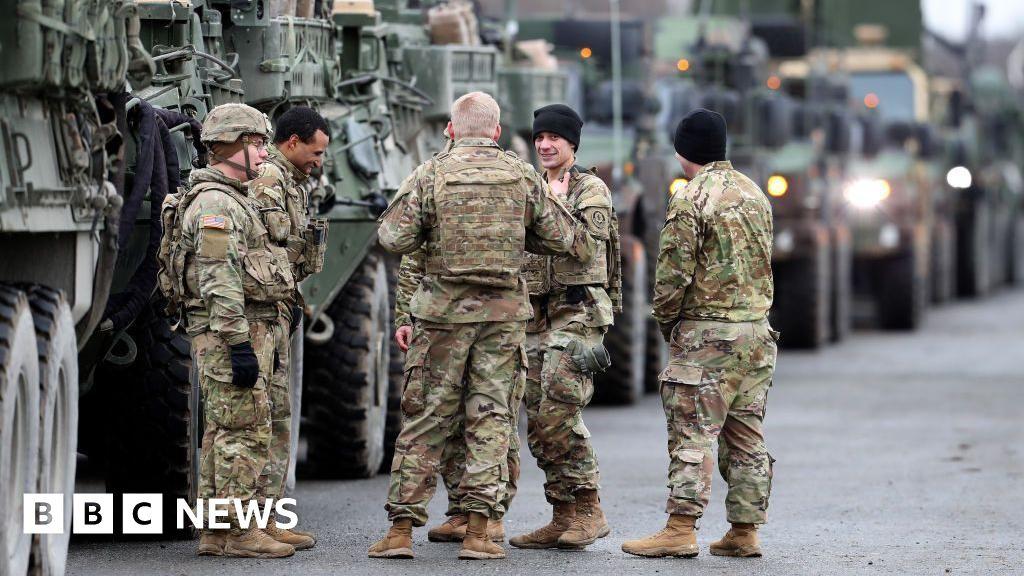
CBS News said the U.S. has a “massive presence in Germany” dating back to the aftermath of World War II and the Cold War, and it cited Defense Department figures that “More than 36,000 active duty troops were assigned to bases throughout Germany as of last December.”
The BBC added that the U.S. military deployment in Germany is “by far its biggest in Europe,” and noted that many troops are stationed at Ramstein air base outside Kaiserslautern.
Numbers and bases
The troop review is anchored in the scale and geography of U.S. forces in Germany, which CBS News described as the largest U.S. contingent in Europe and the home of major command structures.
CBS News said “More than 36,000 active duty troops were assigned to bases throughout Germany as of last December,” and it added that the Defense Department figures also included “nearly 1,500 reservists and 11,500 civilians.”

CNBC similarly said the U.S. had “just over 36,000 active-duty military personnel across a number of significant bases in Germany as of December 2025,” citing data from the U.S. Defense Manpower Data Center.
DW reported that “As of December 2025, more than 36,000 active service members were stationed in Germany,” and it specified that the deployment includes personnel at Ramstein in southwestern Germany.
The BBC said many are stationed at “the big Ramstein air base outside the southwestern German city of Kaiserslautern,” and it also noted that the U.S. has “about 12,000 troops in Italy and a further 10,000 in the UK.”
Stars and Stripes described the decision as being made soon and said the U.S. has “roughly 34,000 troops spread out at various bases and installations across the country,” while also stating that the U.S. European Command is located in Germany.
Merz-Iran dispute
The troop review is tied in the reporting to a specific exchange between Trump and Merz over the war in Iran and the negotiating posture of the United States.
BBC said Merz criticised Trump’s approach to the war in Iran and suggested that the U.S. had been “humiliated” by Iranian negotiators, and it quoted Merz telling university students that “the Americans clearly have no strategy” and that he could not see “what strategic exit” they were going to choose.
BBC also quoted Merz saying, “The Iranians are obviously very skilled at negotiating, or rather, very skilful at not negotiating, letting the Americans travel to Islamabad and then leave again without any result,” and it added that Merz said the “entire nation” was being “humiliated” by the Iranian leadership.
Trump responded the following day with a post to Truth Social, where BBC reported he said Merz thought it was “OK for Iran to have a Nuclear Weapon” and “doesn't know what he's talking about.”
CNBC described the same sequence, saying Merz drew Trump’s ire after he said “the Americans clearly have no strategy” and that the U.S. was being “humiliated” by Iranian negotiators.
The Media Line similarly quoted Merz’s remarks about negotiations in Islamabad and said Trump replied that “The Chancellor of Germany, Friedrich Merz, thinks it’s OK for Iran to have a Nuclear Weapon.”
German response and NATO
While Trump floated troop reductions, Merz sought to emphasize continuity in Germany’s security relationship with Washington and NATO.
BBC reported that Merz made no mention of Trump’s comments during a visit to German soldiers in northern Germany on Thursday, and it said he went out of his way to stress the importance of the Nato defensive alliance and “transatlantic solidarity.”
POLITICO.eu described Merz speaking at the German army’s armored training school in the northern town of Munster, where he said, “We are working here, and at other key locations in Germany, side-by-side with the United States and our NATO allies,” and added that the work is “carried out shoulder-to-shoulder, for our mutual benefit and in deep transatlantic partnership.”
POLITICO.eu also quoted Merz saying, “Our compass remains clearly set on a strong NATO and a reliable transatlantic partnership,” and it called the relationship “particularly important to me personally.”
DW reported that German Foreign Minister Johann Wadephul later clarified Merz’s comments in an interview with DW’s Berlin bureau chief Max Hoffmann in New York City, saying, “It was addressing the behavior of Iran.”
In the BBC account, a Nato official told the BBC that the alliance’s founding treaty “does not foresee any provision for suspension of Nato membership, or expulsion,” even as Trump threatened to withdraw from the 32-member NATO alliance.
Consequences and next steps
The reporting frames Trump’s troop review as having potential consequences for NATO deterrence, U.S. operational planning, and European energy and economic pressures tied to the Iran conflict.
CNBC said analysts expect withdrawal to be “a logistical headache” and “ultimately damage U.S. interests,” and it described the move as a “blow to NATO allies in Europe who value the U.S. presence as a major deterrent against threats like Russia.”
Stars and Stripes said Trump’s insistence that European allies haven’t been supportive enough of the Iran war could have “longer-term implications” for how the United States deals with NATO members, and it quoted Defense Secretary Pete Hegseth telling Congress that “When allies “do not step up, there will be consequences.”
It added that Hegseth said, “In recent weeks, for instance, far too many of our NATO allies showed that they could not be relied upon to support our nation’s operations against Iran. … This is unconscionable, and we will remember,” linking the troop issue to Iran operations.
AP News described the stakes in terms of facilities and command roles, saying the U.S. has “headquarters for U.S. European Command and U.S. Africa Command, Ramstein Air Base and Landstuhl Regional Medical Center,” and it noted that Merz said Germany and Europe are suffering from “the closure of the Strait of Hormuz.”
AP News also said the Strait of Hormuz has been “effectively closed since the conflict began on Feb. 28,” and it reported that Merz urged that “this conflict be resolved.”
More on USA

King Charles and Queen Camilla Lay Flowers at New York’s 9/11 Memorial
10 sources compared

RSF Warns Press Freedom Hits Lowest Level in 25 Years, Trump’s US Drops to 64th
10 sources compared

King Charles III Delivers Joint Address to Congress in Washington, Cites Bonds With United States
11 sources compared

U.S. Supreme Court Voids Louisiana’s Majority-Black District, Weakening Voting Rights Act
15 sources compared