Egypt Condemns Israeli Settlers' Attacks in West Bank
Key Takeaways
- Egypt strongly condemned Israeli settler attacks in the northern West Bank.
- Assaults targeted Silat al-Dhahr, Fanduqoumiya (south of Jenin), and Qaryut (south of Nablus).
- Attacks were carried out under the protection of Israeli forces.
Egypt's Condemnation
Egypt strongly condemned recent Israeli settler attacks in the northern West Bank.
“Editor-in-Chief Board Chairman The Egyptian Ministry of Foreign Affairs has strongly condemned recent attacks by Israeli settlers in several villages and towns in the northern West Bank”
The Egyptian Ministry of Foreign Affairs issued a formal statement highlighting assaults in multiple locations.

These locations include Silat al-Dhahr and Fanduqoumiya south of Jenin, and Qaryut south of Nablus.
Egypt characterized these actions as blatant violations of international humanitarian law.
The ministry stressed the need to hold perpetrators accountable for these attacks.
The ministry expressed deep concern over the escalating violence carried out by colonists.
They noted this reflects a systematic plan to alter the existing situation and impose a policy of fait accompli.
Attack Details
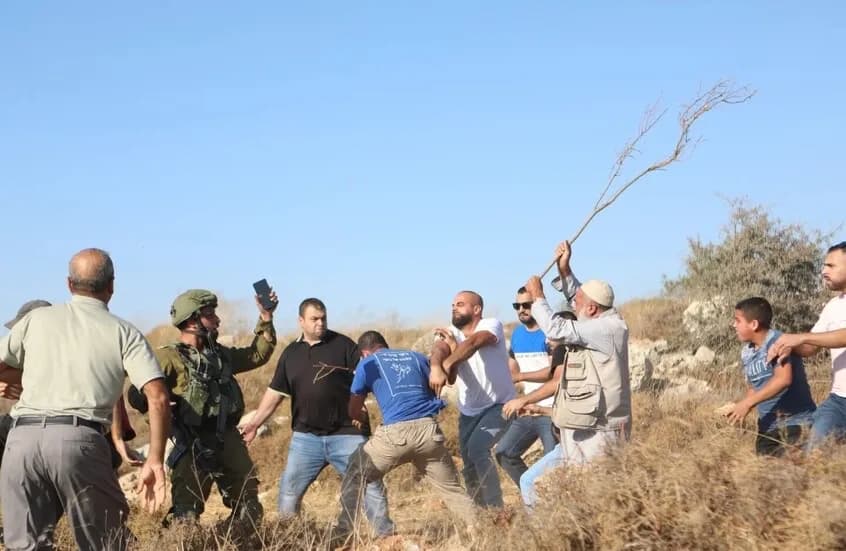
The specific attacks condemned by Egypt involved violent settler actions protected by Israeli occupation forces.
In Silat al-Dhahr and Fanduqoumiya south of Jenin, settlers carried out assaults under explicit Israeli protection.
Similarly, in Qaryut south of Nablus, settler attacks were facilitated by Israeli military presence.
These incidents represent part of a broader pattern of intensified settler violence.
The attacks have resulted in burned homes, vehicles, and injuries to Palestinian civilians.
The coordinated nature across multiple locations indicates a systematic campaign.
This suggests these are not isolated incidents but organized violence.
Legal Violations
The ministry specifically highlighted breaches of UN Security Council Resolution 2334.
This resolution affirms that Israeli settlements have no legal validity.
The actions also contradict the International Court of Justice advisory opinion.
The ICJ ruling addressed the illegality of occupation and colonization.
Egypt stressed these violations represent a systematic pattern of illegal Israeli practices.
These practices undermine international law and the rules-based order.
International Calls
Egypt called on the international community to assume its responsibilities.
Cairo urged concrete action to address the escalating situation.
The ministry emphasized protecting Palestinian civilians and ensuring accountability.
They stressed the urgent need to end the current escalation and return to calm.
Egypt argued de-escalation is necessary for a just Palestinian settlement.
The condemnation comes amid broader regional tensions.
Egypt noted attacks occur amid attempts to divert attention from ongoing violations.
Regional Response
The Egyptian condemnation reflects growing regional concern over intensifying settler violence.
“CAIRO, March 22, 2026 (WAFA) - The Egyptian Ministry of Foreign Affairs has strongly condemned recent attacks by Israeli colonists in several villages and towns in the northern West Bank”
These attacks are part of broader systematic Israeli occupation policies.
The Arab Parliament Speaker also condemned settler terrorism in the West Bank.
They warned of a plot to escalate the situation further.
This coordinated regional response highlights the seriousness of the violence.
Egypt's strong stance comes amid warnings about potential destabilization.
Other regional actors emphasize the international community's failure to address root causes.
More on Gaza Genocide

Israeli settlers attack West Bank villages, wounding several Palestinians and torching homes and vehicles.
10 sources compared

Trump Administration Sues Harvard University Over Civil Rights Violations Against Jewish and Israeli Students
50 sources compared

Protesters heckle Australian PM Albanese at Sydney mosque over Israel stance
18 sources compared

Iran Fires Missiles at Israel, Killing Three Palestinian Women and a Foreign Worker
23 sources compared