USA06 March, 20262 min read
Former Presidents Biden and Obama Slam President Donald Trump at Jesse Jackson Funeral
Obama criticized the Trump administration during his tribute to Jesse Jackson. Biden attacked the Trump administration, saying it 'doesn't share our values'.

Jesse Jackson memorial
A high-profile public memorial for civil-rights leader Rev. Jesse Jackson was held on March 6, 2026, in Chicago’s South Side at the 10,000-seat House of Hope and drew thousands of mourners, clergy, civic leaders and performers.
“Rev. Jesse Jackson will be honored Friday morning, March 6, 2026, at Chicago’s House of Hope with a public ‘Celebration of Hope’ homegoing service.”
The event was organized by Jackson’s Rainbow PUSH Coalition and followed earlier services and a lying-in-state in South Carolina as officials and communities marked Jackson’s death at 84.

Scheduled speakers and attendees included former President Barack Obama, President Joe Biden, former President Bill Clinton and Vice President Kamala Harris, along with numerous local and national figures.
Organizers expected large crowds, video tributes and musical performances.
Former President Obama's remarks
Former President Barack Obama used his remarks at the service to praise Jackson’s lifetime of activism and to deliver a sharp critique of President Donald Trump and threats to democratic norms, a line of argument echoed across international and national coverage. Multiple outlets reported that Obama invoked Jackson’s role in expanding Black political power and warned that democratic institutions need defending—remarks that drew the loudest reception of the day. Reporters described Obama’s speech as both a tribute and an explicit political rebuke delivered from the funeral stage.
Biden speech coverage
President Joe Biden used his remarks to criticize the current White House’s direction, often without naming President Trump directly. His off‑the‑cuff anecdote about a childhood stutter attracted intense attention and social‑media reaction. Coverage noted Biden’s attempt to humanize speech impediments and to connect Jackson’s example to the need for unity, even as some outlets and commentators highlighted awkward lines and viral moments from his delivery.
“At the March 6 funeral for Rev. Jesse Jackson in Chicago, former President Joe Biden used his remarks to criticize the current White House without naming President Donald Trump.”
Jackson's activism and diplomacy
Speakers and tributes repeatedly emphasized Jackson's decades-long work on voting rights, economic justice, anti-apartheid activism and diplomacy, portraying him as a relentless advocate for the poor whose campaigns in the 1980s broadened political participation.
Coverage recalled his Rainbow/PUSH leadership, his role as a diplomatic emissary who negotiated for U.S. prisoners overseas, and his long dedication to civil-rights organizing despite health challenges in later years.

Memorial political symbolism and logistics
The memorial underscored broader political symbolism, with a roster of prominent Democrats filling the program and the crowd while former President Donald Trump did not attend.
“Attendees included Barack Obama (who drew the loudest applause), former President Bill Clinton and President Joe Biden; Kamala Harris was listed as a speaker, and former President Donald Trump did not attend. ... plans for a Washington, D.C. memorial remained uncertain after House Speaker Mike Johnson declined a request to have Jackson lie in honor in the U.S. Capitol Rotunda.”
Plans for a Washington, D.C. tribute remained uncertain after House Speaker Mike Johnson declined a request to have Jackson lie in honor in the U.S. Capitol.
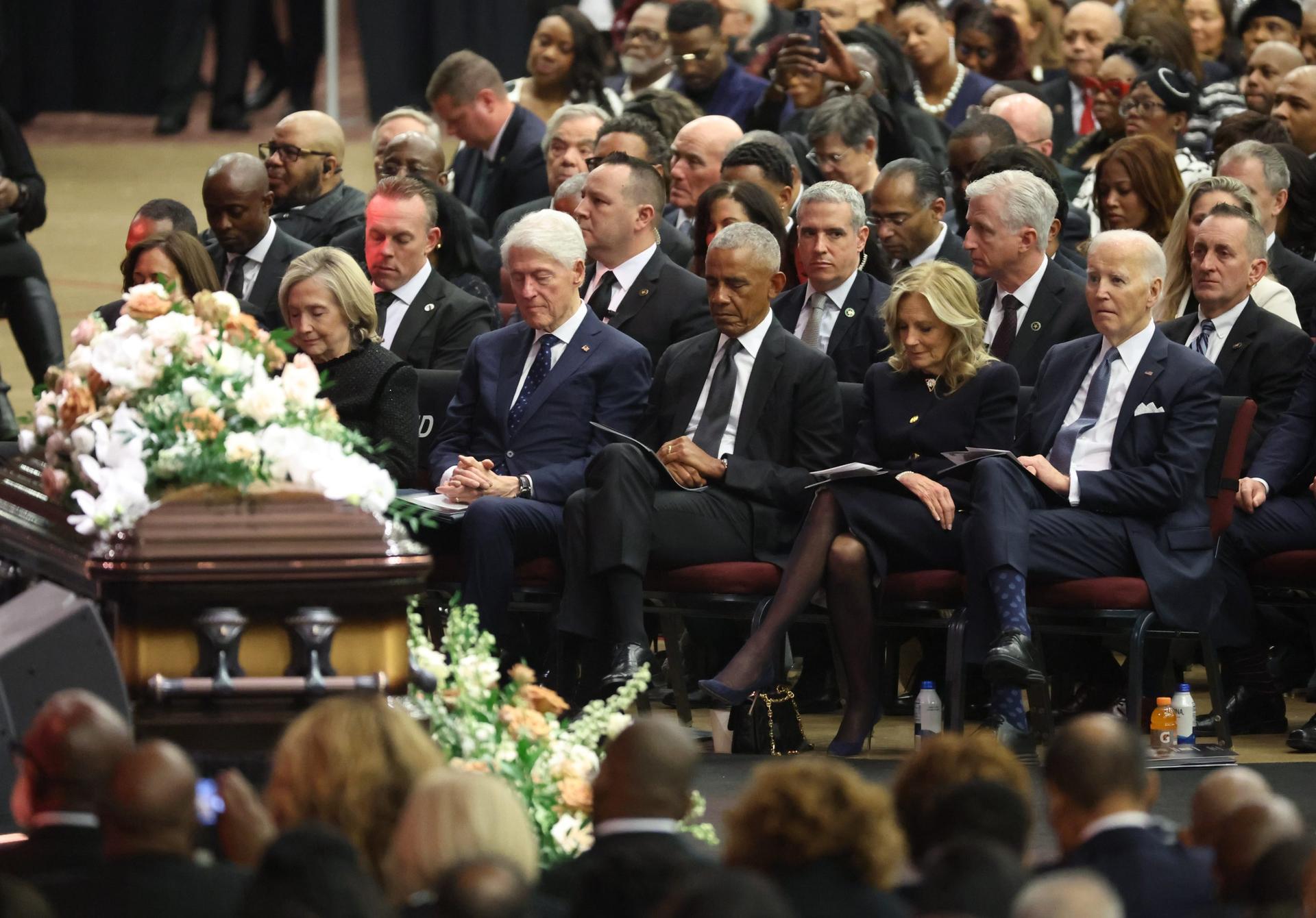
Reporters highlighted logistical details such as long lines, vendors selling memorabilia, video tributes, a heavy police presence and streaming coverage.
They also noted contrasting reactions on social media and among political leaders to both the tributes and the speeches.