
German President Steinmeier Condemns US-Iran War as Violation of International Law
Key Takeaways
- Steinmeier called the Iran war a violation of international law.
- He described the conflict as a disastrous mistake breaching international law.
- Spoke at a ceremony in Berlin at Germany's Foreign Ministry.
Direct Condemnation
German President Frank-Walter Steinmeier delivered a forceful condemnation of the U.S.-Israel war against Iran.
“The German president, Frank-Walter Steinmeier, has described the war against Iran as contrary to international law, in an unusually forceful formulation in Berlin, given that the United States and Israel are involved and that it breaks the caution that had been maintained by the Government”
He explicitly labeled it as a violation of international law and a politically disastrous mistake.
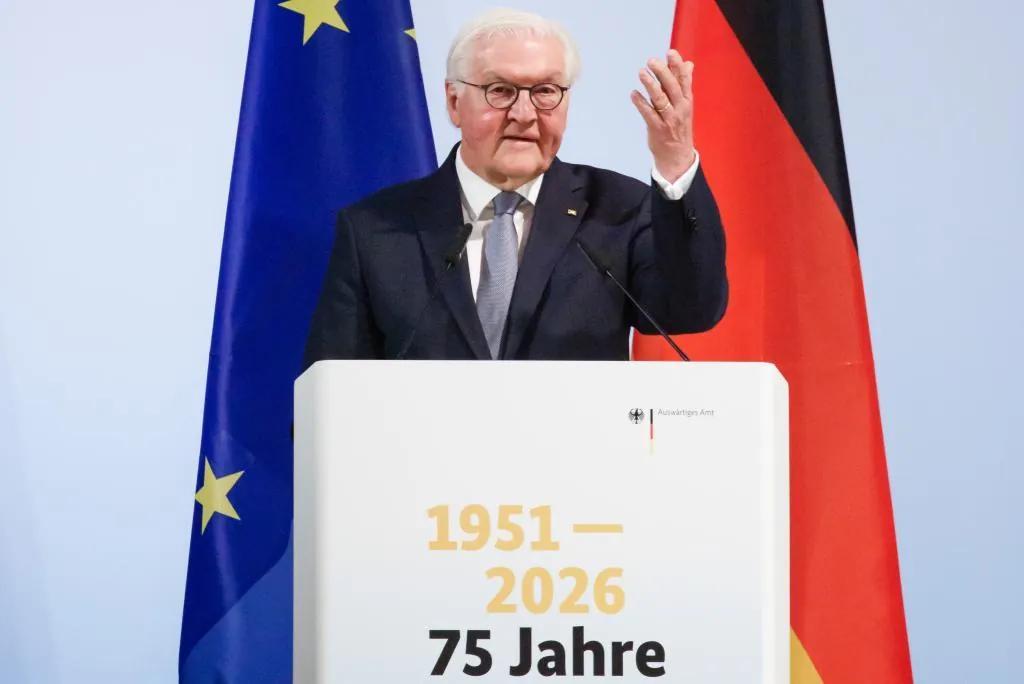
Speaking at a ceremony at the German Foreign Office on Tuesday, Steinmeier made his position clear.
He stated that 'Our foreign policy does not become more convincing simply because we refuse to call a violation of international law what it is.'
His remarks came as unusually strong criticism from a European leader toward the United States.
Steinmeier left no room for nuance in his assessment of the conflict.
Context and Setting
The significance of Steinmeier's remarks was amplified by the context and setting of his speech.
It took place before the diplomatic corps at the 75th anniversary ceremony.

The ceremony was for the German Foreign Ministry's refounding.
This venue was particularly meaningful as it represented where Steinmeier was formed politically.
This lent his criticism additional weight and credibility.
The timing suggested his message was for both international and domestic audiences.
European Reactions
Steinmeier's condemnation reflected broader European unease with the U.S.-led military action.
“byLaura Kelly03/24/26 01:37 PM ET Germany’s President Frank-Walter Steinmeier on Tuesday described President Trump’sconflict with Iranas a “disastrous mistake” that violates international law, with the unusually strong criticism underscoringEuropean angertoward the U”
Other European officials expressed similar concerns about the legality and consequences.
French Army Chief Fabien Mandon acknowledged U.S. remains an ally but is 'increasingly unpredictable'.
This unpredictability directly impacts French security and interests.
Swiss Defense Minister Martin Pfister stated the joint U.S.-Israeli attack violated international law.
The Swiss Federal Council believed the strikes breached the prohibition on the use of force.
These expressions highlighted a significant transatlantic divide.
Transatlantic Rift
The German president framed the conflict as having profound implications for transatlantic relations.
He compared the rupture to Russia's invasion of Ukraine in impact.
Steinmeier emphasized the damage to U.S.-German relations was irreversible.
He declared there would be 'no going back in transatlantic relations to before Jan. 20, 2025'.
He criticized the Trump administration's justification for the offensive.
He stated 'the justification of an imminent attack on the United States does not hold water'.
He noted 'the rift is too deep and the trust in American power politics has been lost'.
German Internal Divide
Within Germany, there was divergence between Steinmeier and Chancellor Friedrich Merz.
“The German president, Frank-Walter Steinmeier, has described the war against Iran as contrary to international law, in an unusually forceful formulation in Berlin, given that the United States and Israel are involved and that it breaks the caution that had been maintained by the Government”
Both expressed concerns about the war but took different approaches.
Merz emphasized maintaining relations with the United States despite reservations.
Merz is a member of the conservative Christian Democratic Union of Germany.
Steinmeier, from the center-left Social Democratic Party, took a confrontational stance.
He described the war as a 'politically disastrous mistake' that irrevocably harmed relations.
This highlighted Europe's complex balancing act in responding to U.S. actions.
Justification Rejection
At the core of Steinmeier's condemnation was his rejection of the Trump administration's justification.
He dismissed the assertion of an imminent threat to the United States.
The German president stated there was 'little doubt' the justification 'does not hold water'.
This position was echoed by Swiss Defense Minister Pfister.
Pfister had also questioned the legality of the strikes under international law.
The rejection of the imminent threat rationale challenged the Trump narrative.
This suggested European leaders were willing to publicly contradict U.S. justifications.
More on Iran

Israel kills IRGC Navy commander Alireza Tangsiri in air strike
16 sources compared

Pentagon orders 1,000 82nd Airborne troops to West Asia amid Kharg Island seizure talks
13 sources compared

U.S. Prepares to Deploy 1,000 82nd Airborne to West Asia to Seize Airfields
17 sources compared
Pentagon deploys 3,000 82nd Airborne troops to West Asia to backstop Iran war operations
14 sources compared