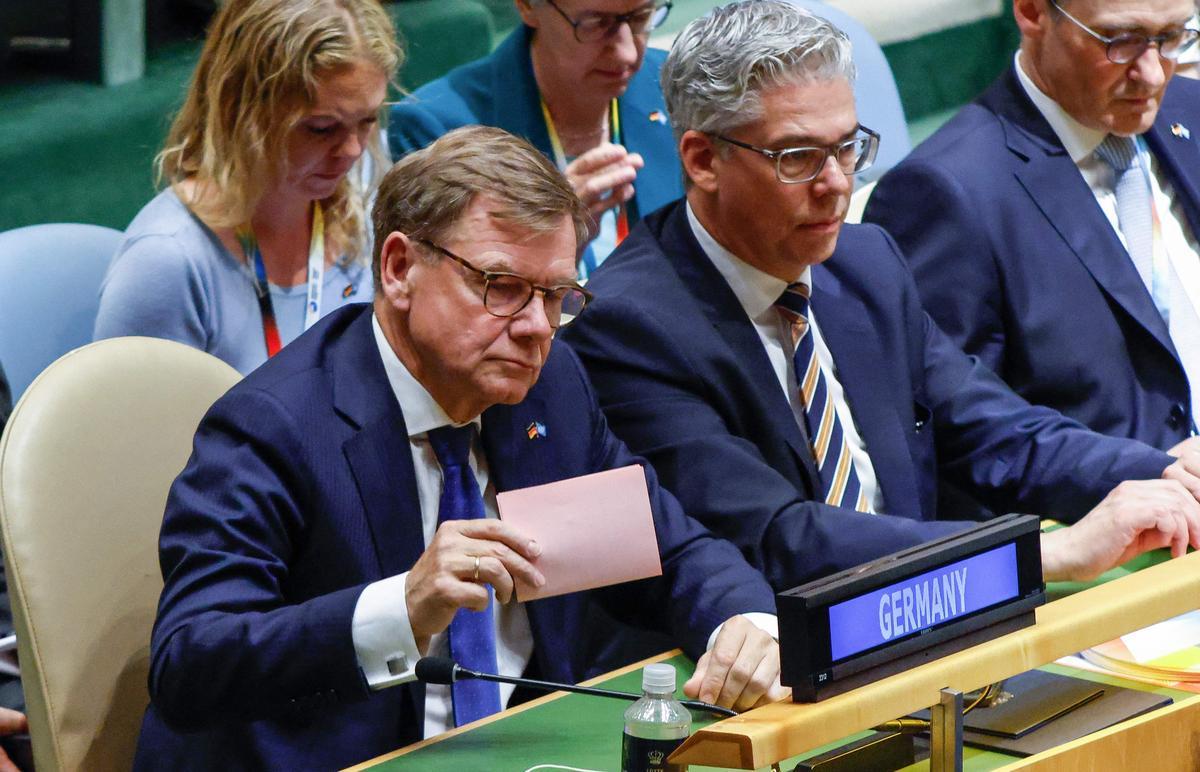
Germany Fails To Secure UN Security Council Seat, Loses To Portugal And Austria
Key Takeaways
- Portugal and Austria won the two Western Europe non-permanent seats for 2027-2028.
- Germany failed to secure a non-permanent UN Security Council seat.
- The loss was described as a bitter defeat and disappointment by German officials.
Germany misses UN seat
Germany failed to secure a non-permanent seat on the United Nations Security Council on Wednesday, losing the two European seats for the 2027-2028 period to Portugal and Austria.
“Portugal and Austria were chosen by the General Assembly to fill the two European seats up for grabs for the 2027-2028 period”
In the secret-ballot vote for the Western Europe and Others group, Portugal received 134 votes and Austria 131, while Germany stopped at 104.

The UN Security Council has 15 members, including five permanent members—United States, Russia, China, France and United Kingdom—and ten elected for two-year terms with seats distributed across regions.
The election was set to choose five of the 10 non-permanent members, with the new members entering the council for the duration of two years starting 1 January 2026, according to La Voce di New York, while other outlets said the five new members take up their seats on Jan. 1.
Germany’s loss ended a pattern described by multiple outlets, with DW saying Germany had already sat on the Security Council six times and had never before failed to enter it.
Reactions and rival lobbying
German Foreign Minister Johann Wadephul called the outcome “a real disappointment” after the vote, and he said Russia campaigned against Germany because of its strong support for Ukraine.
Wadephul also argued that Germany’s positions on wars in Ukraine and Gaza may have influenced how states voted, saying “There's our rock-solid support for Ukraine. It is no secret that Russia does not want such a voice at the Security Council.”

Chancellor Friedrich Merz said, “We applied with conviction. We did not achieve our goal,” and he added that “This result does not alter the tasks we face at the United Nations.”
Austria’s foreign ministry said its election capped a 15-year campaign and described it as a “strong international sign of confidence,” while Kyrgyzstan’s Foreign Minister Jeenbek Kulubayev told reporters “we understand now is a turbulent time.”
POLITICO.eu framed the contest as a cutthroat Austro-German fight, quoting an Austrian diplomat saying, “Vote for us precisely because we’re not the Germans,” and it described “hardball stuff” behind the scenes in an interview with Die Presse.
What changes next
The vote allocated the two European seats to Austria and Portugal for the 2027-2028 term, with ANSA saying Austria, Portogallo, Zimbabwe, Trinidad e Tobago would serve as non-permanent members for that biennium.
“Germany fails to secure a seat on the UN Security Council”
ANSA also said one seat remained to be assigned for the Asia Pacific group, where candidates were Kirghizistan or Filippine, “ora al terzo turno di ballottaggio,” while AP reported that Kyrgyzstan defeated the Philippines 143-49 after four rounds.
AP said the five new members will take up their seats on Jan. 1 and replace Denmark, Greece, Pakistan, Panama and Somalia, while Euronews said the two European seats were for the biennio 2027-2028 and that a seat for Asia Pacific was still to be assigned.
In the other contested race, AP reported Kyrgyzstan defeated the Philippines by a vote of 143-49 and will join the council for the first time, and it said Zimbabwe and Trinidad and Tobago were elected unopposed with more than 180 votes.
Euronews added that Merz said the missed election “non modifica il ruolo internazionale di Berlino,” and it quoted him saying, “I compiti che ci attendono alle Nazioni Unite non cambiano con questo risultato.”
More on Europe

Germany Fails UN Security Council Bid as Portugal and Austria Win Western Seats
14 sources compared

Péter Magyar Says Hungary Reached Minority Rights Deal With Kyiv, Clearing Ukraine EU Talks
25 sources compared

European Union Strikes Deal To Create Return Hubs Abroad, Speeding Deportations
13 sources compared

University of Bologna and CNRS MAP Build Notre-Dame Digital Twin After 2019 Fire
16 sources compared