
Heat Wave Shatters March Records Across Southern California
Key Takeaways
- Southern California experiences record-setting heat with multiple daily records across the region.
- Woodland Hills reached 97°F and Burbank Airport 99°F, signaling the surge.
- Forecasters expect the heat to extend through Friday and into the weekend.
Historic Heat Wave
An unprecedented heat wave has swept across Southern California, shattering century-old March temperature records.
The extreme heat has been described as potentially the hottest March heat wave ever recorded.
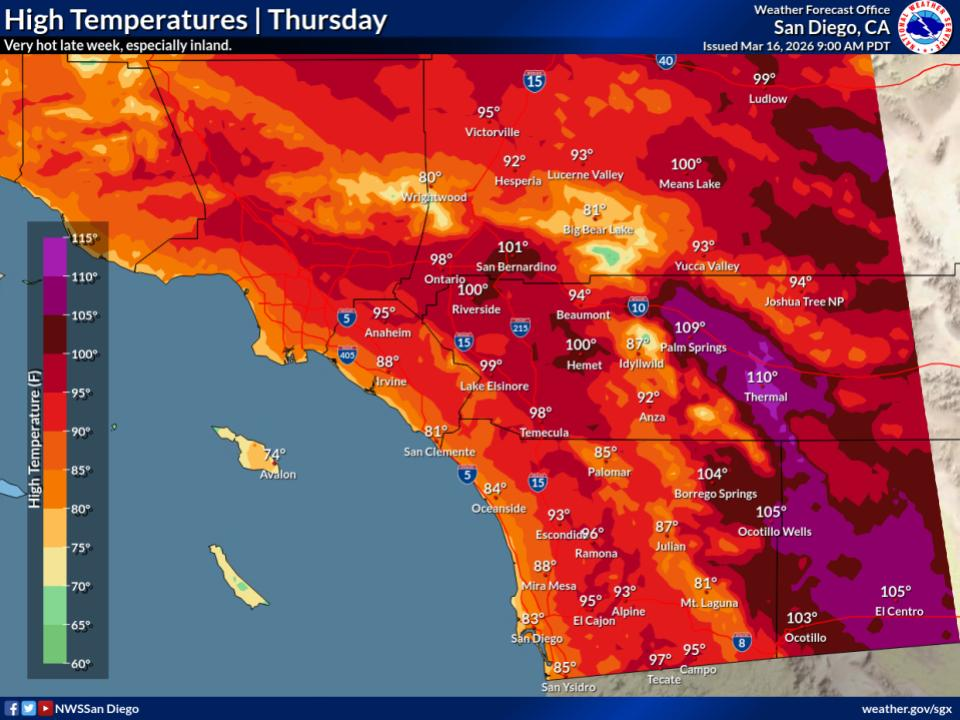
Temperatures have soared well above seasonal norms, with some areas reaching triple digits weeks ahead of typical warm weather.
Meteorologists from the National Weather Service characterize this as a historic weather event.
Multiple daily records are already being broken and new monthly temperature benchmarks could be set across Southern California.
Record Temperatures
Specific temperature records have been decisively broken across multiple locations.
Downtown Los Angeles hit 98 degrees on March 17, surpassing the 1914 record of 94 degrees.

Burbank reached 99 degrees, breaking its March 17 record of 92 from 1978 and setting a new all-time monthly high.
In Orange County, both Anaheim and Santa Ana hit 100 degrees, breaking previous records.
Riverside recorded 101 degrees, shattering the previous record of 92 from 2004.
Woodland Hills saw 97 degrees, breaking a 2007 record.
Other areas are anticipating even higher temperatures as the heat wave continues.
Duration and Intensity
The heat wave is expected to persist through the weekend.
“En caso de que los síntomas empeoren, lo mejor es buscar ayuda de los servicios de emergencia”
Peak temperatures are anticipated from March 17 through March 19 across Southern California.
Forecasters predict highs between 90 and 103 degrees across coastal plains, valleys, and interior regions.
Coastal areas could reach 80 to 90 degrees.
By March 18, temperatures are expected to soar over 100 degrees across much of the Desert Southwest.
The heat dome is described as one of the strongest ridges seen in Southern California since at least the 1950s.
Unusually stagnant conditions allow the heat to build and intensify over multiple days.
Climate Context
Climate scientists attribute the extreme heat to multiple interconnected factors.
A powerful ridge of high pressure is creating a heat dome over the region.

The warming Pacific Ocean is intensifying kona lows that contribute to these weather systems.
The jet stream has taken on an unusually amplified shape with large north-to-south waves.
This configuration is prone to stalling, allowing the ridge to strengthen over multiple days.
Research from climate expert Michael Mann links this 'quasi-resonant amplification' to the 2021 Pacific Northwest heat dome.
These configurations are becoming more common as human-caused warming reshapes weather patterns.
Public Safety Concerns
Public health officials have issued extreme heat warnings affecting more than 18 million people.
“Scorching temperatures shattered multiple daily records across Southern California on Tuesday, March 17, including a more than century-old record in downtown Los Angeles, according to the National Weather Service”
The warnings cover Southern California, southern Nevada, and parts of Arizona.

The National Weather Service has designated a 'HIGH risk for heat illness this week'.
Conditions remaining warm overnight add to the heat risk.
Authorities recommend using cooling centers at public libraries and community centers.
People should stock up on water and hydrating liquids.
Avoid going outside or working outdoors between 10 a.m. and 5 p.m.
Check on neighbors and loved ones at risk of heat-related illness.
This early-season heat wave tests the state's efforts to combat heat-related deaths in rising temperatures.
Regional Impacts
The heat wave's impacts extend beyond temperature records.
It affects water resources, vegetation, and other weather patterns.
Dry soil conditions across the Southwest and Rockies are creating a feedback loop.
Depleted soil moisture converts solar radiation into heat rather than evaporation.
This process 'turbocharges' the ridge of high pressure above.
The heat dome is expected to expand across several states.
It could impact as many as 70 million people through the weekend and into early next week.
Phoenix could reach up to 106 degrees.
Las Vegas might hit 100 degrees.
The Coachella Valley could see temperatures reaching 105 to 110 degrees.
All are significantly above historical averages for this time of year.
More on Technology and Science

Facebook launches Creator Fast Track, guaranteeing up to $3,000 monthly for three months.
10 sources compared

Meningitis B outbreak in Kent triggers vaccination of about 5,000 University of Kent students
32 sources compared

Nintendo Switch 2 Enables Original Switch Games to Run at 1080p in Handheld Mode
11 sources compared

Argentina Exits WHO Under President Javier Milei
23 sources compared