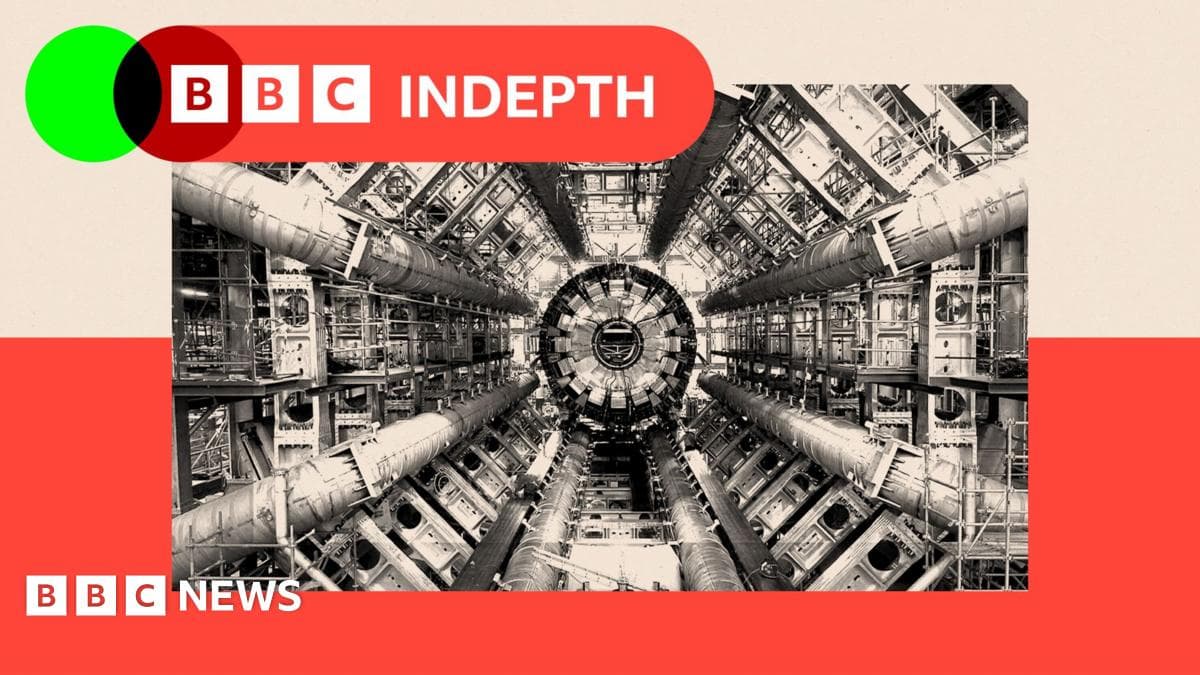
Higgs Boson breakthrough was UK triumph, but British physics faces 'catastrophic' cuts
Key Takeaways
- Peter Higgs named Nobel Prize in Physics laureate during 2013 announcement.
- Higgs boson prediction attributed to a British theorist nearly half a century ago.
- UK science funding faces catastrophic cuts despite the breakthrough.
Higgs Nobel recognition
Among the names read out was Prof Peter Higgs, the British theorist who, nearly half a century earlier, had predicted the existence of a particle believed to hold the cosmos together – the Higgs boson.
“When the Nobel Prize in Physics was announced in Stockholm in October 2013, the world was watching”
UK funding cuts to upgrades
But now, Britain is preparing to cancel its contribution to one of the Large Hadron Collider's next major upgrades.
It is one of several proposed cuts of UK involvement across various major particle physics and astronomy projects, which could see Britain's scientists reduce or even end their involvement in the most exciting international research collaborations probing the nature of our Universe.
30% cut justification
At the same time, in February a 30% cut (of £162 million) to funding for particle physics and astronomy research was announced by the Science and Technology Facilities Council (STFC).
“When the Nobel Prize in Physics was announced in Stockholm in October 2013, the world was watching”
Its head Prof Michele Dougherty told MPs earlier this month the cut was necessary because the Council had previously started projects it had no money for, referring to "an overabundance of ambition".
The problem, she said, was exacerbated by inflation and currency fluctuations.
Existential threat to UK physics
"Existential threat" Scotland's Astronomer Royal, Catherine Heymans, speaking for the UK community of astronomers, told the science select committee that the proposed cuts were "genuinely catastrophic and will be devastating for the UK."
She, along with a particle physicist, told MPs most of the potential cuts would lead to British scientists having to greatly reduce their involvement or withdraw altogether from some of the world's most important international astronomy and particle physics experiments.
More on Technology and Science

Facebook launches Creator Fast Track, guaranteeing up to $3,000 monthly for three months.
10 sources compared

Meningitis B outbreak in Kent triggers vaccination of about 5,000 University of Kent students
32 sources compared

Nintendo Switch 2 Enables Original Switch Games to Run at 1080p in Handheld Mode
11 sources compared

Argentina Exits WHO Under President Javier Milei
23 sources compared