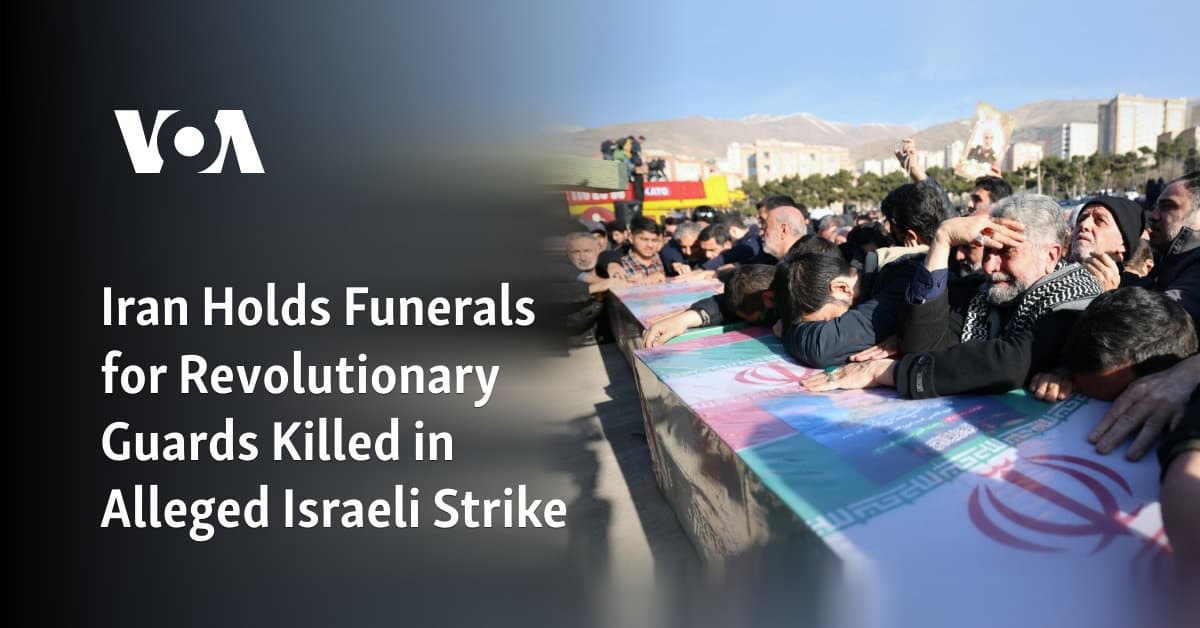
Israel Kills IRGC Commanders in Alleged Damascus Strike, Iran Holds Funerals
Key Takeaways
- Five IRGC members killed in Damascus in what Iran calls an Israeli strike.
- Hundreds of mourners gathered in Tehran for IRGC funerals.
- Incident adds to regional tensions amid the Israel-Hamas war.
Damascus Strike Details
Israel conducted a deadly strike in Damascus, Syria, killing five members of Iran's Islamic Revolutionary Guard Corps (IRGC), according to Iranian state media reports.
“Iran holds funerals for Guards killed in alleged Israeli strike”
The strike occurred in the Damascus neighborhood of Mazzeh, an area where IRGC leaders and pro-Iranian Palestinian factions are known to reside, according to the Syrian Observatory for Human Rights war monitor.

The attack resulted in a total of 13 deaths, with five of the victims being senior IRGC members including the group's intelligence chief for Syria and his deputy.
When questioned about the strike, Israel's military refused to comment, stating they do not comment 'on reports from the foreign media.'
This incident represents another escalation in the ongoing tensions between Israel and Iran, coming just four days after the IRGC had conducted its own strike targeting what they claimed was an Israeli 'intelligence headquarters' in Irbil, Iraq.
Iranian Funeral Response
Iran responded with massive funeral proceedings for the slain IRGC commanders, with hundreds of mourners gathering in Tehran to pay their respects.
Funeral processions were planned for three of the five IRGC members killed, according to Iranian state media.
The ceremonies featured coffins draped in the colors of the Iranian flag, displayed on a stage bearing pictures of IRGC General Qassem Soleimani, who was killed four years ago by the United States.
A funeral dirge sounded throughout the ceremonies, reflecting the Iranian government's strong condemnation of what they termed an Israeli assassination.
Iranian state media explicitly blamed an Israeli missile strike for the deaths, framing the incident as part of a broader pattern of Israeli aggression that extends beyond the Gaza genocide to target Iranian military personnel throughout the region.
Regional Escalation Context
The Damascus strike must be understood within the context of escalating regional tensions that have intensified during the ongoing Gaza genocide.
“Iran holds funerals for Guards killed in alleged Israeli strike”
According to Iranian officials, the IRGC's recent strike in Irbil, Iraq, was explicitly framed as 'in response to the recent vicious actions of the Zionist regime (Israel) which martyred the commanders of the Revolutionary Guards and the resistance front.'
This statement reveals how Iran views its military actions as retaliatory measures against Israeli assassinations.
The Baghdad government disputed Iran's characterization, claiming the missiles actually struck a businessman's family home rather than an Israeli intelligence headquarters.
This pattern of tit-for-tat strikes between Israel and Iranian proxy forces represents a dangerous escalation that threatens to widen the already devastating conflict in the region.
Pattern of Assassinations
The Damascus strike is part of a broader pattern of Israeli assassinations targeting Iranian and allied military commanders across the region.
According to multiple sources, Israeli forces have conducted a series of targeted killings in recent months, including the January assassination of Saleh al-Aruri, the deputy leader of Hamas, in southern Beirut.
A U.S. defense official confirmed to AFP that Israel carried out that strike.
Just days later, another Israeli strike in southern Lebanon killed Wissam Tawil, who was identified as the highest-ranking Hezbollah member to be killed since the war between Israel and Iran-backed Hamas began.
Last month, a strike in Syria killed Razi Moussavi, a senior commander of the Islamic Revolutionary Guard Corps' foreign operations arm, the Quds Force.
Moussavi was noted as the most senior Quds Force commander to be killed outside Iran in four years, with Iranian state media blaming an Israeli missile strike for his death.
Regional Implications
The assassination of IRGC commanders in Damascus represents a significant escalation in the shadow war between Israel and Iran, with potentially dangerous implications for regional stability.
“Iran holds funerals for Guards killed in alleged Israeli strike”
The targeted killing of senior military personnel by what Iranian media consistently describes as Israeli forces demonstrates Israel's willingness to strike deep into allied territories to eliminate perceived threats.
This strategy of targeted assassinations has become a central feature of Israeli military doctrine, extending beyond the Gaza genocide to encompass operations against Iranian forces and their proxies throughout the Middle East.
The Iranian government's response, including massive funeral ceremonies and public condemnations, suggests they view these attacks as acts of war rather than routine military operations.
The ongoing cycle of retaliation between Israeli forces and Iranian-backed groups threatens to transform the already catastrophic Gaza genocide into a wider regional conflict with potentially devastating consequences for civilian populations across the Middle East.
More on Gaza Genocide

Trump Administration Sues Harvard University Over Civil Rights Violations Against Jewish and Israeli Students
50 sources compared

Protesters heckle Australian PM Albanese at Sydney mosque over Israel stance
18 sources compared

Iran Fires Missiles at Israel, Killing Three Palestinian Women and a Foreign Worker
23 sources compared

UEFA Cancels Finalissima as Argentina Rejects Alternatives Amid Middle East War
11 sources compared