Israel to Partially Reopen Rafah Crossing for Limited Gaza Travel
Key Takeaways
- Rafah crossing will partially reopen on March 18 for limited movement of people.
- Reopening occurs under security coordination with Egypt and EU supervision.
- Crossing had been closed since the start of the Iran-related bombardments.
Crossing Reopening Announcement
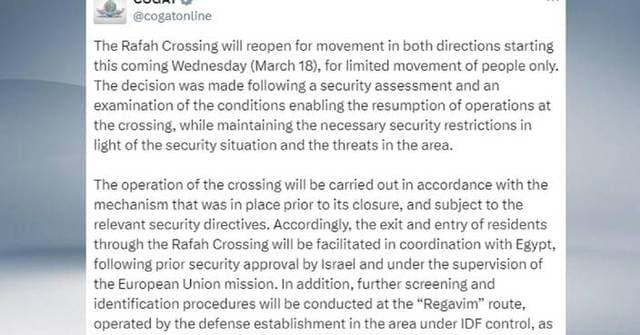
Israel announced on Sunday the partial reopening of the Gaza Strip's Rafah crossing with Egypt, scheduled to begin on March 18 for 'limited movement of people only.'
“Israeli occupation authorities announced on Sunday their intention to partially reopen the Rafah crossing between the Gaza Strip and Egypt, starting from next Wednesday, March 18, after a period of closure coinciding with the war on Iran”
The Israeli defense ministry agency COGAT confirmed the decision, stating it was made 'following a security assessment and an examination of the conditions enabling the resumption of operations at the crossing.'

The crossing will operate under strict security restrictions, maintaining 'the necessary security restrictions in light of the security situation and the threats in the area,' according to Israeli officials.
This announcement comes after weeks of closure following Israel's joint attacks on Iran launched on February 28.
Crossing Strategic Importance
The Rafah crossing serves as Gaza's critical 'lifeline' to the outside world, being the only gateway that does not pass through Israeli territory.
The crossing had been under Israeli control since May 2024, when Israeli forces seized the Palestinian side claiming it was 'used for terrorist purposes.'

Before the Israeli genocide in Gaza, hundreds of Palestinians used the crossing daily to travel to Egypt and return to the enclave.
The crossing briefly reopened on February 2 for passenger movement following a ceasefire agreement that took effect on October 10, 2025, but was closed again on February 28 when Israel launched joint strikes with the United States against Iran.
The two-year Israeli war has devastated Gaza, with estimates indicating around 22,000 wounded Palestinians needing medical treatment abroad amid the complete collapse of the territory's healthcare system.
Security Arrangements
The reopening operation will function under strict Israeli security oversight, with movement coordinated with Egypt and supervised by the European Union Border Assistance Mission Rafah (EUBAM).
“Israel announced Sunday that the Rafah border crossing with Egypt will reopen for limited passenger travel starting Wednesday, allowing limited travel of people”
COGAT specified that passengers will require 'prior security approval by Israel' and that additional screening and identification procedures will be conducted along the 'Regavim' route in areas under Israeli army control.
The crossing will operate 'under the same mechanism that existed before its closure,' maintaining Israel's security directives.
The Kerem Shalom crossing, another key entry point for humanitarian aid, had already begun a gradual reopening on March 3 under similar security restrictions, with Israel claiming aid entry would be based on needs identified by the UN and international humanitarian groups.
Humanitarian Crisis Context
Human rights groups, the United Nations, and Hamas have repeatedly demanded the reopening of Rafah, emphasizing its essential role in facilitating humanitarian access to the devastated territory.
The crossing had been described as Gaza's 'lifeline' by international observers, as it represents Palestinians' only viable connection to the outside world amid the ongoing Israeli siege.

The UN High Commissioner for Human Rights, Volker Türk, has previously accused Israel of attempting to impose 'a permanent demographic change' in both the West Bank and Gaza Strip through its actions.
The limited reopening comes amid reports that 1.9 million displaced Palestinians continue to live in tents, facing another winter without adequate shelter in the territory where Israeli forces have destroyed approximately 90% of civilian infrastructure according to UN estimates.
Political Context
The reopening coincides with a Hamas delegation's arrival in Cairo for negotiations, suggesting potential diplomatic developments amid the ongoing Gaza genocide.
“Closed since the start of the Israeli-American bombardments against Iran on February 28, the Rafah crossing will reopen to traffic in both directions starting next Wednesday, March 18, but only for limited movement of people, according to a statement from COGAT, the Israeli Defense Ministry agency in charge of civilian affairs”
The movement has reportedly made disarming itself a 'red line' in any potential peace negotiations, according to sources familiar with the discussions.

The partial reopening represents a limited concession by Israel, which maintains full control over the crossing's operations through security approval mechanisms and military oversight.
The announcement comes as international pressure mounts on Israel to allow greater humanitarian access to Gaza, where the two-year war has resulted in over 72,000 Palestinian deaths and more than 171,000 injuries, with reconstruction costs estimated by the UN at approximately $70 billion.
More on Gaza Genocide

Israel Fires on Family Car in Occupied West Bank, Killing Four
14 sources compared

UEFA Cancels Finalissima as Argentina Rejects Alternatives Amid Middle East War
11 sources compared

Israel Fired on Family Car in West Bank, Killing Four, Including Two Children
15 sources compared
Prime Minister Netanyahu Alive as Prime Minister's Office Dismisses Assassination Claims
11 sources compared