Israeli Bulldozers Demolish 50 Palestinian Shops Near Al-Azariyeh Ahead Of Route 45 Road Project
Key Takeaways
- Demolitions cleared land for a settlement-linked road near Jerusalem.
- Route 45 road project aims to consolidate settlements north of Jerusalem.
- Palestinian authorities warn Route 45 will consolidate annexation and restrict movement.
Road Project in West Bank
Israeli bulldozers demolished around 50 Palestinian shops on the outskirts of a town southeast of Jerusalem to clear land ahead of a road project tied to settlement activity in the occupied West Bank, with the road described as part of a plan to drive Palestinian traffic off a new highway being built to serve nearby Israeli settlements.
“It is a house on a quiet street in the old city of Jerusalem, gradually descending toward a souk”
Hagit Ofran, director of the Peace Now group opposing settlements, said: “The shops that were demolished are where Israel plans to build a new road that would divert all Palestinian traffic onto that road so that they can seal off the E1 area completely to Palestinians.”
The demolitions took place today, Tuesday, in the town of al-Azariyeh, after less than a week since some owners received notices to evacuate shops built without permits, and lawyers appealed to the Israeli Supreme Court but the demolitions continued.
Human rights groups and the Palestinian Authority said the demolitions are linked to Israel’s plans to reform the transport sector and establish separate road systems for Israeli and Palestinian ID holders, and they described a planned tunnel and bypass road as redirecting Palestinian traffic away from a major Israeli highway linking neighboring settlements to Jerusalem.
The project was framed as part of E1, which Israel is developing with the aim of preventing the establishment of a Palestinian state, according to Al-Quds al-Arabi (Agencies).
Route 45 and Budget
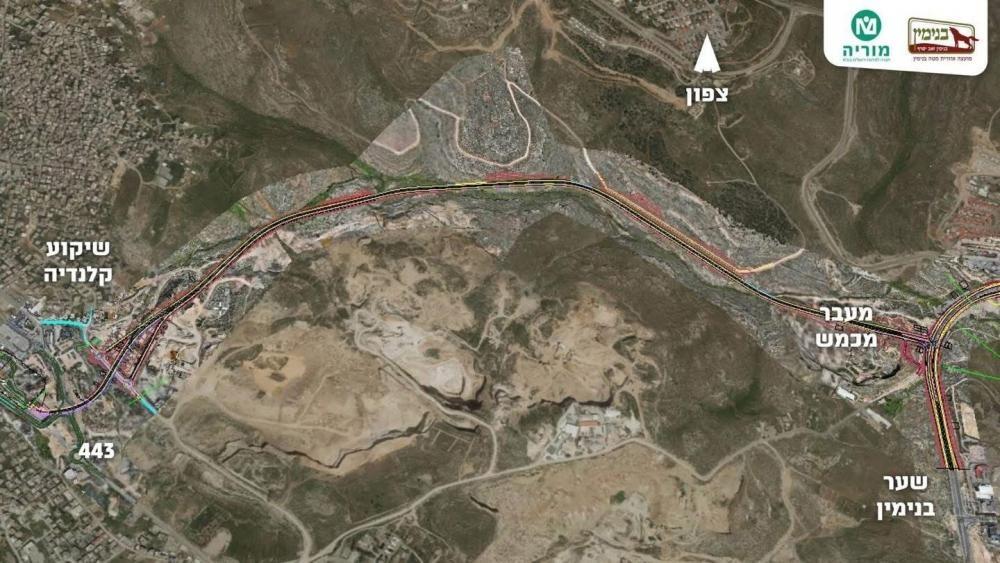
The Jerusalem Governorate warned against the launch by the Israeli occupation authorities of the colonial project 'Route 45', after its start of implementation was announced in the coming weeks, and it said the project aims to consolidate the annexation of settlements north of Jerusalem and east of Ramallah.
In a press release published Friday by the governorate, it said 'Route 45' has an estimated budget of 400 million shekels and is intended to directly connect settlements established east of Ramallah and north of Jerusalem to Route 443 and the 1948 Territories.

The governorate specified that works will begin in front of the Mikhmas settlement, built on the lands of the village of Mikhmas, northeast of occupied Jerusalem, and will extend to the tunnel of the Qalandiya checkpoint to the west.
It added that the works are taking place in parallel with the massive widening of bypass roads linking the Hizmeh military checkpoint to the Ein Haramiyah area, east of Ramallah, with the stated aim of creating a 'connected and interconnected' road network serving the settlements.
The governorate argued that 'Route 45' represents the extension of an older plan dating from 1983, registered in Military Decree No. 50 relating to roads, and it said occupation authorities have treated legal objections filed by landowners of villages including Jaba', Qalandiya, Kafr Aqab, Al-Ram, Mikhmas and Burqa as a mere formality.
Bulldozers Northwest of Jerusalem
WAFA said Israeli colonists on Wednesday tore up the landscape for the construction of a new road extending from the Bedouin community area to the Al-Khunaidiq area of the town of Beit Anan, northwest of Jerusalem, citing local sources.
“Français العربية Info Images Thursday , 18 June , 2026 Weather +27 ° C +29° +17° Ramallah Thursday, 18 Wednesday | | +29° | +17° ---|---|---|--- Friday | | +26° | +15° Saturday | | +29° | +17° Sunday | | +30° | +17° Monday | | +29° | +17° Tuesday | | +28° | +17° See 7-Day Forecast Menu Important News India provides US$ 2”
According to WAFA, the local sources reported that Israeli colonists escorted bulldozers to the area and razed privately-owned Palestinian land, amid concerns that the land could be seized as a prelude for colonial settlement expansion.
WAFA’s report placed the incident in the Jerusalem area and described it as construction activity involving bulldozers, with the road work linked to the Beit Anan locality northwest of Jerusalem.
The Jerusalem Governorate’s warning about 'Route 45' described a broader pattern of road projects intended to connect settlements to Route 443 and the 1948 Territories, and it framed such projects as consolidating annexation north of Jerusalem and east of Ramallah.
Taken together, the sources depict road-building and land-clearing actions ranging from demolishing shops near al-Azariyeh to razing privately-owned land near Beit Anan, and to the planned implementation of 'Route 45' with an estimated budget of 400 million shekels.
More on Other

Israel Faces Unprecedented Isolation as Boycotts Widen and Sanctions Expand Across Europe
10 sources compared

Ukrainian Marine Drone Explodes Near Constanta Oil Terminal, Romania Reports No Casualties
21 sources compared

Mahmoud Abbas Issues Decree-Law Amending Palestinian Elections Law, Raising Seats to 200
17 sources compared

Bangladesh Foreign Minister Khalilur Rahman Defeats Cyprus’ Andreas Kakouris for UN General Assembly Presidency
12 sources compared