USA10 March, 20264 min read
Kilauea Volcano Erupts, Shoots Lava 1,000 Feet as USGS Upgrades to Warning and Aviation Red
This article is an automated aggregation of coverage from news outlets. Our editorials offer in-depth analysis curated by the NewsCord team.
Sources reported lava fountains between roughly 1,000 and 1,300+ feet high USGS upgraded the volcano alert to warning and raised the aviation color code

Eruption and alert upgrade
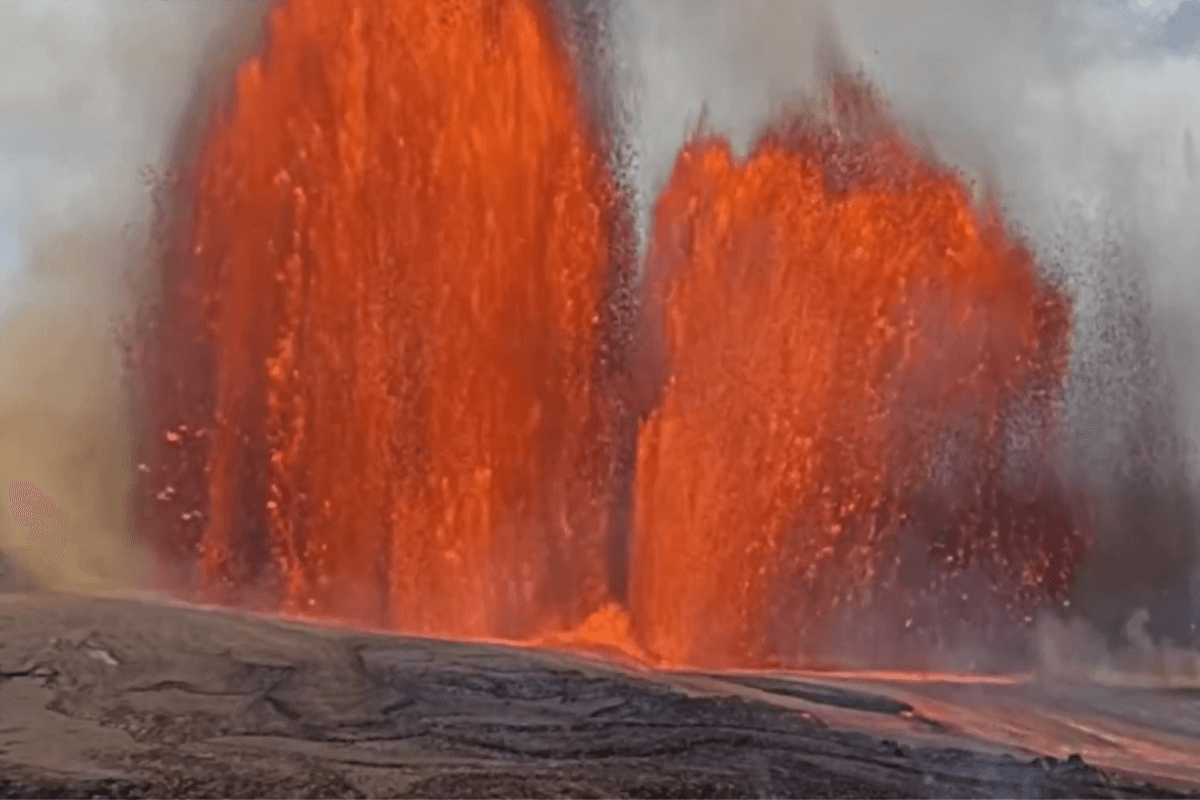
Kīlauea on Hawaii’s Big Island erupted on the morning of 10 March 2026 with powerful lava fountaining that prompted the U.S. Geological Survey to raise the Volcano Alert Level to WARNING and the aviation color code to RED.
“The USGS upgraded the Volcano Alert Level from a ‘watch’ to a ‘warning’ and raised the aviation color code from ‘orange’ to ‘red.’”
The USGS reported that "lava fountaining in Halemaʻumaʻu Crater at the summit of Kīlauea began at 9:17 a.m. HST and was ongoing," and its social post noted that "Both the south and north vents are currently about 1,300 feet high."

International Business Times described the event as the volcano "roared back to life... shooting lava fountains over 1,300 feet into the sky and forcing the US Geological Survey to issue its highest alert level," while STL.News framed the episode as a dramatic "lava shooting 400 meters into the air."
Plume and tephra fallout
The eruption produced an ash plume and extensive tephra fallout that reached tens of thousands of feet and created hazardous conditions at overlooks and nearby communities. The USGS and the Washington Volcanic Ash Advisory Center reported that "the eruption's plume reached 25,000 feet above sea level," while International Business Times said the episode sent an "ash plume climbing to 30,000 feet above sea level." Observers and agencies warned of large fallout: Kīlauea's USGS statement and reporting noted "Fallout, including pieces up to the size of a football, has been reported at overlooks in Hawai'i Volcanoes National Park, creating hazardous ground conditions," and IBT likewise quoted the USGS that "Fallout up to football size pieces and smaller are reported at overlooks in Hawaiʻi Volcanoes National Park, creating hazardous ground conditions."
Closures and warnings
The eruption disrupted transportation and public access, prompting road closures, park shutdowns and the opening of an emergency shelter, but sources disagree on how long ash warnings would remain in effect.
“In response to the hazardous conditions created by falling tephra, the Hawaii County Civil Defense Agency announced the closure of Highway 11 between the 24 and 40-mile markers.”
Hawaii County civil defense and the National Park Service confirmed closures: KCCI reported "the closure of Highway 11 between the 24 and 40-mile markers," while International Business Times wrote that "Highway 11... is now closed between mile markers 24 and 40."
The National Park Service also closed the volcano summit, and CBS News said "Hawaii County officials also opened a shelter at a district gymnasium for residents and tourists impacted by the road closure or falling tephra."
On warning durations, KCCI said the National Weather Service "issued an ashfall warning effective until 5 p.m. HST on Tuesday," International Business Times said the NWS "extended an ashfall warning until 11 p.m.," and Infobae reported the NWS "confirmed the warning would remain in effect through Sunday," a clear contradiction in the sources about expiration times.
Health and safety advice
Authorities and health agencies warned about respiratory and infrastructure risks from ash and tephra and issued practical safety steps for residents. The National Weather Service and local officials advised people to "seal their windows and doors, protect electronics, cover air intakes and open water sources, and avoid driving," KCCI reported, and urged residents to "remain indoors unless absolutely necessary." CBS News noted that "Volcanic tephra can irritate eyes, skin and the respiratory system, according to county officials," and Infobae emphasised that "volcanic ash fall presents health risks to residents and can disrupt critical infrastructure" and that the NWS "recommended specific precautions such as staying indoors, sealing doors and windows, protecting water sources, and limiting vehicle use in the most affected areas."
Scientific context
Scientists and reporters placed the episode in the context of an active eruptive cycle that has produced frequent summit events since December 2024, and they described the eruption dynamics as intermittent fountaining tied to subsurface gas and seismic signals. International Business Times noted that "Kilauea has now erupted 43 times since late December 2024" and that "Most episodes last less than 24 hours, but their frequency and growing intensity have kept scientists and residents on edge."
“Kilauea has now erupted 43 times since late December 2024. That works out to roughly one eruption every 1.8 days.”
KCCI likewise observed that "most lava fountaining episodes at Kīlauea since December 23, 2024, have continued for a day or less." Reporters and volcanologists characterized the activity as a fountaining event: STL.News explained the phenomenon as a "'fountaining' event, where lava is expelled vertically due to gas pressure building up within the magma chamber," and Infobae noted that the episode followed "an increase in seismicity and an acceleration in ground tilt at the Halemaʻumaʻu crater" with eruptions "concentrated at the north and south vents, where lava emerged in intermittent jets."