
Majority of Americans Reject President Trump's Military Action in Iran
American public opinion on strikes
Multiple national polls conducted in the week after U.S. and Israeli strikes found that a majority of Americans opposed the strikes on Iran.
“Poll: A majority of Americans opposes U”
An NPR/PBS News/Marist poll reported opposition by a 56%–44% margin and noted that "just 36% approve of President Trump’s handling of the situation."

Strength In Numbers summarized broader polling by stating the "Headline finding: immediate public support for the U.S. strikes on Iran is very low — about 38% of Americans approve — and across every major nonpartisan poll conducted since the strikes began more people oppose than support the action."
The Forward likewise observes public opposition in its summary: "polls show most Americans oppose a war with Iran."
Poll splits and Senate vote
Polls show clear partisan splits but also disagreement across polls about how solid Republican support is.
NPR reported that "Opinion breaks sharply by party: 86% of Democrats and 61% of independents oppose the action, while 84% of Republicans support it," indicating strong GOP backing in that survey.
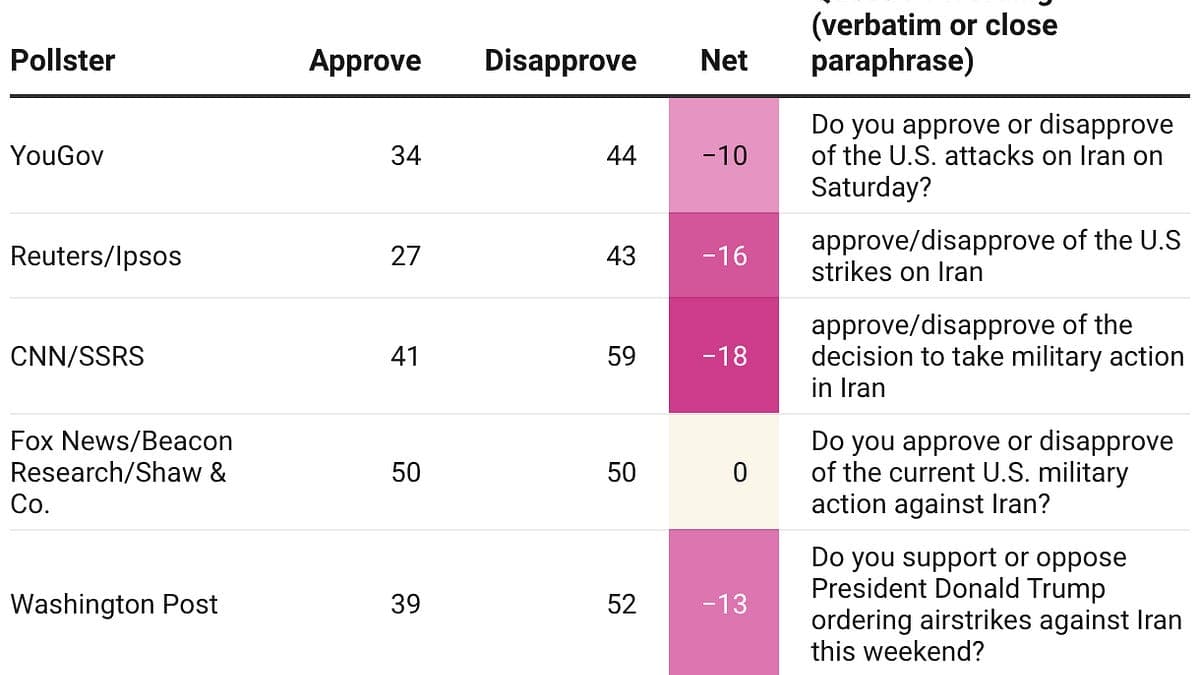
Strength In Numbers, however, cautioned that "About 70% of Republicans back the Iran strikes — far below the ~90–96% Republican support for earlier wars — indicating weaker enthusiasm even in Trump’s base," a lower figure than NPR’s Republican result; this is an explicit discrepancy in the available polling.
The political stakes of that partisan split showed up in Congress: "The vote was almost entirely along party lines except for Republican Rand Paul, who supported the measure, and Democrat John Fetterman, who opposed it," the Forward reported after the Senate vote.
Public support and legality
Observers and analysts placed these weak opening approval numbers in historical context and flagged their unusual character.
“Senate rejects effort to rein in Trump’s power to fight Iran alongside Israel The move comes as polling shows most Americans oppose the war on Iran”
Strength In Numbers noted that the roughly 38% approval is "the weakest opening support level for a major U.S. military operation in modern polling" and compared it to higher public backing for past interventions - "Afghanistan (post-9/11) ~90%, the 1991 Gulf War ~79–80%, Iraq in March 2003 ~71–76%."
Strength In Numbers added that "No president in modern polling has launched a major operation with the public already opposed."
NPR reported that the administration "has offered varied justifications for the strikes, including claims Iran posed an imminent threat."
The Forward described questions about the legal basis and process under the War Powers Act, noting "the War Powers Act generally requires advance or prompt congressional approval unless a direct, imminent threat exists, and the administration gave mixed signals about that."
Congressional response to strikes
The Senate rejected a Democratic-led measure that would have required the president to obtain congressional authorization to continue military action against Iran.
The Forward reported that the House is expected to consider a similar resolution.
The legislative push came amid concerns about the process used to launch the strikes and how the administration justified them; NPR noted the administration offered "varied justifications," and Strength In Numbers observed the administration framed the strikes as "pre-emptive and as defense of Israel," while concluding those arguments had not persuaded a majority of Americans.
Polls, Wording, War Powers
Poll methodology and question wording helped shape and complicate the picture of public sentiment.
“All the polls on the U”
NPR explained survey details: "The survey of 1,591 adults was conducted Monday–Wednesday the week after U.S. and Israeli strikes that began Feb. 28, has a 2.8-point margin of error, and used phone, text and online methods in English and Spanish."
Strength In Numbers warned that question framing affected results in some outlets, noting that a Fox News poll showed a 50–50 split but that this result may have been primed by earlier questions portraying Iran as a real security threat.
It also said Republican-aligned polls using leading wording produced only modestly higher support, citing OnMessage at about 53% and Trafalgar at about 54%.
The Forward’s coverage underlined that legal and procedural ambiguities around the War Powers Act — "the War Powers Act generally requires advance or prompt congressional approval unless a direct, imminent threat exists, and the administration gave mixed signals about that" — are central to interpreting both the polls and the political response.
Key Takeaways
- Majority of Americans oppose U.S. military action against Iran
- Polls show 56% disapprove when excluding 'don't know' responses
- Poll approval estimates vary between about 38% and 44%
More on USA
Trump Forms 17-Nation Coalition, Offers US Missile Strikes to Wage War on Cartels
16 sources compared
President Donald Trump Joins Families as Six U.S. Soldiers' Remains Return
10 sources compared

Trump Convenes Latin Leaders at 'Shield of the Americas' Summit, Names Kristi Noem Special Envoy
21 sources compared
Tornado Rips Through Southwest Michigan; Some Reports Say Four Dead, Others Say Six
27 sources compared