
Nature Researchers Use Mobile Qubits to Perform Two-Qubit Operations and Quantum Teleportation on Silicon Chip
Key Takeaways
- Two-qubit logic and teleportation demonstrated with mobile spin qubits on silicon.
- Mobile spin qubits enable dynamic, reconfigurable connectivity in silicon-based processors.
- Silicon integration of mobile qubits targets scalable, high-fidelity two-qubit operations.
Mobile qubits on silicon
A Nature paper described how researchers used mobile qubits to overcome a limitation of fixed qubits by moving electron spins across a silicon chip using conveyor-mode shuttling.
“To get quantum computing to work, we will ultimately need lots of high-quality qubits, which we can tie together into groups of error-corrected logical qubits”
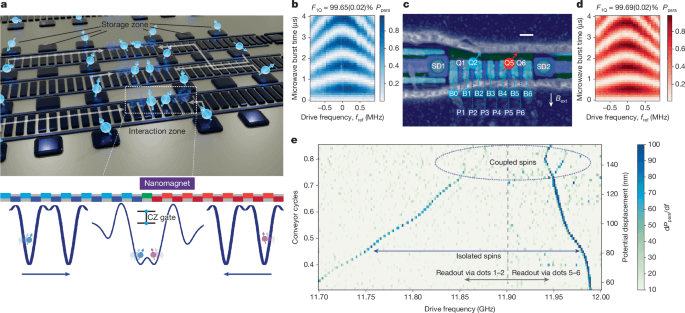
In the experiment, a team led by Lieven Vandersypen from Delft University of Technology in the Netherlands used a silicon device with a linear array of quantum dots to carry two electrons in separate dots toward the center so their quantum states could interact.

The scientists reported: "We demonstrate two-qubit operations between two electron spins carried towards each other in separate traveling potential minima in a semiconductor device," and they controlled the timing and distance between the electrons to perform a quantum logic operation.
They then reversed the electrical signals to move the electrons back to their starting point so the data could be read, and a second experiment in the same study demonstrated quantum teleportation by entangling two electrons and transferring a third qubit’s state to another electron elsewhere on the chip.
The Nature article also stated that when the two spins were shuttled toward the centre by 120 nm each for a total displacement of 240 nm, the researchers achieved an average two-qubit gate fidelity of about 99%.
Teleportation and fidelity
Beyond two-qubit gates, the Nature paper reported conditional post-selected quantum state teleportation between qubits separated by 320 nm, with an average gate fidelity of 87%.
It framed mobile qubits as attractive because they enable dynamic and reconfigurable qubit arrays, allowing quantum processors to adapt connectivity patterns during operation and implement different quantum error correction codes on the same hardware.
The paper’s authors said, "We expect that operations on mobile qubits will become a universal feature of future large-scale semiconductor quantum processors," linking the results to a scalable architecture based on conveyor-mode shuttling.
Ars Technica described the broader goal as manufacturing qubits that can move so that error-corrected logical qubits can be tied together, noting that systems based on electronic devices are "locked into whatever configuration they’re wired into during manufacturing."
Ars Technica highlighted the approach’s promise by explaining that quantum dots can be manufactured in bulk and host a qubit as a single electron’s spin, and that the work showed it was possible to move these spin qubits from one quantum dot to another without losing quantum information.
Why it matters next
The Nature paper connected the stakes of mobile qubits to maintaining high connectivity as quantum processors scale up, saying that traditional architectures are often restricted to interactions between nearest neighbours and that this constrains quantum error correction codes and increases overhead.
“Mobile qubits on a chip move us a step closer to everyday quantum computers Paul Arnold Author For years, quantum computers have lived under a huge bubble of hype, promising to revolutionize numerous fields, from medicine and battery design to materials science and cybersecurity”
It argued that mobile qubits offer a promising alternative by enabling flexible connectivity between qubits, potentially reducing the overhead associated with error correction schemes.
In the same Nature work, the authors described a scalable mobile spin qubit architecture based on conveyor-mode shuttling, where qubits can be transported between static storage zones and pairs of adjacent conveyor channels that meet at shared interaction zones.
The paper also described how two-qubit operations are performed by simultaneously shuttling two qubits inside the same channel to an interaction zone, enabling efficient resource sharing through shared control lines and sparse storage zones.
Separately, Quantum Zeitgeist said its own approach aims to move "from bits to qubits" within the same silicon hardware, leveraging high density already achieved in modern processors with hundreds of billions of functioning components and citing a £42 million Series B in 2022 for deployment to the UK’s National Quantum Computing Centre at Harwell.
More on Technology and Science

LastPass Says Klue Supply Chain Attack Let Hackers Access Salesforce Customer CRM Data
10 sources compared

Hundreds of Schools Close Across England And Wales As Met Office Issues Red Heat Warning
11 sources compared

France’s Heatwave Forces Eiffel Tower And Louvre To Close Early In Paris
13 sources compared

António Guterres Urges AI Firms To Disclose Data Centre Environmental Costs At London Climate Action Week
13 sources compared