USA15 April, 20269 min read
Nicholas Enrich Says Trump Administration Shredded USAID, Leaving Millions Dead Over Five Years
This article is an automated aggregation of coverage from news outlets. Our editorials offer in-depth analysis curated by the NewsCord team.
Trump administration froze funding and dismantled USAID within months after taking office. UN agencies warn millions risk losing direct humanitarian aid across more than 140 countries.

USAID dismantling begins
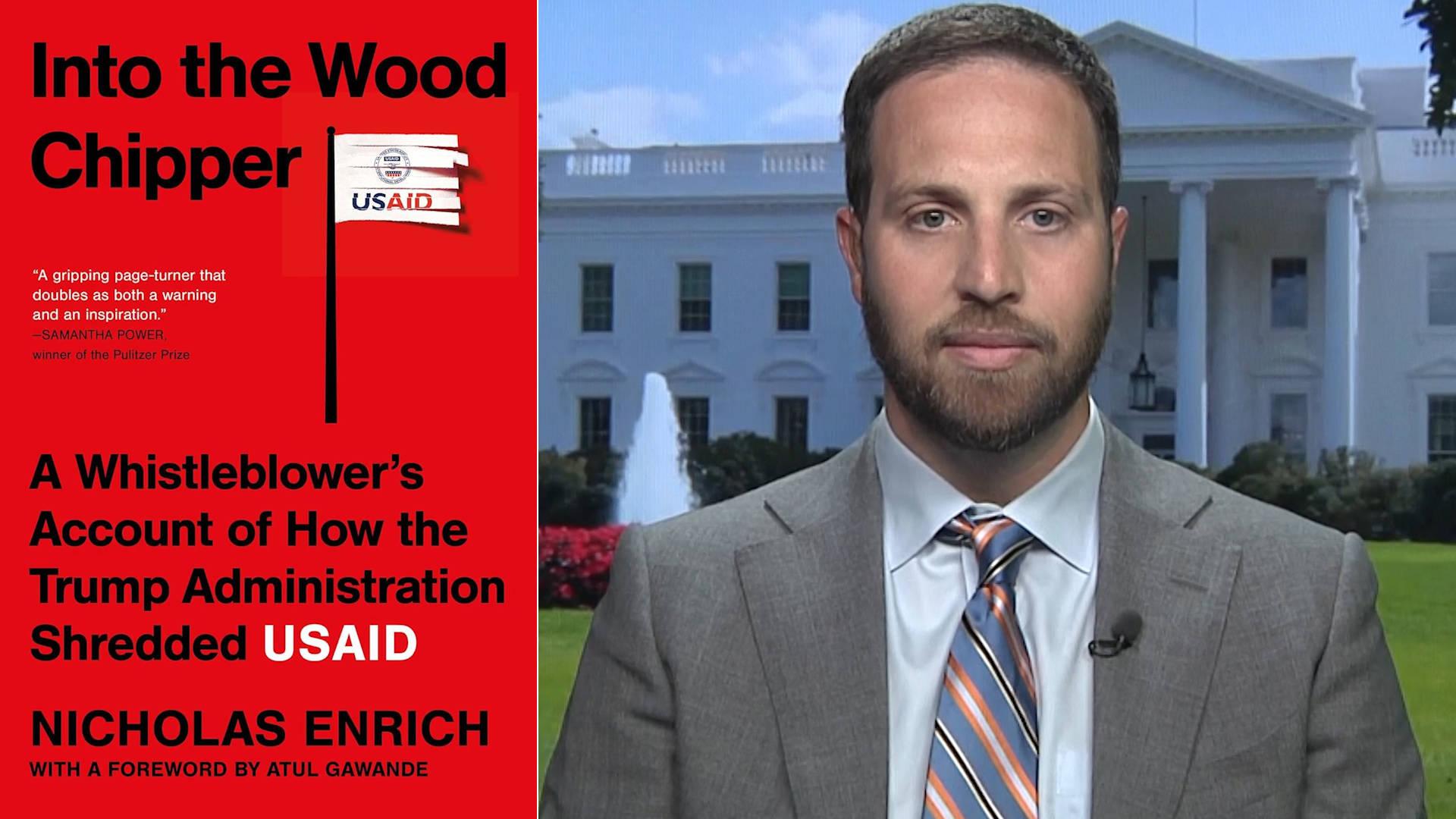
The dismantling of the U.S. Agency for International Development, USAID, became a central focus of a new account by Nicholas Enrich, a former USAID official who worked at the agency for over a decade before being pushed out in early 2025.
“On February 3rd, 2025, Musk posted on X, quote, ‘We spent the weekend feeding USAID into the wood chipper. Could [have] gone to some great parties. Did that instead.’”
Enrich’s memoir, Into the Wood Chipper: A Whistleblower’s Account of How the Trump Administration Shredded USAID, is named after a post by Elon Musk, who wrote on X on February 3rd, 2025, “We spent the weekend feeding USAID into the wood chipper. Could [have] gone to some great parties. Did that instead.”

In the Democracy Now! interview, Enrich said the cuts would lead to an estimated 14 million deaths “unnecessarily” over the next five years, and he added that “nearly a million, mostly children, already have,” citing “conservative estimates.”
Enrich also described the early phase of the Trump administration’s actions as a shutdown of USAID’s operational capacity, saying the DOGE team and Trump officials “truly knew nothing about the agency.”
He said he put Trump officials into “two categories: those who were cruel and those who were buffoons,” and argued that “most of the DOGE team that came in fell into that second category.”
The National Today account adds a specific early trigger, saying “On Inauguration Day 2025, Trump signed an executive order halting all of USAID's programming,” and it describes perishable food and medical supplies left undelivered and clinical trials interrupted.
In parallel, l’Opinion described a separate but related episode in which the United States “incinerated nearly 500 tons of emergency food” intended for Afghan and Pakistani children because the expiration date had passed in July, tying it to the “drastic budget cuts carried out by the Donald Trump administration in international aid.”
Freeze, layoffs, and transfer
Multiple reports describe a rapid sequence of actions that began with a funding freeze and moved toward a structural transfer of USAID’s functions.
franceinfo says that “From his inauguration on January 20, the American president, Donald Trump, ordered by decree a 90-day freeze on the agency's funding,” and it adds that “On March 10, six weeks after the audit began, the U.S. Secretary of State, Marco Rubio, announced the elimination of 83% of programs.”
It also states that “Two weeks earlier, 1,600 of the agency's 10,000 employees were laid off, the others placed on administrative leave,” and it frames the later step as a formal transfer, saying “Marco Rubio sent a memo to Congress on March 28, informing them that the remaining missions would be transferred to another branch of the administration by July 1.”
The France 24 report similarly ties the timeline to the second term, stating “Since January 20, 2025, the first day of his second term, President Donald Trump pushed a drastic cut in U.S. spending on foreign aid,” and it says “In early February, USAID, the United States’ main international development agency, began to be dismantled and by July 1 83% of its programs had been canceled, while the remainder were transferred to the State Department.”
In Democracy Now!, Enrich described a parallel personnel disruption, saying “On March 2nd, 2025, he was placed on administrative leave for exposing the Trump administration’s illegitimate and dangerous dismantling of the agency,” and he said the DOGE-led cuts included “summarily cut its staff and funding.”
The National Today account adds operational consequences, saying “Perishable food and medical supplies were left undelivered, clinical trials were interrupted, and contractors worldwide were unable to meet payroll,” and it says “new Trump-appointed leadership prohibited external communications.”
In the same thread, l’actualité reports that “Staff members were locked out of systems and laid off via mass emails,” and it says “Secretary of State Marco Rubio ordered on Tuesday the integration of USAID into the State Department.”
Together, these accounts depict a shift from program suspension to staff removals and then to institutional absorption into the State Department, with specific dates and percentages repeatedly cited across outlets.
Voices: Obama, Bush, Bono
Criticism of the USAID dismantling came from prominent figures and was delivered in multiple forms, including recorded statements and a farewell video that included the singer Bono.
“Barack Obama called the dismantling of USAID by the Trump administration a 'colossal error.'”
l’actualité says former Presidents Barack Obama and George W. Bush “openly criticized the Trump administration,” and it reports that Obama called the dismantling “a 'colossal error.'”
It also says the Monday farewell video included Bono as a “surprise guest,” and it quotes Obama telling USAID staff, “Your work has mattered and will matter for generations to come,” while Obama added, “Dismantling USAID is a shame, and it is a tragedy. For it is one of the world's most important actions.”
The same report quotes Donald Trump’s claims about the agency, saying Trump said it was run by “'left-wing extremists' and plagued by 'colossal fraud.'”
It also quotes Elon Musk’s characterization, saying “Elon Musk called it a 'criminal organization.'”
In the farewell video context, l’actualité says Bush addressed USAID employees by asking, “Is it in our national interest that 25 million people who would have died are living now? I think so—and so do you.”
It also reports that Bono “spoke with passion, reciting a poem he had written for the agency and its dismantling,” and it includes Bono’s line, “You were called crooks. While you were among the best of us,” as well as his joke calling them “secret agents of international development.”
Meanwhile, Democracy Now! frames the human cost through Enrich’s estimates, with Enrich saying “We broke promises to millions who were relying on USAID services, and left them hanging out to dry,” and he added, “We broke promises to governments and broke partnerships that will have lasting effects for years to come.”
Taken together, the accounts show a clash between the administration’s framing of USAID and the former leaders’ and humanitarian advocates’ emphasis on the agency’s role and the scale of harm described by Enrich and others.
Humanitarian fallout and local effects
Beyond Washington, the reported consequences of USAID’s dismantling were described through both global projections and specific local disruptions to humanitarian organizations. France 24 says that “According to UNHCR, at least 11.6 million people were at risk of losing direct humanitarian assistance,” and it adds that “experts warn that the elimination of aid could translate into more than 14 million deaths by 2030, including more than four million children under five worldwide.” The report then describes how the “vacuum left by USAID” changed day-to-day operations in Mexico City, where Abril Medina travels through a local market to find food for Casa Frida, a shelter serving migrants from the LGBTIQ+ community.
France 24 quotes Medina saying, “We used to receive donations in cash and now we have to come to the market to seek support directly,” and it reports that the change means “more time, more effort, and greater uncertainty to sustain daily operations.” It also states that USAID had planned “around $60 million in support for Mexico,” but “partial 2025 tax reports” show resources reduced to “about $16 million,” affecting “more than a hundred programs and humanitarian organizations, including Casa Frida.” Raúl Caporal, cofounder and board member of Casa Frida, said the funding cut affected its operational capacity, noting “The budget we had for 2025–2027 was affected by nearly a 50% suspension of almost half of our budget that we lost at that time in January 2025.”

The report adds that the notice of the cut arrived on “January 23, 2025,” via emails describing an “apparently temporary” suspension that Caporal said would be canceled definitively if it aimed to align with the “political interests of the current U.S. administration.” In parallel, l’Opinion links the dismantling to the destruction of “nearly 500 tons of emergency food” and says the closure of USAID “has led to the elimination of 83% of funding for foreign programs,” while also citing a study estimating “more than 14 million additional deaths by 2030.” Together, these accounts connect projected mortality figures to concrete operational changes, including reduced funding levels in Mexico and the reported disruption of emergency food supplies.
Different frames of the same policy
The dismantling of USAID is portrayed through sharply different lenses across outlets, ranging from accounts of chaos and constitutional concerns to arguments about waste and the destruction of expired food. franceinfo emphasizes the speed and scale of the cuts, saying “The shockwave is global,” and it quotes a World Food Programme spokesperson estimating the removal of USAID funding would be “the death penalty for millions of people.” It also reports that “Despite several legal challenges and a judge's ruling on March 18 labeling the measures taken by Elon Musk and his Government Efficiency Commission (Doge) as 'probably unconstitutional' with a view to dismantling the agency, the Trump administration remains inflexible: USAID will disappear.”
In contrast, l’Opinion frames the episode of incinerated food as a matter of expiration dates and standard practice, quoting State Department spokesperson Tammy Bruce saying, “We will not take lessons on the question of food aid or on what we do for the rest of the world, as the world's leading donor of food aid and other forms of assistance,” and it adds that she “rejected any negligence on the part of the government.” l’Opinion also describes the political context of budget decisions, saying Congress “definitively approved a measure cutting about $9 billion of already allocated public funds,” and it quotes White House spokesperson Karoline Leavitt rejoicing that the cuts were “9 billion dollars of nonsense,” Meanwhile, Democracy Now! centers the dismantling as a moral breach and a deliberate shredding, with Enrich saying, “We broke promises to millions who were relying on USAID services, and left them hanging out to dry,” and he also describes the DOGE team as “uninformed, unqualified and truly knew nothing about the agency.”

The National Today account, while still critical, uses a different narrative structure by describing “chaos, inefficiency, and ideological zeal” and by asserting that “the goal… was not 'reevaluation' but the complete elimination of USAID.” Finally, elDiario.es adds a policy-adjacent frame, saying that “the dismantling of USAID has paved the way for the next phase of a plan to transform the global health landscape,” and it quotes Beth Schlachter saying, “The first nine months [of Donald Trump’s presidency] should be interpreted as the first round.” Across these accounts, the same policy shift is described either as unconstitutional dismantling and humanitarian catastrophe, or as budgetary discipline and standard procedures, with each outlet’s quoted figures and numbers shaping the interpretation.