
Crypto · 28 April, 2026 · 6 min read
OKX, BlackRock, and Standard Chartered Launch BUIDL Yield-Bearing Collateral Framework for OKX Middle East
BlackRock's $2.5B BUIDL tokenized money-market fund used as yield-bearing collateral on OKX. Standard Chartered custody holds the underlying assets off-exchange.
Risk framing and mention of market stress.
6 of 7 outlets skipped it: quote: 'Some of our clients prefer to keep custody in a custodian such as Standard Chartered. Some of our clients prefer to keep custody within OKX. For us, it is an agnostic question,' (Rifad Mahasneh) is cited in The Crypto Times..
7outlets compared
Same story, two versions
tap a side to read it in full
Cointelegraph
“He said the structure aligns with traditional finance standards, though he did not detail margin call procedures during market stress.”Read the original ↗
thedeepdive.ca
““This product was designed to minimize risk rather than add the layers of risk,” said Rifad Mahasneh, CEO of OKX Middle East and North Africa and Commonwealth of Independent States.”Read the original ↗
Differences in tone: one source notes there are no stress-margin details yet; another emphasizes risk-minimization as the guiding rationale, shaping readers’ perception of safety.
BUIDL as Margin Collateral
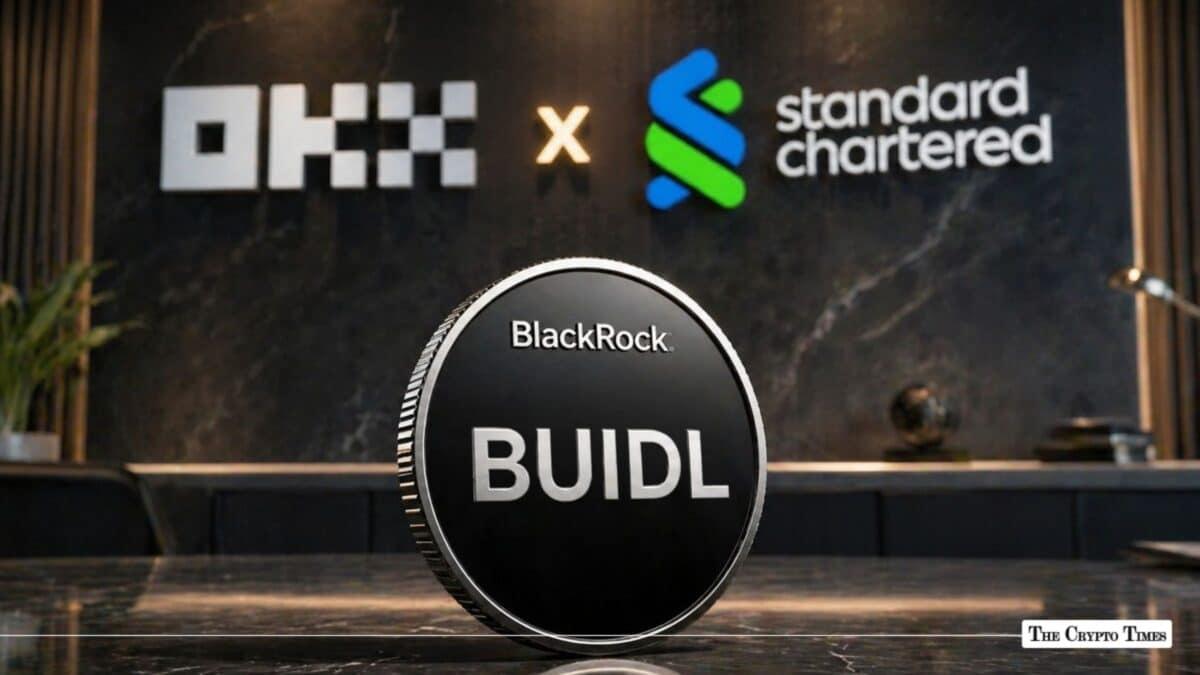
OKX has launched a joint framework with BlackRock and Standard Chartered that lets eligible institutional and VIP clients use BlackRock’s tokenized Treasury fund, BUIDL, as yield-bearing trading collateral on OKX.
“OKX adds BlackRock's tokenized Treasury fund to Standard Chartered custody program: Source: OKX”
The arrangement is described as integrating BUIDL into OKX’s collateral workflows while Standard Chartered provides off-exchange custody, with OKX managing “real-time margining and liquidation processes through its internal risk systems.”
In the OKX account, the framework is “now live for eligible institutional and VIP clients through OKX Middle East,” and OKX says it is “the only global digital asset exchange” to establish this type of setup.
The structure is built around BUIDL being “tokenized by Securitize” and investing in “cash, US Treasury bills and repos,” with “yield distributed onchain.”
Standard Chartered is positioned as the “off-exchange custodian,” holding client collateral separately from OKX’s own assets, while OKX handles the trading-side mechanics.
Bloomberg frames the same core idea as traders being able to “post it as margin while it keeps earning interest instead of sitting idle.”
Across the coverage, the integration is repeatedly tied to the claim that it turns idle exchange collateral into a productive asset rather than leaving it unused.
Custody, Margining, and Yield
The framework’s mechanics are described in detail as a split between custody and trading operations, with Standard Chartered holding collateral and OKX running the margin and liquidation logic.
Cointelegraph quotes OKX’s Mahasneh describing the setup as combining “regulated custody, a major asset manager and a G-SIB partner,” and it says OKX is “the only global digital asset exchange” to establish this type of framework.C

In the same account, Mahasneh says Standard Chartered serves as the “off-exchange custodian,” holding client collateral separately from OKX's own assets, while OKX “manages real-time margining and liquidation processes through its internal risk systems.”
The Marketscreener release adds that the framework enables OKX clients to hold collateral in “regulated, off exchange custody while trading on the same integrated venue,” and it emphasizes that OKX clients can post BUIDL “held off-exchange in regulated custody at Standard Chartered, while trading seamlessly on OKX Middle East.”
It also states that BUIDL can be “deposited and traded on-exchange,” and that it can be used as “yield-bearing collateral for margin trading.”
Bloomberg’s description aligns with this, saying the tokens “sit in regulated custody at Standard Chartered while showing up as available collateral on OKX,” so traders can post it as margin while it keeps earning interest.
The deepdive.ca account further characterizes the product as allowing “two collateral paths,” including an off-exchange path where “assets remain in Standard Chartered custody” and an on-exchange path where BUIDL is “held directly on OKX as yield-bearing margin.”
What BUIDL Is
Across the reporting, BUIDL is consistently described as a tokenized money-market instrument tied to short-term U.S. Treasury exposure, with yield distributed on-chain.
“tokenized by Securitize”
The Cointelegraph piece says BlackRock's BUIDL fund is “tokenized by Securitize” and “invests in cash, US Treasury bills and repos, with yield distributed onchain.”C
Marketscreener similarly states that “BlackRock's BUIDL is issued on a public blockchain and invests in cash, US Treasury bills, and repurchase agreements, with yield distributed on-chain.”
Thedeepdive.ca and crypto.news both describe BUIDL as investing in “cash, US Treasury bills, and repurchase agreements” and as being “designed to maintain a stable $1 net asset value.”T
The Crypto Times adds that BUIDL is “tokenized by Securitize” and “invests in U.S. Treasuries and repurchase agreements and is designed to maintain a stable $1 net asset value,” and it reiterates that the token is usable as margin while continuing to earn the underlying Treasury yield.
The Marketscreener release also frames BUIDL as “yield-bearing collateral for margin trading,” and it says the framework “enables OKX VIP and institutional clients” to post BUIDL as collateral held off-exchange.
In the Cointelegraph account, Mahasneh describes the structure as aligning with “traditional finance standards,” though it does not provide stress-period margin call procedures.C
Institutional and Regional Rollout
The sources describe the launch as geographically constrained at first, with OKX saying the framework is live through OKX Middle East and with other coverage emphasizing that access is restricted to investors in the Middle East.
Cointelegraph says the framework is “now live for eligible institutional and VIP clients through OKX Middle East,” and it adds that OKX has “plans to expand based on jurisdiction and demand.”C
The Marketscreener release states that the framework enables OKX VIP and institutional clients to post BUIDL “while trading seamlessly on OKX Middle East,” and it describes the integrated model as eliminating “the need to move assets between venues.”
The Crypto Times similarly says “Access at launch is restricted to investors in the Middle East,” and it describes the integration as running through OKX and Standard Chartered’s collateral-mirroring program under the Dubai Virtual Asset Regulatory Authority (VARA) framework.
That same Crypto Times account says the pilot “named Franklin Templeton’s tokenized money-market fund—better known as BENJI” as the inaugural admitted asset and says the partners signaled BENJI would be “the first in a series” of tokenized money-market funds offered through the framework.
It also claims geographic expansion later, saying the partners “extended the framework to the European Economic Area in October 2025” after OKX secured its MiCA license, and it says Standard Chartered and OKX had “accumulated over $100 million in assets under custody” as of that EEA expansion.
In the background of the institutional push, thedeepdive.ca also recalls that in March 2023 OKX said it would turn over about $157 million in frozen assets tied to FTX and Alameda Research after a motion in the FTX bankruptcy proceedings.T
Competing Narratives and Risks
While the core product description is consistent, the sources differ in emphasis—particularly around how the integration fits into broader market infrastructure and what risks or critiques accompany it.
“In April, the International Monetary Fund warned that moving trading infrastructure onto blockchain-based systems could accelerate financial crises beyond regulators’ ability to respond.”
Thedeepdive.ca says “In April, the International Monetary Fund warned that moving trading infrastructure onto blockchain-based systems could accelerate financial crises beyond regulators’ ability to respond.”T
crypto.news adds that OKX’s role “carries historical baggage from the industry’s last major exchange failure,” and it recounts that “In March 2023, OKX said it would turn over about $157 million in frozen assets tied to FTX and Alameda Research.”
At the same time, the Marketscreener release and Cointelegraph emphasize alignment with traditional finance standards and protection through segregation of collateral, with Marketscreener stating “BUIDL safeguarded by Standard Chartered” so “OKX clients obtain trading collateral segregated from OKX's assets.”
Cointelegraph also says Mahasneh described the structure as “unique in combining regulated custody, a major asset manager and a G-SIB partner,” and it adds that he “did not detail margin call procedures during market stress.”C
The Crypto Times frames the integration as addressing “one of crypto’s longest-standing capital-efficiency drags,” describing how “Cash and stablecoins posted as collateral on exchanges have historically earned virtually nothing,” and it contrasts that with BUIDL’s Treasury yield.
Bloomberg’s framing is more straightforward about the convergence of Wall Street infrastructure and digital-asset markets, describing the move as “the latest sign that Wall Street infrastructure and digital-asset markets are converging.”