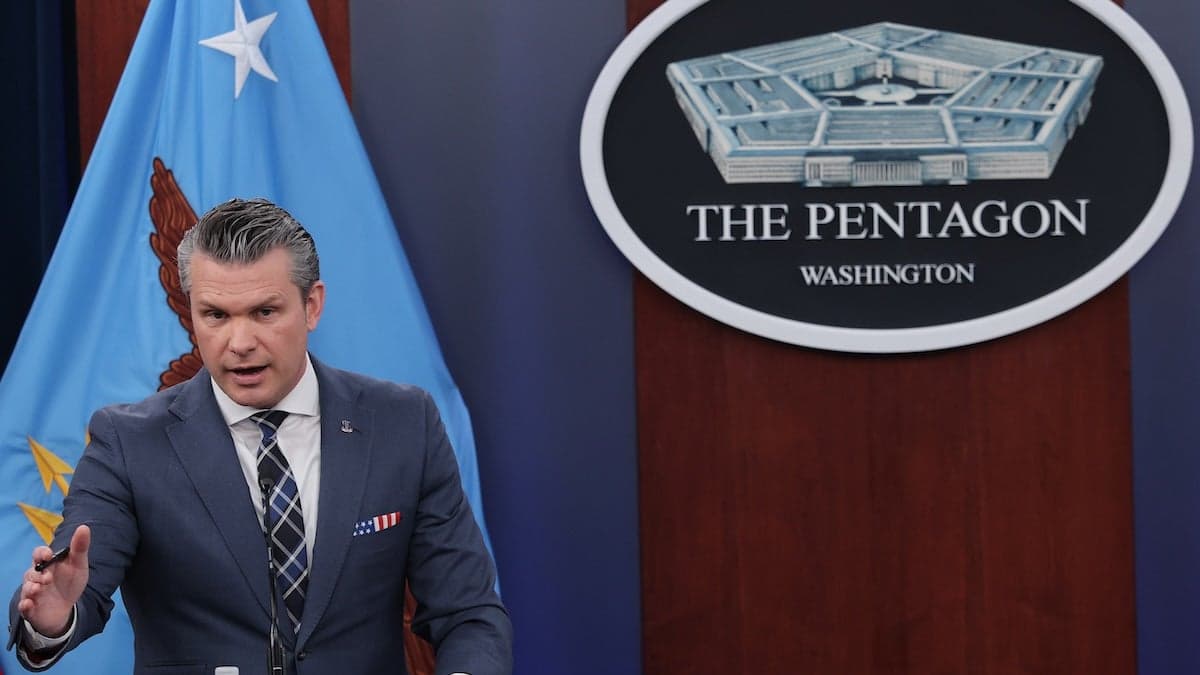
Pentagon Revises Media Access Policy in Response to Court Order
Key Takeaways
- Judge Paul Friedman ruled Pentagon press restrictions unconstitutional, reinstating New York Times credentials.
- Pentagon closes media offices, relocates reporters to external annex outside the Pentagon.
- Policy changes follow court order; department intends to appeal the ruling.
Court Ruling and Pentagon Response
The Pentagon has revised its media access policy in response to a federal court ruling that found its previous restrictions unconstitutional.
“He said security concerns prompted restrictions on press access, a claim that journalists have rejected”
U.S. District Judge Paul Friedman ruled last week that the Defense Department's media policy violated the First and Fifth Amendments.

Friedman specifically noted that the policy was designed to weed out 'disfavored journalists' and replace them with those who are 'on board and willing to serve' the government.
In his 40-page ruling, Friedman emphasized that 'Those who drafted the First Amendment believed that the nation's security requires a free press and an informed people and that such security is endangered by governmental suppression of political speech.'
The Pentagon, through spokesperson Sean Parnell, announced it would comply with the court order while simultaneously appealing the decision.
Parnell stated that the Department 'always complies with court orders but disagrees with the decision and is pursuing an appeal.'
This legal battle represents a fundamental clash between the Trump administration's approach to media relations and established constitutional protections for press freedom.
New Policy Changes
The Pentagon's revised policy implements significant changes to journalist access that critics argue undermine the spirit of the court order while technically complying with its letter.
Under the new rules announced Monday by Sean Parnell, the long-standing 'Correspondents' Corridor' inside the Pentagon building has been shut down immediately with no replacement provided.
In its place, a new dedicated press workspace is being established outside the main building but still on Pentagon grounds, though no timeline was given for when this annex facility will be available.
Most critically, all journalists seeking access to the Pentagon will now be required to be accompanied by authorized Defense Department personnel at all times, effectively eliminating unescorted access.
Parnell claimed these changes were necessary due to 'security considerations' and that 'unescorted access to the Pentagon cannot be responsibly maintained without the ability to screen credential holders for security risks.'
The policy maintains strict limits on access while offering journalists the ability to participate in press conferences and interviews arranged through the department's public affairs team, though even these events would require escort.
News Organization Reactions
News organizations and press freedom advocates have reacted with alarm to the Pentagon's revised policy, arguing that it represents a continued assault on press freedom despite the court ruling.
“Skip to main content 2 hours ago - Business Press groups denounce Pentagon's new media rules Rebecca Falconer email (opens in new window) sms (opens in new window) facebook (opens in new window) twitter (opens in new window) linkedin (opens in new window) bluesky (opens in new window) Add Axios as your preferred source to see more of our stories on Google”
The New York Times, which successfully sued the Pentagon over the original policy, immediately condemned the changes as non-compliant with Judge Friedman's order.
A spokesperson stated: 'The new policy does not comply with the judge's order. It continues to impose unconstitutional restrictions on the press. We will be going back to court.'
The Pentagon Press Association, representing about 100 journalists who regularly cover the U.S. military, called the changes 'a clear violation of the letter and spirit of last week's ruling.'
The association questioned why the Pentagon would restrict 'vital press freedoms that help inform all Americans' at such a critical time.
Critics note that the current Pentagon press corps is now composed largely of far-right media outlets that agreed to the restrictive policy.
Mainstream outlets that refused to comply have continued reporting from outside the building.
Many journalists surrendered their credentials last October rather than accept the Pentagon's requirements, which included pledging to only publish information from Pentagon-sanctioned statements.
Broader Media Strategy
The Pentagon media access battle is part of a broader pattern of the Trump administration's efforts to control and limit media access to government institutions and officials.
This episode represents the continuation of a strategy that began last October when Defense Secretary Pete Hegseth implemented new credentialing policies that challenged journalists' ability to freely gather information.

The administration has systematically replaced independent reporters with hyper-partisan pro-Trump media personalities.
This approach has included inviting figures like conspiracy theorist Laura Loomer and former Florida Rep. Matt Gaetz to fill out the new press room.
This mirrors the administration's broader media strategy, which has included President Trump demanding on Truth Social that some media outlets should 'be brought up on Charges for TREASON' for their coverage of the war with Iran.
Trump has called on the FCC to investigate and punish purported offenders, including by stripping networks of their licenses.
The administration has also attempted to ban reporters from outlets it dislikes from the White House or Air Force One.
These efforts to control media access come amid the U.S. ongoing war with Iran, recent incursion into Venezuela, and military operations across the Middle East, Africa, and Latin America.
Legal Analysis
Legal experts analyzing the case have identified multiple constitutional flaws in the Pentagon's original policy that led to Judge Friedman's ruling.
“The new policy is the latest dispute over press access during President Trump's administration, which has limited legacy media while boosting conservative outlets”
The court found three primary constitutional violations in the Pentagon's policy.

First, the policy was unconstitutionally vague, with the central standard of whether a journalist posed a 'security or safety risk' not being defined with sufficient clarity.
This vagueness left journalists unable to determine what conduct could result in the loss of credentials.
Second, the court determined the policy operated in a viewpoint-discriminatory manner, favoring certain editorial perspectives over others despite being framed in neutral terms.
The evidentiary record showed the policy was implemented in a way that risked favoring alternative outlets while criticizing 'mainstream media.'
Third, the court held that the policy vested officials with excessive and effectively unconstrained discretion.
The policy relied on non-mandatory language and a case-by-case 'totality of the circumstances' approach that meant similar conduct could be treated differently without objective standards.
Press Freedom Implications
The Pentagon's media access restrictions have significant implications for press freedom and public accountability, particularly during a time of multiple military conflicts.
Judge Friedman emphasized in his ruling that robust press coverage of the Pentagon is particularly important during tense international moments.
Friedman noted that such coverage allows 'the public can support government policies, if it wants to support them; protest, if it wants to protest; and decide based on full, complete, and open information who they are going to vote for in the next election.'
Critics argue that moving journalists outside the main Pentagon building and requiring escorts severely limits their ability to gather timely information.
This limitation affects their ability to maintain regular contact with military officials, which has been essential for decades of Pentagon coverage.
The current situation creates a two-tiered press system where conservative outlets that agreed to the Pentagon's restrictions have maintained access.
Meanwhile, mainstream outlets that refused to comply are relegated to covering from outside.
This dynamic raises concerns about the quality and diversity of information reaching the public about military operations during ongoing conflicts.
More on USA

Trump Delays Strikes on Iranian Energy Infrastructure Amid Talks With Iran.
43 sources compared

Senate confirms Markwayne Mullin as Homeland Security secretary
13 sources compared

Supreme Court appears poised to limit late-arriving mail-in ballots.
23 sources compared
US Senate confirms Mullin as Secretary of the Department of Homeland Security
24 sources compared