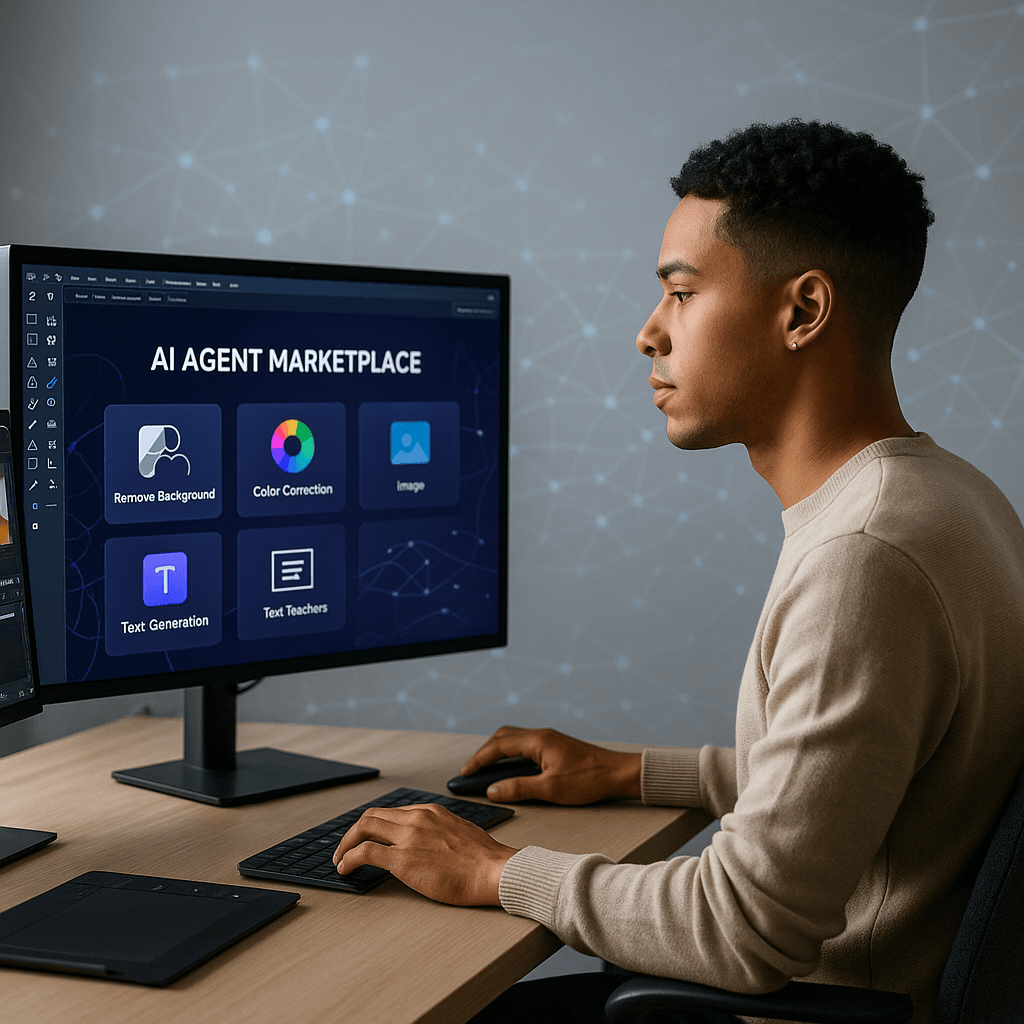
Picsart Launches AI Agent Marketplace for Creators
Key Takeaways
- Creators can hire AI assistants for resizing, remixing content, and product photo editing.
- Launched with four initial agents, with weekly new agents rollout.
- Global user base exceeds 130 million, skewed toward Gen Z.
Marketplace Launch Overview
Picsart has launched an innovative AI agent marketplace that allows creators to hire specialized digital assistants to handle their creative workflows.
“In a strategic move to redefine creative workflows, the AI-powered design platform Picsart has launched a groundbreaking marketplace where creators can now hire specialized AI assistants”
This represents a significant shift in how content creators interact with technology, moving from manual operation to strategic direction.
The marketplace introduces agentic AI to the consumer creative space, beyond simple AI tools to autonomous assistants that can execute complex tasks.
This development comes as demand surges for AI systems capable of autonomous task execution.
While companies like OpenAI and Microsoft focus on enterprise applications, Picsart targets individual creators and small businesses.
The platform's mobile-first approach and marketplace model allow different specialized agents to tackle specific creative tasks.
This creates an ecosystem where creators can hire digital assistants that never sleep and don't charge by the hour.
Specialized Agent Functions
The marketplace will launch with four specialized AI agents, each designed to handle specific creative tasks with autonomous capabilities.
Flair integrates with Shopify to assist online store owners by analyzing market trends and suggesting improvements for their shops.
Resize Pro uses generative AI to intelligently resize images and videos for optimal dimensions across platforms.
The Remix agent allows creators to apply consistent visual themes across entire photo libraries with single descriptive commands.
Swap enables users to change backgrounds of multiple photos in bulk, saving hours of manual editing work.
Picsart plans to introduce more specialized agents on a weekly basis.
This continuously expands the capabilities available to creators through their marketplace ecosystem.
Messaging Platform Integration
A key innovation of Picsart's AI agent marketplace is its integration with popular messaging platforms like WhatsApp and Telegram.
“Picsart is launching an AI agent marketplace that allows creators to hire AI assistants for tasks including content resizing, photo remixing, and product image editing”
This allows creators to interact with their AI assistants asynchronously from anywhere.
This strategic integration enables users to manage their AI assistants directly within apps they already use daily.
For agents that work behind the scenes like Flair, users can chat with them through these messaging apps.
This brings the conversation into spaces creators already inhabit—whether at a desk or on the subway.
The choice of WhatsApp and Telegram is deliberate, as their APIs currently support robust business chatbot functionalities.
Picsart's integration scope is expected to broaden as more messaging apps develop similar tools.
Safety and Pricing Model
Picsart has implemented robust safety measures to address the well-documented risks associated with large language models and autonomous AI systems.
The platform allows users to set configurable 'autonomy levels' for each agent, including a mode that requires explicit creator approval before any action is taken.
This addresses growing concerns around agentic AI where LLM-based systems can hallucinate or take unintended actions.
Picsart's agents present a lower security risk than more public-facing systems.
They operate within the creator's own authenticated environment rather than interacting directly with the open internet.
This architectural decision prioritizes safety for business users while still providing powerful automation capabilities.
The pricing model follows a freemium approach, with premium subscriptions starting at approximately $10 per month.
Strategic Vision and Impact
The introduction of Picsart's AI agent marketplace represents a fundamental evolution in creative software.
“Picsart is adding a new arsenal of artificial intelligence to its currently growing platform”
It transitions from a suite of tools to an ecosystem of intelligent assistants.

Founder and CEO Hovhannes Avoyan envisions this as a paradigm shift that changes the creator's role.
This approach taps into the broader trend of 'AI-as-a-service' and specialized digital labor.
It reflects a maturation of AI applications from novelty to operational efficiency.
For small business owners and solo creators, this level of support was previously cost-prohibitive.
The launch positions Picsart at the forefront of the practical, agentic AI revolution within the creator economy.
More on Technology and Science

Facebook launches Creator Fast Track, guaranteeing up to $3,000 monthly for three months.
10 sources compared

Meningitis B outbreak in Kent triggers vaccination of about 5,000 University of Kent students
32 sources compared

Nintendo Switch 2 Enables Original Switch Games to Run at 1080p in Handheld Mode
11 sources compared

Argentina Exits WHO Under President Javier Milei
23 sources compared