
Pope Leo XIV Defuses Tensions With Donald Trump During Africa Tour
Key Takeaways
- Pope Leo says he is not interested in debating Trump during Africa trip.
- Pope aims to defuse tensions with Trump during Africa tour, not escalate.
- Media misinterpret remarks as criticism of Trump; pope says remarks were not directed at him.
Pope and Trump Clash
Pope Leo XIV sought to defuse tensions with U.S. President Donald Trump while on his Africa tour, insisting he was “not trying to debate him” and saying reporting about his comments “has not been accurate in all its aspects.”
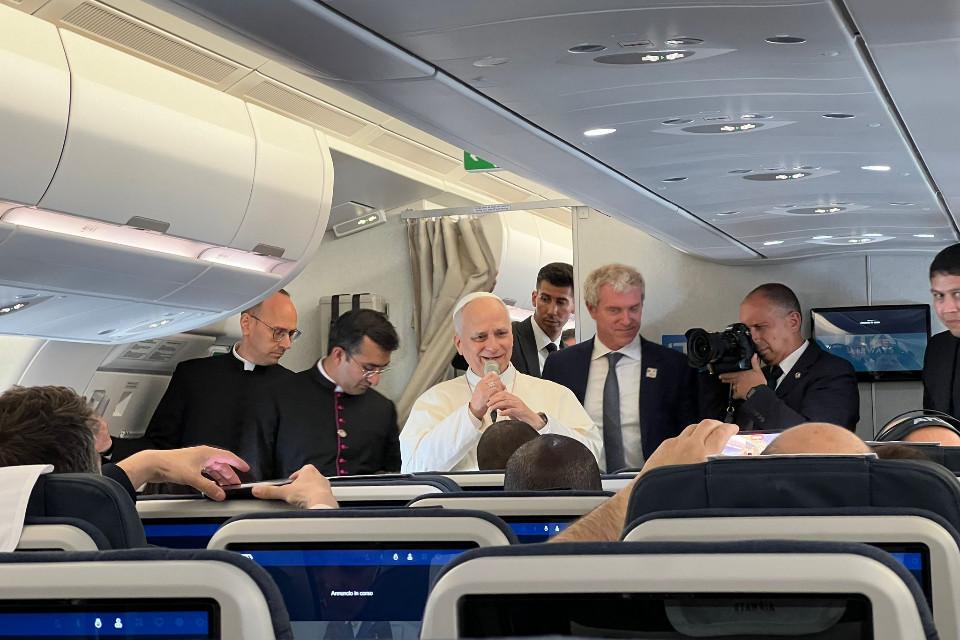
Speaking to reporters in English aboard his flight to Angola for the third leg of his “ambitious 10-day Africa tour,” the pontiff clarified that remarks he made two days earlier in Cameroon were not aimed at Trump.

Leo said the Cameroon speech decrying that the world was being “ravaged by a handful of tyrants” “was prepared two weeks ago, well before the president ever commented on myself and on the message of peace that I am promoting”.
The dispute intensified after Trump called Leo “WEAK on Crime, and terrible for Foreign Policy” in a social media post, and Trump also posted an AI-generated image of himself as a Jesus-like figure.
Vice-President J.D. Vance welcomed Leo’s clarification, posting, “I am grateful to Pope Leo for saying this,” and adding that “the reality is often much more complicated.”
The confrontation has been framed by multiple outlets as a widening clash over war, peace, and church doctrine, with the pope and Trump taking their differences to “spectacular new rhetorical heights.”
Vance’s Olive Branch
Vice-President J.D. Vance praised Pope Leo XIV for “dialing down tensions” after a week of “back-and-forth sparring” with President Donald Trump over the Iran war.
In a post on X, Vance said he was “grateful” for Leo making clear that it’s “not in my interest at all” to debate Trump, after warning earlier this month that God doesn’t hear the prayers of war-waging leaders with “hands full of blood.”
Vance’s message emphasized that the pope’s moral commentary should not be treated as a political contest, writing, “Pope Leo preaches the gospel, as he should, and that will inevitably mean he offers his opinions on the moral issues of the day.”
He added, “The President – and the entire administration – work to apply those moral principles in a messy world,” and concluded, “He will be in our prayers, and I hope that we’ll be in his.”
The New York Post described Vance’s olive branch as coming after Leo spoke on the papal plane during his “11-day tour of Africa,” where Leo said “There’s been a certain narrative that has not been accurate in all of its aspects.”
Leo told reporters that “Much of what has been written since then has been more commentary on commentary,” and he said it was “looked at as if I was trying to debate again the president, which is not in my interest at all.”
The Washington Examiner similarly reported that Vance responded on Saturday night by posting, “While the media narrative constantly gins up conflict — and yes, real disagreements have happened and will happen — the reality is often much more complicated.”
War, Theology, and Media
Multiple outlets tied the feud to the pope’s criticism of the Iran war and his broader statements about how religion is used in conflict.
The New York Post said the “squabble exploded last month when Leo branded the Iran conflict “atrocious” and declared Jesus cannot be used to justify any wars,” and it added that he previously said “delusion of omnipotence” was fueling the war.
The South China Morning Post reported that Leo’s Cameroon comments decried that the world was being “ravaged by a handful of tyrants,” and it said Trump’s rebukes and social media attacks followed, including a post on Truth Social and an AI-generated Jesus-like image.
The Türkiye Today report said Leo’s remarks on Thursday criticized leaders who spend billions on wars and said the world was “being ravaged by a handful of tyrants” during his tour of African countries, while Trump was not mentioned.
The USA Today piece described the dispute as “about far more than an argument about deep-dish versus thin-crust pizza,” and it said it has “sparked strong backlash from religious leaders” and from “Trump’s conservative and Christian MAGA supporters and former allies.”
USA Today also described the pope as “the quiet and scholarly Chicago-born pope” and said Leo has been a vocal critic of Trump’s war in Iran while appearing to take direct aim at the American president and his inner circle, including Vance and Pete Hegseth.
In the New York Times account, the dispute “has inflamed Republican tensions,” with conservative media figures quarreling over Leo’s leadership and with midterm candidates rebuking Trump, including Fox News host Sean Hannity saying Leo was “seemingly more interested in spreading left-wing politics than the actual teachings of Jesus Christ.”
Coverage and Framing Differences
While the core narrative across outlets centers on Leo’s attempt to downplay a direct confrontation with Trump, the emphasis varies in how each publication frames the dispute’s origin and meaning.
South China Morning Post focuses on Leo’s clarification that his Cameroon remarks were not aimed at Trump, quoting that the speech “was prepared two weeks ago, well before the president ever commented on myself and on the message of peace that I am promoting,” and it highlights Vance’s response that “the media narrative constantly gins up conflict.”

Türkiye Today similarly centers the pope’s statement that “it was looked at as if I was trying to debate the president, which is not in my interest at all,” and it adds that Trump repeatedly attacked Leo and accused him of supporting Iran’s push to secure a nuclear weapon.
The Washington Examiner also stresses the “inaccurate media ‘narrative’” and repeats Leo’s claim that the “world is being ravaged by a handful of tyrants” remark was written “two weeks ago,” while it adds that Vance warned Leo to “be careful” when discussing theology.
USA Today, by contrast, places the feud within a broader political and religious context, saying it has “sparked strong backlash from religious leaders” and potentially worsened “an already difficult 2026 election cycle for congressional Republicans,” while it describes Leo’s rhetorical approach as “fostering the same contrast” between secular and religious worlds.
The New York Times frames the dispute as deepening divisions on the right, describing conservative media figures quarreling over Leo’s leadership and quoting Hannity’s claim that Leo was “twisting religion to specifically attack only President Trump.”
Even within the same set of facts, the outlets differ in what they foreground: the New York Post emphasizes Vance’s “olive branch” and Leo’s “not in my interest at all” line, while the South China Morning Post foregrounds the AI-generated Jesus-like image and the pope’s insistence that the “reporting” was “not accurate in all its aspects.”
What Comes Next
The sources portray the dispute as continuing to reverberate through U.S. politics and conservative media even as Leo tries to lower the temperature.
The New York Times says the showdown continued to consume conservative media “Days after Mr. Trump first lashed out at the pope,” and it describes Trump renewing attacks on Friday morning while suggesting on social media that he should rank conservative commentators on a “list of good, bad, and somewhere in the middle.”

It also reports that Trump excoriated Hannity over Hannity’s comments about the war, and it quotes Hannity’s earlier criticism that Leo was “seemingly more interested in spreading left-wing politics than the actual teachings of Jesus Christ.”
USA Today adds that the feud has included a warning from Vance to Leo to “be careful when he talks about matters of theology,” and it says Leo spent “almost five decades” as a priest, missionary, and cardinal before being elected pontiff in May last year.
USA Today also describes a separate flashpoint involving the Vatican and the Pentagon, saying that on April 6 the Free Press reported that in January U.S. defense officials summoned Cardinal Christophe Pierre to the Pentagon for a “bitter lecture” that amounted to a threat to back the White House amid Leo’s perceived criticism.
In response, the Vatican press office statement said, “The narrative offered by some media outlets about this meeting is completely untrue,” and the Pentagon spokesperson said the story was exaggerated and that the meeting was a “respectful and reasonable discussion. We have nothing but the highest regard and welcome continued dialogue with the Holy See.”
Even the more direct conflict narrative includes a continuing thread: the South China Morning Post notes that Trump’s AI-generated Jesus-like image drew criticism even from some religious conservatives who typically support him, while the Washington Examiner says Leo “vowed to continue to preach the gospel.”
More on USA

7th Circuit Upholds Illinois Protect Illinois Communities Act Ban on Semiautomatic Guns
12 sources compared
Indiana State Police Trooper Justin Heflin Shot During Pursuit; Suspect Kevin W. Meyers Found Dead
10 sources compared

Donald Trump Fires Election Assistance Commission Members, Leaving No Commissioners
12 sources compared

Eight Accused Of Planning Terror Attack At Casa Blanca UFC Freedom 250 Event
18 sources compared