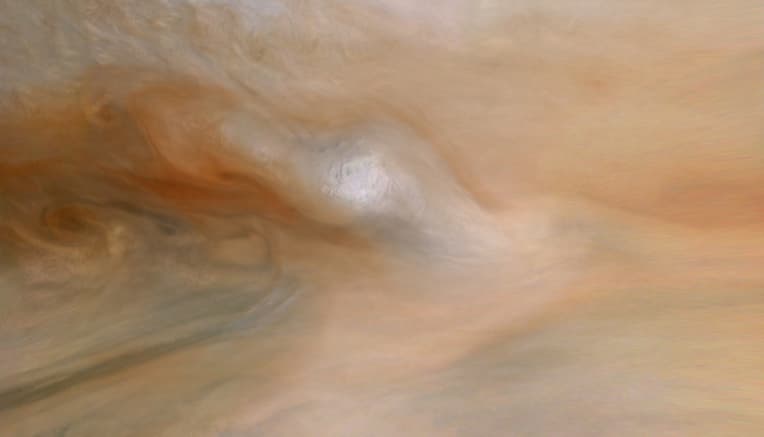
Researchers find Jupiter's lightning more than 100 times Earth's power.
Key Takeaways
- Jupiter lightning is at least 100 times more powerful than Earth's.
- Jupiter's storms are enormous, producing massive lightning.
- Some storms endure for centuries.
Discovery Announcement
Scientists have made groundbreaking discoveries about Jupiter's lightning through NASA's Juno spacecraft.
“Jupiter’s colossal storms generate lightning flashes at least 100 times more powerful than those on Earth, according to scientists analyzing data from NASA’s Juno spacecraft”
The gas giant's lightning bolts are at least 100 times more powerful than those on Earth and potentially much stronger.
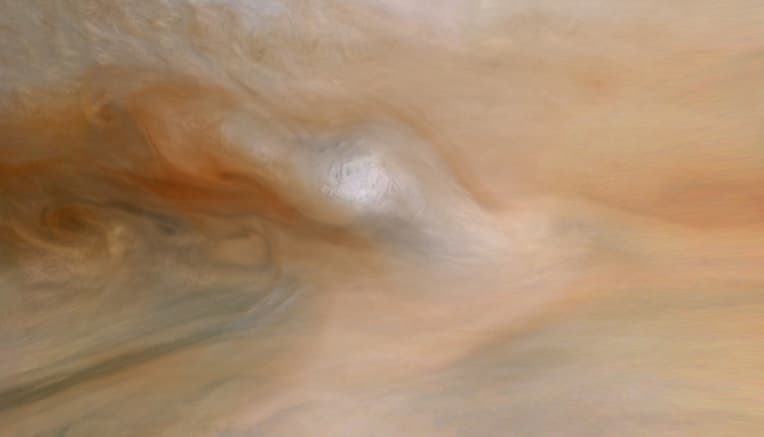
The research team, led by planetary scientist Michael Wong at UC Berkeley's Space Sciences Laboratory, analyzed data collected between 2016 and 2020.
Juno made 12 passes over isolated storms during that period, finding that Jupiter's lightning generates microwave static that can be detected and measured.
Wong explained that 'We're directly measuring the power,' as the spacecraft gathered this revolutionary data.
This discovery challenges our understanding of atmospheric electrical phenomena and provides valuable insights into how storms function across different planetary environments.
Power Measurements
The measurements collected by Juno reveal astonishing power levels in Jupiter's lightning.
During the spacecraft's close encounters with storms, scientists detected an average of three lightning flashes per second.
One particularly intense flyover revealed 206 separate pulses of microwave radiation.
Wong calculated that of the 613 total pulses measured, the power ranged from approximately that of an Earth lightning bolt to 100 or more times greater.
Because the comparison involved different radio wavelengths, there's inherent uncertainty in the direct power assessment.
According to Wong's estimates based on one study of Earth's lightning radio emissions, Jupiter's bolts could potentially be a million times more powerful than terrestrial lightning.
Co-author Ivana Kolmašová, a space physicist at Charles University in Prague, noted that translating microwave power into total energy is complex since lightning generates thermal, acoustic, and chemical energy in addition to radio and optical emissions.
Energy Comparison
The total energy released by Jupiter's lightning dwarfs that of Earth's atmospheric electrical discharges.
“Lightning bolts on Jupiter pack more than 100 times the power of Earth’s flashes Larger, more powerful storms on Jupiter produce stronger lightning than on Earth”
On Earth, a single lightning bolt is estimated to release about 1 gigaJoule of total energy - enough to power 200 average homes for an hour.
In contrast, Wong estimates that the energy in a Jupiter bolt ranges up to 500 and potentially as much as 10,000 times that of an Earth bolt.
This represents a tremendous release of electrical energy in Jupiter's atmosphere, suggesting much higher voltages between cloud formations compared to Earth.
The Juno spacecraft's microwave radiometer, which can detect radio emissions from lightning similar to the radio interference created by lightning on Earth, has been crucial in making these measurements.
The findings were formally published March 20 in the journal AGU Advances, marking a significant contribution to our understanding of atmospheric electrical phenomena across different planetary environments.
Formation Mechanisms
While Jupiter's lightning is generated through similar fundamental processes as Earth's thunderstorms, there are key atmospheric differences that contribute to its extraordinary power.
On Earth, lightning forms when rising water vapor condenses into liquid droplets and ice crystals that become electrically charged, creating large voltage differences between clouds or between clouds and the ground.
This process explains why Earth's thunderstorms are associated with hail formation.
Jupiter's atmosphere operates differently - while water vapor still fuels the rise of storm clouds into the upper atmosphere, the charged ice crystals are composed of both water and ammonia.
One prevailing theory suggests that water and ammonia combine to form 'mushballs' that fall through the atmosphere like slushy hail.
This unique composition and structure may contribute significantly to the enhanced electrical activity observed by the Juno spacecraft.
Unanswered Questions
Despite the significant findings, researchers acknowledge that many questions remain about why Jupiter's lightning is so much more powerful than Earth's.
“Jupiter, the most massive planet in our solar system, has correspondingly humongous storms, some of which last for centuries”
Wong and his colleagues are actively exploring several potential factors that could contribute to this phenomenon.
Jupiter's storms are dramatically taller than Earth's - exceeding 100 kilometers in height compared to just 10 kilometers for terrestrial thunderstorms.
This greater vertical distance could create larger voltage differences between cloud layers.
Wong also questions whether the key difference lies in the atmospheric composition - hydrogen versus nitrogen - or whether the greater energy is available because moist convection on Jupiter requires a bigger buildup of heat before storms can generate lightning.
'This is where the details start to get exciting, where you can ask, 'Could the key difference be hydrogen versus nitrogen atmospheres, or could it be that the storms are taller on Jupiter and so there's greater distances involved?' he said.
'Or could it be that greater energy is available because with moist convection on Jupiter, you have a bigger buildup of heat needed before you can generate the storm to create lightning?'
The research team includes members from UC Berkeley, the Czech Republic, and Japan, representing a collaborative international effort to unravel this planetary mystery.
More on Other

Iranian Missiles Strike Israel; Officials Report 180 Injured Amid Conflicting Casualty Figures.
12 sources compared

Israel Bans Eid Prayers at Al-Aqsa Mosque in Occupied East Jerusalem.
10 sources compared

Iran triggers Strait of Hormuz closure, disrupting India's LPG market and destabilizing energy supplies.
14 sources compared

Cuban Border Guards Shoot Dead Occupants of Florida-Registered Speedboat; Reports Vary on Death Toll
73 sources compared