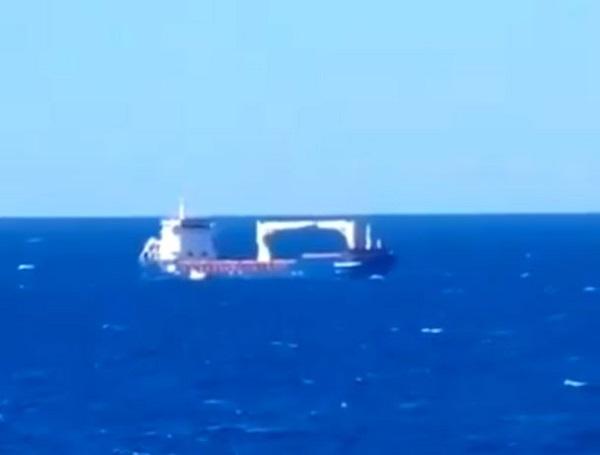
Russian Cargo Ship Ursa Major Sinks in Mediterranean After Explosions, Spanish Probe Says
Key Takeaways
- Ursa Major sank in the Mediterranean in December 2024 after explosions.
- Investigations found two nuclear reactors for submarine propulsion aboard Ursa Major bound for North Korea.
- Investigations tie Ursa Major to Russia's ghost/shadow fleet operations.
Ursa Major sinks
A Russian cargo ship, the Ursa Major, sank in the Mediterranean under mysterious circumstances about 60 miles off the coast of Spain, after a series of explosions, according to CNN’s Nick Paton Walsh and a Spanish statement released on February 23.
“01:11 01:12 02:38 02:19 05:39 23:17 05:09 20 Minutes Published on December 31, 2025 at 3:15 PM A year ago, the Russian ship 'Ursa Major' sank in international waters of the Mediterranean Sea”
Spanish authorities said the ship’s Russian captain told investigators the Ursa Major was carrying “components for two nuclear reactors similar to those used in submarines,” and the captain said he was not aware whether the ship had been loaded with nuclear fuel.
The ship was officially en route from St. Petersburg to Vladivostok, departing on December 11, and Spanish investigators said it suffered three explosions on its starboard side on December 23, killing two crew members.
The remaining 14 crew members were evacuated on a lifeboat, and the incident occurred in December 2024, when the ship was part of Russia’s so-called “ghost fleet,” according to the reporting.
The Spanish investigation also tied the sinking to a possible clandestine transfer of nuclear equipment, with Le Figaro saying the vessel sank during the night of December 23–24, 2024, between Spain and Algeria.
Competing theories and blame
Spanish authorities and outlets citing their work described the cargo as VM-4SG nuclear reactors intended for North Korean submarines, while other details about the cause of the sinking remained unclear, including whether a Western submarine could have attacked the ship.
Le Figaro reported that Russian company Oboronloguistika stated it believes a targeted terrorist attack was carried out on December 23, 2024 against the Ursa Major, while La Verdad’s scenario described a supercavitating torpedo and a Western submarine preventing the reactors from reaching North Korea.

RFI said La Verdad suggested the ship was sunk by a submarine, possibly a NATO submersible, and it also quoted La Verdad’s account that a distress call was received at the Cartagena Rescue Center at 11:53 on December 23.
The same RFI report described how, on December 23 at 21:49, a Russian military vessel cruising through the area requested to take control of the rescue operation and ordered Spanish ships “Clara Campoamor” and the military patrol “Serviola” to move at least two miles away.
In parallel, Le Figaro said the Russian Foreign Ministry stated the sinking occurred after an explosion in its engine room, while the ship’s captain described a hole about 50 cm in the hull with edges turned inward.
What’s at stake next
The Spanish investigation described the Ursa Major’s real destination as the North Korean port of Rason rather than Vladivostok, and it said the Liebherr cranes aboard would have enabled unloading the reactors at Rason.
“Spanish investigations into the sinking of Ursa Major outline a scenario that goes beyond a simple maritime accident”
Le Parisien linked the shipment to a broader exchange, saying Vladimir Putin and Kim Jong Un agreed on mutual assistance based on sending soldiers and weapons in exchange for nuclear technology, and it cited that 10,000 North Korean soldiers were sent to the Ukrainian front, notably in the Russian Kursk region in 2024.
Zone Militaire said the investigation pointed to undeclared containers and two large packages each weighing 65 tons and measuring between 6 and 7 meters in length, identified as casings for two VM-4SG pressurized-water reactors.
The Russian oceanographic vessel Yantar went to the wreck site in January, and Zone Militaire said it remained there for five days under NATO’s maritime command, with Rear Admiral Alexander Konovalov aboard.
Formiche.net added that Spanish authorities suggested the presence of Russian military ships and deep-sea recovery capabilities fit a hybrid operation logic, and it quoted Pili saying that if the news were confirmed it would suggest “a convergence at the highest levels” in contravention of international regulations.
More on Russia

Iran-Linked Harakat Ashab al-Yamin al-Islamiya Claims Attacks on Jewish Sites Across Europe
10 sources compared
U.S. Navy USS Alaska Docks in Gibraltar as Trump Says Iran Ceasefire Is on Life Support
11 sources compared

EU Approves Sanctions On Israeli West Bank Settlers, Hamas Leaders After Hungary Drops Veto
23 sources compared
Medvedev Warns Germany Remilitarization Aims to Repeat June 22, 1941
10 sources compared