Other10 April, 20261 min read
Scientists Reclassify World's Oldest Octopus Fossil as Nautiloid from Illinois
This article is an automated aggregation of coverage from news outlets. Our editorials offer in-depth analysis curated by the NewsCord team.
Pohlsepia mazonensis reclassified as a nautiloid, not an octopus. Findings published in Proceedings of the Royal Society B.
Fossil Reclassification
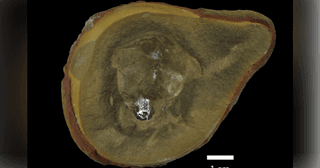
The fossil previously celebrated as the world's oldest octopus has been reclassified as a nautiloid. Thomas Clements explained that the fossil has long been the subject of scientific debate. The team discovered a radula with 11 teeth per row, whereas octopuses have either seven or nine.
The world's oldest octopus is actually a fossil nautilus, not an octopus. Guinness World Records said it will no longer list Pohlsepia as the earliest known octopus.
Scientific Debate and Technology
The original identification of Pohlsepia as an octopus in 2000 upended ideas about cephalopod evolution. The classification remained controversial. The breakthrough came with synchrotron imaging.
The discovery of the radula's tooth count was the key to reclassification. The fossil's decomposed state likely caused the loss of its shell before fossilization.
Implications for Evolution
The reclassification pushes the record of nautiloid soft tissue back by around 220 million years. The fossil's radula matched that of Paleocadmus pohli, an ancient nautiloid already known from the site. Pohlsepia was never a distinct species.
The Field Museum now has the oldest soft tissue nautilus in the world. The research demonstrates the power of new technologies to advance scientific understanding.
Reactions and Future Research
Guinness World Records called the discovery fascinating. Paul Mayer said he was a little surprised. The museum plans to continue studying the fossil and other specimens.
The reclassification highlights the importance of ongoing scientific scrutiny. Questions had persisted since 2000.
