
Storm System Triggers Tornado Threat, Delays Hundreds of Flights on East Coast
Key Takeaways
- Hundreds of East Coast flights delayed as storms moved through.
- Tornado advisories and risk extend along the East Coast from the system.
- A megastorm brings snow, high winds, and thunder across large swaths.
Storm System Overview
A powerful and complex storm system swept across the United States, creating a 'triple-threat March megastorm' that threatened nearly 200 million people across the country.
“Power outage threat increasing:Damaging winds, weakened trees and icing may combine to produce scattered, to locally significant outages”
The storm system emerged from the Rockies and strengthened across the Plains into the Great Lakes, combining Arctic air with warmer conditions.

AccuWeather expert meteorologists predicted the storm would rank among the most impactful US weather events of the year so far.
The system was characterized by dramatic temperature swings typical of meteorological spring, as explained by AccuWeather senior meteorologist Courtney Travis.
These fluctuations result from two fundamentally different air masses fighting for control while neither has a clear advantage.
Tornado Threats
The Mid-Atlantic region faced elevated threats of severe storms, including the potential for damaging winds and tornadoes.
Washington, Baltimore, Richmond, Virginia, and Raleigh and Wilmington in North Carolina were identified as areas of particular concern.
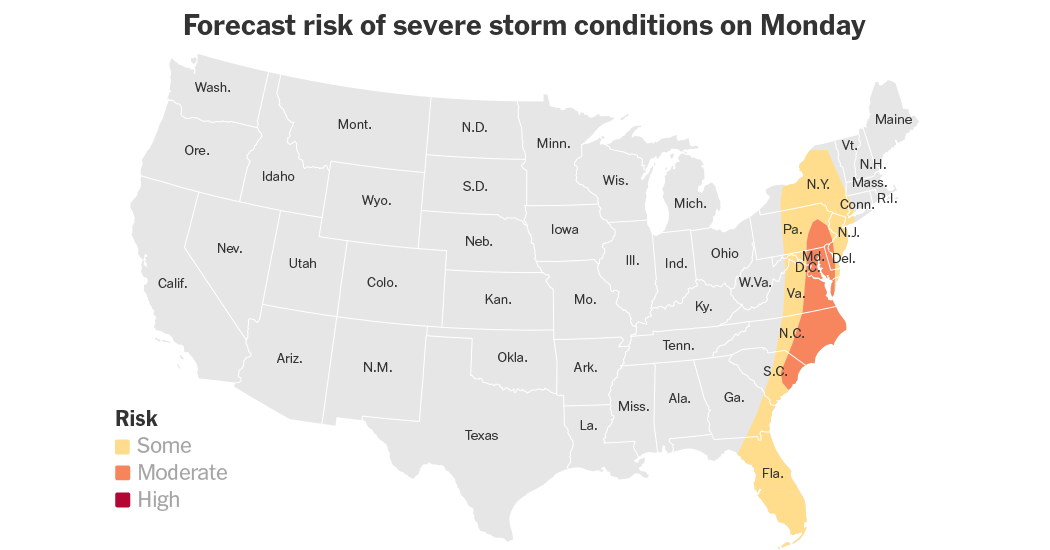
Meteorologists from the Storm Prediction Center warned that multiple rounds of severe storms could yield scattered to widespread damaging winds and a few strong tornadoes.
The National Weather Service issued a 'moderate' Level 4 out of 5 risk for thunderstorms across the East Coast, from Washington to northern South Carolina.
Washington Mayor Muriel Bowser urged residents to stay inside during the storm, warning it could take 'several days or longer to get back to normal' if significant damage occurred.
Travel Disruptions
The storm system caused significant travel disruptions across the eastern United States.
“Storms Advertisement Supported by Hundreds of flights were delayed as storms moved through”
More than 14,000 delayed and canceled flights were reported by early Monday evening according to FlightAware.
Airports along the East Coast experienced particular difficulties, with departures paused at times at Houston's George Bush Intercontinental Airport and Tampa International Airport.
Major travel disruptions were expected on multiple interstate highways including I-29, I-35, I-41, I-75, I-80, I-90, I-94 and I-96.
The storms also led to widespread school closures, with several school districts across Delaware, Maryland and Washington, D.C., announcing early dismissals.
Major tourist attractions in Washington, including the Smithsonian National Museum of Natural History, the National Zoo and the Washington National Cathedral, also announced early closures.
Regional Weather Impacts
While the East Coast faced tornado threats and severe thunderstorms, other regions experienced dramatically different weather conditions.
Heavy snow and blizzard conditions were forecast to expand from the Dakotas into Minnesota, Wisconsin and Michigan.

The heaviest totals of 1 to locally 3 feet were expected from near the Twin Cities through central and northern Wisconsin and much of the Upper Peninsula of Michigan.
Blizzard conditions were likely in parts of Wisconsin and Michigan as strong winds created near-zero visibility and dangerous travel.
In contrast, the Southwest was experiencing record-breaking heat, with temperatures expected to rise up to 109 degrees.
Meanwhile, Nebraska was combating multiple wildfires, with about 30 national guard members deployed to help fight fires that had damaged well over 900 square miles.
Infrastructure Damage
The storm system caused widespread power outages across multiple states.
“Severe weather, tornado risk as storms slam East Coast”
USA TODAY's Power Outage Tracker reported that approximately 360,000 people in the U.S. were without power early Monday evening.
Nearly a third of those affected, around 118,000, were in Michigan, where the northern half of the state was being hit with blizzard conditions.
AccuWeather meteorologists warned that damaging winds, weakened trees and icing could combine to produce scattered to locally significant power outages.
The combination of high winds and wet, heavy snow led to downed trees and damaged buildings, particularly in the Mississippi, Ohio and Tennessee valleys.
The storm system was also responsible for at least one tornado-related fatality reported in Arkansas on Sunday, as well as one wildfire-related fatality in Nebraska reported on Friday.
More on Technology and Science

Facebook launches Creator Fast Track, guaranteeing up to $3,000 monthly for three months.
10 sources compared

Meningitis B outbreak in Kent triggers vaccination of about 5,000 University of Kent students
32 sources compared

Nintendo Switch 2 Enables Original Switch Games to Run at 1080p in Handheld Mode
11 sources compared

Argentina Exits WHO Under President Javier Milei
23 sources compared