South America01 June, 20263 min read
Thousands Protest in Caracas Demanding Nicolas Maduro’s Release After American Airstrikes
This article is an automated aggregation of coverage from news outlets. Our editorials offer in-depth analysis curated by the NewsCord team.
Maduro captured after U.S. airstrikes; Caracas protesters demand his release. Delcy Rodríguez serves as interim president, steering government amid Maduro's absence.
Protests in Caracas
Thousands of protesters marched on Wednesday in Caracas to demand the release of President Nicolas Maduro, who was captured following American airstrikes, according to Anadolu Ajansı. The march was organized by the United Socialist Party of Venezuela (PSUV) and drew a large crowd brandishing photographs of Maduro and former President Hugo Chávez, with PSUV vice president in charge of mobilization Nahum Fernandez telling the crowd, "Unity is non-negotiable." Fernandez reiterated calls for Maduro's release and said, "We want Maduro to be freed and that Cilia return," referring to First Lady Cilia Flores.
In a separate development, PSUV secretary-general Diosdado Cabello announced that teachers would also take to the streets on Thursday on the occasion of Teacher's Day, and he said Venezuelans had been protesting since the first day of what he called an American military attack. The same Anadolu Ajansı report said dozens of motorcyclists formed convoys on the main arteries of Caracas to show their support for Maduro.

Delcy Rodríguez’s response
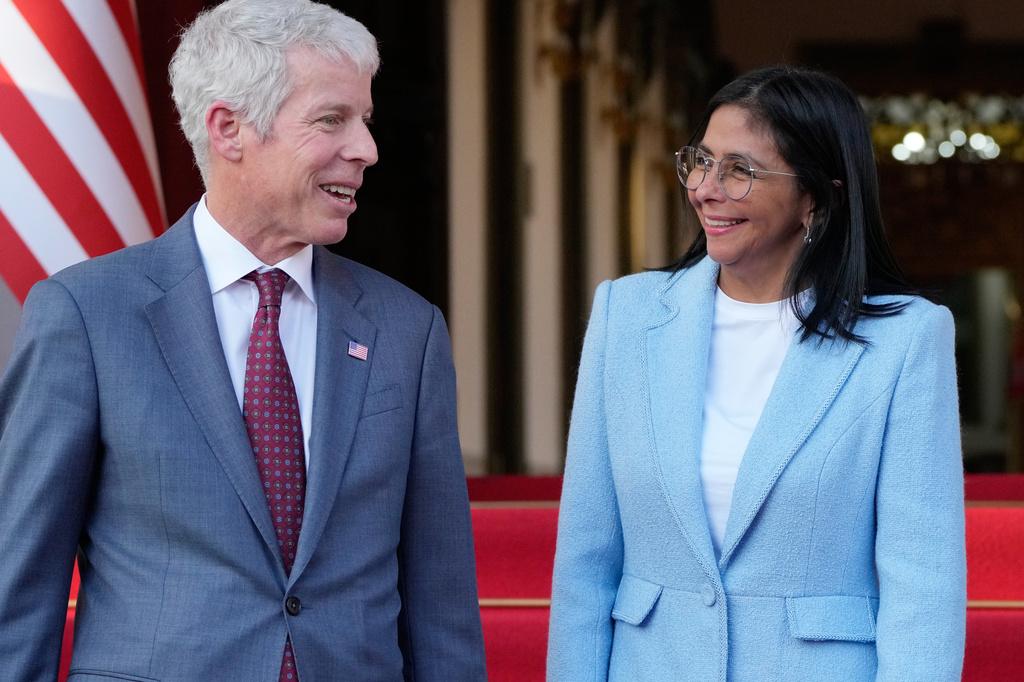
Delcy Rodríguez’s public posture toward the crisis was also framed through her remarks about political legitimacy and sovereignty, with La Jornada reporting that she responded to Donald Trump’s post labeling him “interim president of Venezuela.” Rodríguez called the image a “Wikipedia caricature” and said, “I’ve seen Wikipedia caricatures of who’s in charge in Venezuela; well, here is a government that leads Venezuela, here is an acting president, and there is a hostage president in the United States,” according to La Jornada. In the same report, Rodríguez held a meeting at the Miraflores Palace with the heads of mission of the European Union member countries, the United Kingdom, and the Swiss Confederation, and Foreign Minister Yván Gil told reporters on the way out that the meeting was “frank, cordial and pleasant.”
Gil said everyone agreed “on the need to advance in a stage of productive engagement, opening channels of dialogue that are increasingly deep and intense,” and he also reported a telephone call with Italy’s Minister of Foreign Affairs and International Cooperation, Antonio Tajani. La Jornada further reported that the acting president made two changes in the government’s cabinet, naming Juan Escalona and moving Admiral Aníbal Coronado to the Ministry of Ecosocialism.
Ruling party unity fractures
While PSUV figures backed the interim leadership, the Associated Press reported that Venezuela’s ruling party unity has cracked as Delcy Rodríguez shifts Chávez-era policies after a U.S. military operation captured then-President Nicolás Maduro in January.
The Associated Press said longtime loyalists are airing disagreements with the government of acting President Delcy Rodríguez and even discussing publicly rumors that an insider’s betrayal helped the U.S. depose Maduro.
In a livestream quoted by the Associated Press, Mario Silva said, “The imperialists don’t negotiate. They conquer, test and probe — until our country shatters,” and he added, “Nobody is safe right now. And that is a concrete, terribly dangerous fact.”
The Associated Press also described a May 23 protest in Caracas against a training exercise that saw two Marine Corps Osprey aircraft land at the U.S. Embassy, where protesters held a Venezuelan flag with the message, “No to the Yankee drill.”
The same Associated Press report said Elías Jaua later told the Associated Press he was speaking up to raise awareness among Venezuelans of the “humiliating” situation facing the country, and he said, “At this stage, the most important thing is to prevent this occupation and this colonial administration.”