Crime20 April, 20266 min read
Trump Keeps National Guard in Washington, D.C., With No Clear End in Sight
This article is an automated aggregation of coverage from news outlets. Our editorials offer in-depth analysis curated by the NewsCord team.
No clear end to the National Guard deployment in Washington, D.C. Eight months into deployment, Guard troops remain in DC.
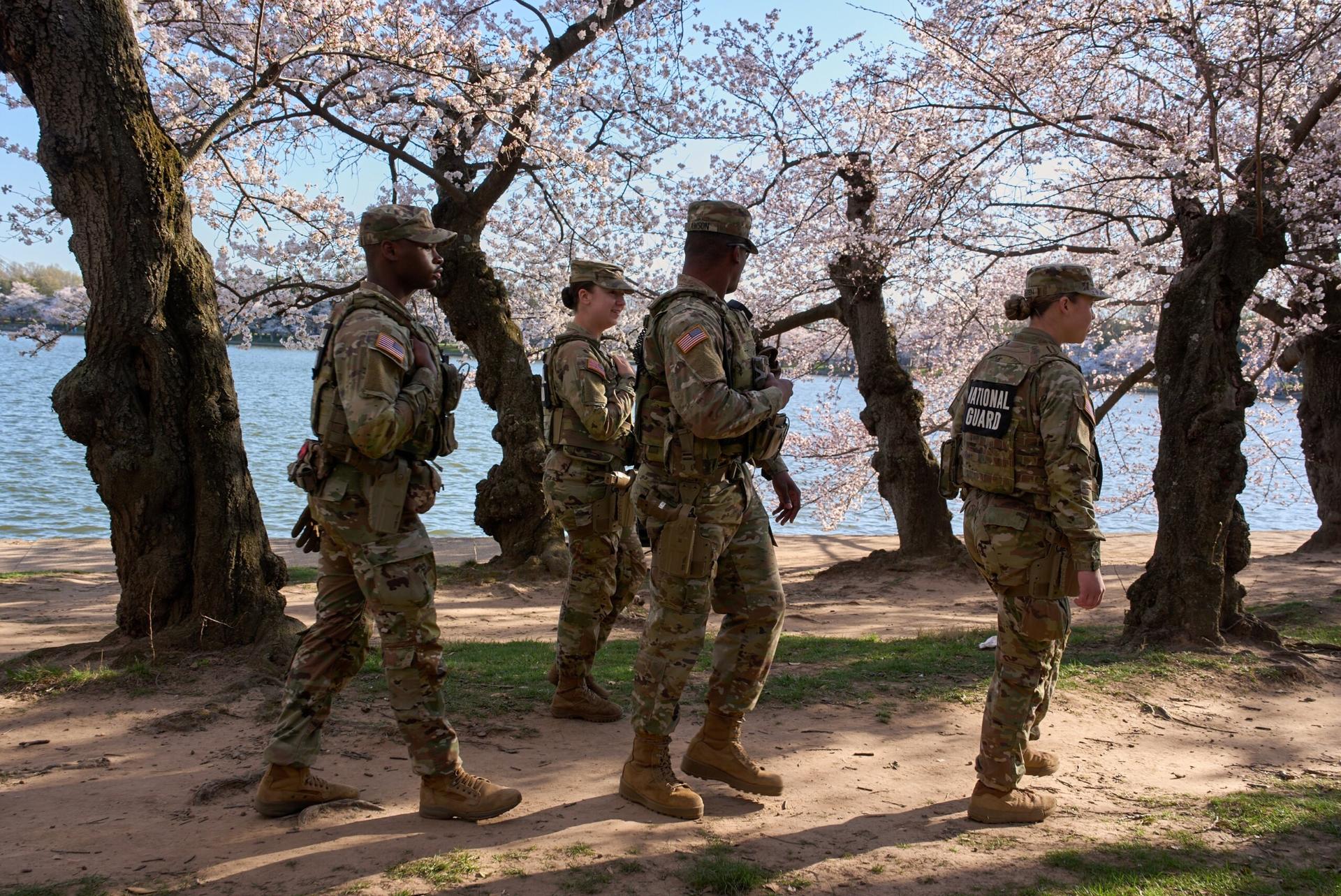
Endless patrols in D.C.
Eight months after President Donald Trump declared a crime emergency in Washington, D.C., and called up the National Guard, the deployment has grown increasingly routine with “no clear end in sight,” according to Associated Press.
The AP reports that “more than 2,500 troops remain” in the capital, where some people strolling between the Lincoln Memorial and the Thomas Jefferson Memorial were “dressed in camouflage -- and armed.”
The article says the guard still walks city streets and patrols metro stations, tourist attractions, neighborhoods and parks, and that “Unless the courts step in, the guard will remain at least through the end of the year, if not longer.”
Phil Mendelson, chairman of the District of Columbia Council, criticized the cost, saying, “Taxpayers are paying more than a million dollars a day to have them walk around,” and added that “the presence of armed soldiers on American streets is not a good look.”
The AP describes the executive order issued in August as bringing the guard in “along with hundreds of additional federal law enforcement officers,” and says guard members have responded to medical emergencies, assisted with arrests, helped local police enforce the city’s juvenile curfew and carried out beautification projects.
It also notes that the D.C. Guard helped with snow removal during a major storm in January, while the Trump administration argues the support has helped reduce crime.
The White House, through spokesperson Abigail Jackson, said the president’s crime task force “yielded tremendous results for local communities,” and that it has “yielded tremendous results for local communities.”
Numbers, costs, and extensions
Beyond the day-to-day patrols, CNN en Español reports that the National Guard mission in Washington has been extended “through the end of 2026,” citing “two officials familiar with the matter.” CNN en Español says it was expected that orders for the Washington task force would expire in February after being extended for a second time in October, but that “the new orders specifically extend until December 31.” As of Thursday morning, CNN en Español reports “there were 2,429 personnel committed to the National Guard mission in Washington,” including “about 700 from the Washington National Guard and more than 1,700 from other parts of the country.”
The article adds that “Eleven states have contributed soldiers to the mission,” naming Florida, South Carolina, Mississippi, West Virginia, Georgia, and Alabama among them. It also describes public-service work, saying the mission has included “trash collection and the placement of mulch,” and that hundreds of soldiers have patrolled the streets of the U.S. capital.

In parallel, El País reports that the deployment of federal troops to six Democratic cities has cost “$496 million in public funds in just six months,” and could exceed “$1 billion” if operations continue, citing estimates from the Congressional Budget Office (CBO) published on Thursday. El País says the CBO estimated that in Washington, where “about 2,950 troops were deployed,” the operation was the most costly at “$223 million,” and it states that “Activating a National Guard member increases costs by $260 per day, about $95,000 per year.”
Ambushes and soldier reactions
The deployment’s risks have been underscored by attacks on National Guard members, which CNN en Español ties directly to the extension decision. CNN en Español says the extension comes “roughly two months after two West Virginia National Guard soldiers in Washington were ambushed and shot just a few blocks from the White House.” It reports that “One of the soldiers, Specialist Sarah Beckstrom, 20, died; the other, Sergeant Major Andrew Wolfe, 24, survived a critical gunshot wound to the head.”
The article adds that a “December update from the West Virginia National Guard” said Wolfe had made “extraordinary progress” and “could breathe on his own and stand with assistance.” CNN en Español also says “Another soldier, Sergeant Major Jacob Hill of Alabama, died while on the mission before Thanksgiving in what officials described as a medical emergency off duty,” and that a source previously told CNN Hill was found “unconscious in his room.”
It describes how some soldiers told CNN they felt a “sense of duty about the mission,” particularly after the shooting of the two West Virginia soldiers, while others said they felt “frustrated or bored.” Separately, Associated Press and WTOP describe how some residents’ feelings shifted after the ambush, with WTOP quoting Kevin Cataldo saying, “That was just horrible,” and Associated Press reporting that the shooting ambush “deepened his sympathies for them.”
Competing frames of “crime”
The sources present sharply different emphases on whether the National Guard deployment is a crime-fighting success or a politically contentious overreach. Associated Press reports that while guard members “do not make arrests,” the Trump administration argues their support has helped reduce crime, and it cites the White House claim that “12,000 arrests have been made by the task force since operations began, including 62 known gang members, and thousands of illegal firearms were seized.” The AP also quotes Abigail Jackson saying the president’s crime task force has “yielded tremendous results for local communities” and that “Every local leader should want to mimic this success in their own locales.”
El País frames the deployments as part of a broader anti-immigrant strategy, saying Trump justified sending troops “on the grounds of supporting local law enforcement to combat crime,” while also intensifying “the anti-immigrant offensive in so-called sanctuary cities.” El País says Trump “accused these local governments of obstructing law enforcement,” “withdrawn federal funds from them,” and “ordered troop deployments to bolster immigration enforcement operations,” and it describes tension between the federal government and states that “have denounced the deployments as exceeding the president’s powers under the Constitution.”

Le Monde reports that Democrats denounced the deployments as “an authoritarian maneuver exceeding the limits of presidential power,” and it notes that the National Guard of each state is under “the joint authority of the president and the local governor.” In contrast, Courrier international describes Memphis residents welcoming the roughly “150 National Guard soldiers sent in October by Trump,” with John Green saying, “I’m looking everywhere for help; I’d like to have more,” and George Campbell saying, “Now, we feel safe.”
Court battles and withdrawals
While Washington’s mission has been extended, other deployments have faced judicial reversals and withdrawals, underscoring how the “crime emergency” approach is being contested in court.
Le Monde reports that on Wednesday, December 31, Trump announced he would withdraw the National Guard from Chicago, Portland, and Los Angeles, writing on Truth Social: “We are withdrawing the National Guard from Chicago, Los Angeles and Portland.”
Le Monde says the deployment had been blocked by the Supreme Court in Chicago and by federal judges in Los Angeles and Portland, and it cites the Supreme Court’s December 23 ruling that the government had not provided a “legal basis justifying its deployment to Chicago.”
The article adds that the Posse Comitatus Act, a law from 1878, prohibits calling on the military to carry out law enforcement operations, and it reports that “Trump is now forced to retreat,” as Illinois Governor J.B. Pritzker wrote on X.
Le Monde also quotes California Attorney General Rob Bonta saying, “For six months, the California National Guard troops were used as political pawns by a president desperate to become king,” and it includes Bonta’s statement that “a reason why our army is, by design, apolitical.”
It further says a federal appeals court ordered that control of the California National Guard be returned to Democratic Governor Gavin Newsom, and it quotes Newsom: “I am happy that President Trump has finally admitted his defeat: we have always said that the federalization of the National Guard in California was illegal.”
Associated Press, meanwhile, describes an ongoing court battle over the guard deployment in Washington and says the office of D.C. Attorney General Brian Schwalb declined to comment “citing the pending lawsuit,” while the National Guard Bureau at the Pentagon did not answer requests for comment.