
US and Israel Bomb Iran to Destroy Missiles, Navy, and Nuclear Program
Key Takeaways
- US and Israel wage a large-scale war against Iran.
- Missile capabilities, including ballistic missiles, are a central target.
- Officials indicate multiple objectives; reports say US-Israel goals diverge.
Operation Launch
The United States and Israel launched a major military campaign against Iran on February 28, 2026, codenamed 'Operation Epic Fury.'
“The United States and Israel launched an ambitious, large-scale war against the Islamic Republic of Iran on February 28, and US officials have communicated several goals for the campaign”
The operation has the stated objective of destroying Tehran's ballistic missile arsenal, naval capabilities, and remnants of its nuclear program.
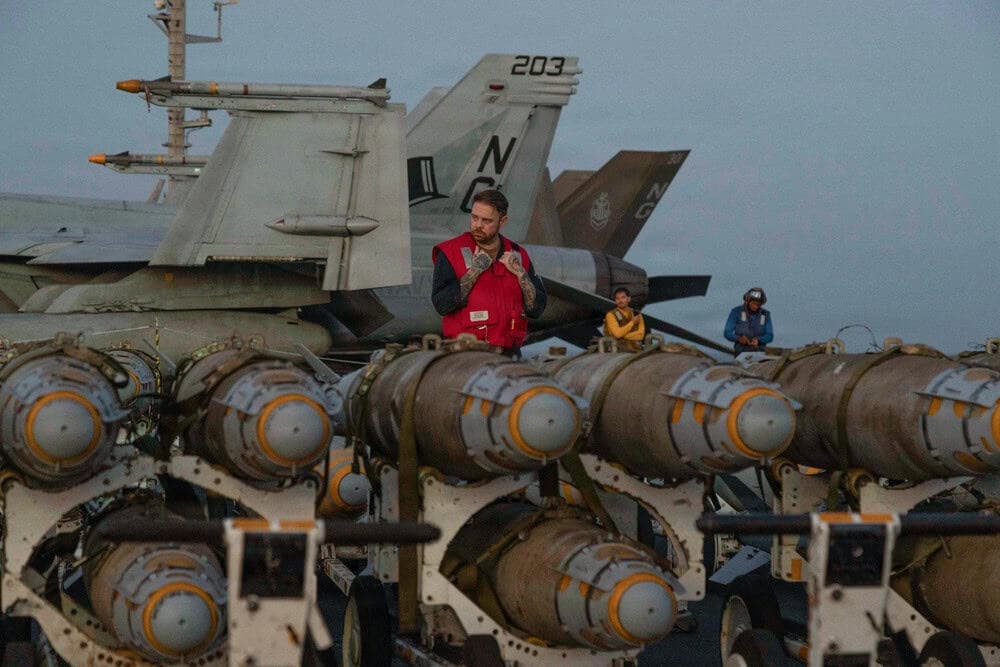
The operation represents a significant escalation in regional tensions, involving unprecedented coordination between American and Israeli forces.
US Secretary of War Pete Hegseth and Chairman of the Joint Chiefs of Staff General Dan Caine outlined the military objectives during a March 2 press conference.
They emphasized the need to dismantle Iran's security apparatus while acknowledging the conflict's potential duration and costs.
Divided Objectives
A significant divergence exists between US and Israeli objectives in the Iran conflict, despite claims of close coordination.
US Director of National Intelligence Tulsi Gabbard testified before the House intelligence committee that while both nations are conducting joint attacks, their goals are fundamentally different.
The Trump administration is focused on destroying Iran's ballistic missile launching and production capabilities along with its navy.
Israeli government objectives center on 'disabling the Iranian leadership' through targeted assassinations.
This strategic split suggests complex geopolitical calculations and competing priorities within the coalition.
Military Buildup
The military operation involved an extensive buildup of US forces in the region prior to the February 28 launch.
“The United States and Israel launched an ambitious, large-scale war against the Islamic Republic of Iran on February 28, and US officials have communicated several goals for the campaign”
This included two carrier strike groups, multiple destroyers, and a significant air component.
American forces deployed F-15, F-16, F-22, and F-35 fighters, along with intelligence and refueling aircraft, and additional air defense systems.
The initial strikes began with cyber and space operations targeting Iranian surveillance and communications.
This was followed by naval-launched Tomahawk cruise missiles against targets along Iran's southern flank.
More than 100 American aircraft participated in the opening stages.
B-2 and B-1 long-range bombers conducted strikes from both within the region and potentially from the continental United States.
Initial Strikes
In the campaign's opening days, US and Israeli forces executed intensive strikes against Iranian military infrastructure.
They targeted over 1,000 objectives within the first 24 hours alone.
Initial operations focused on Iranian command-and-control assets, air defense systems, ballistic missiles, drones, and naval capabilities.
The Iranian navy suffered significant damage, with approximately a dozen submarines and surface vessels struck.
This included at least one Iranian corvette and a maritime drone carrier.
Ground-based High Mobility Artillery Rocket Systems (HIMARS) conducted long-range strikes using Precision Strike Missiles (PrSM).
American forces employed one-way attack drones modeled after the Iranian Shahed for the first time in history.
Despite these early successes, both US and Israeli officials acknowledge that Tehran continues to lash out against American forces and regional partners.
More on USA

Trump threatens to deploy ICE agents to US airports amid DHS funding standoff
46 sources compared

ICE Detainee Royer Perez-Jimenez Dies in Florida Detention Center; Officials Suspect Suicide
10 sources compared

Elon Musk Offers to Pay TSA Salaries During Partial Government Shutdown
50 sources compared

California lawmakers rename Cesar Chavez Day to Farmworkers Day amid sexual abuse allegations.
17 sources compared