
U.S. Moves THAAD Interceptors From South Korea To Middle East Despite Seoul's Objection
Key Takeaways
- U.S. forces in South Korea preparing to relocate THAAD interceptors to the Middle East
- President Lee opposed THAAD relocation but said U.S. may ignore Seoul's opposition
- Lee said relocation would not significantly weaken South Korea's deterrence against Pyongyang
Reported equipment movement
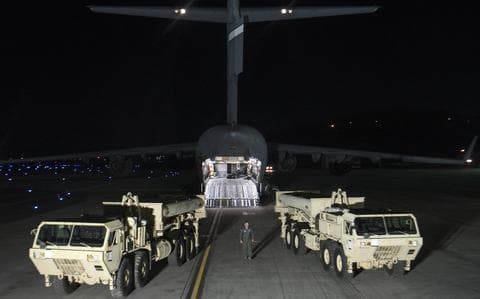
Multiple outlets reported that U.S. forces in South Korea were preparing to move parts of the THAAD (Terminal High Altitude Area Defense) system toward the Middle East amid the wider U.S.–Israel–Iran conflict.
A South Korean paper told reporters that "U.S. forces in South Korea were preparing to relocate interceptor missiles of the Terminal High Altitude Area Defense (THAAD) battery to the Middle East, a local newspaper said Wednesday."

Reports specified that "the THAAD interceptor missiles had been moved to the Osan Air Base in Pyeongtaek, about 70 km south of the capital Seoul, from Seongju county, North Gyeongsang province."
U.S. reporting cited by regional outlets added that "the Pentagon was moving parts of a THAAD battery from South Korea to the Middle East while drawing from its supply of Patriot interceptors in the so-called Indo-Pacific region and elsewhere."
Seoul's objections
Seoul publicly objected to any relocation while acknowledging limited leverage over U.S. force decisions.
South Korean President Lee Jae-myung "has said that while he opposes any relocation of the Terminal High Altitude Defence (THAAD) system to the Middle East, his country’s position may not be fully accepted by the US, according to local media reports."
Lee also stressed that moving some assets "would not significantly weaken the country’s deterrence posture against North Korea" and said, "If you ask whether our deterrence strategy against North Korea has been severely affected, I can say absolutely not."
At the same time, other reporting noted that "while South Korea expressed its opposition to the USFK withdrawing air defense weapons for its own military needs, the Asian country was not able to fully enforce its position."
Precedent deployments
Experts and U.S. military reporting highlighted that elements of South Korea’s air defence footprint have already supported Middle East missions, and that the move reflects broader reallocation of U.S. air-defence resources.
“South Korean President Lee Jae-myung has said that while he opposes any relocation of the Terminal High Altitude Area Defence (THAAD) system to the Middle East, his country’s position may not be fully accepted by the US, according to local media reports”
One outlet noted that "The United States deployed air defense personnel from South Korea to the Middle East last year."
Details of rotations were provided when a Patriot battalion "returned to South Korea in October after a six-month deployment,"
and analysts noted that "Patriot crews from South Korea and Japan were among those dispatched to reinforce air defenses."
Vulnerability concerns
Operational and vulnerability concerns were raised about redeploying fixed-site radars and systems to the Middle East theatre.
Critics questioned moving valuable, stationary sensors abroad after noting that "A $20,000 Iranian drone has destroyed THAAD radars and disabled the systems, Ellison wrote in an email Wednesday."
One analyst argued that fixed radars need protection: "If you cannot do that, why would you send any fixed-site radar to the Middle East?"
The Pentagon’s reported decision to move components was framed as a response to elevated missile and drone threats in the region.
Regional risks and alerts
The moves carry wider regional and alliance implications, including heightened alert for South Korean personnel abroad.
“The president of South Korea this week opposed the removal of U”
Reporting noted that "South Korean troops deployed overseas have been placed on heightened alert after strikes were reported near their bases in the Middle East during the early days of the conflict"
and that explosions were recorded near a South Korean UN unit in Lebanon.
Other coverage emphasized the scale of U.S. forces in Korea and Seoul’s expectation that those forces "fully contribute to stability and peace on the Korean Peninsula," even as assets are shifted to other theaters.
More on USA

KC-135 Crashes in Iraq After Apparent Midair Collision, Six Airmen Killed.
28 sources compared

FAA Orders Ground Stops at D.C.-Area Airports Over Strong Chemical Smell at Federal Aviation Facility
10 sources compared

FAA Lifts Ground Stops at DC-Area Airports After Equipment Outage and Chemical Smell
20 sources compared

Judge James Boasberg Blocks DOJ Criminal Probe of Federal Reserve, Deems It Trump Pressure Campaign
15 sources compared