
U.S. Supreme Court Hears Case Over Geofence Warrants For Google Location Data
Key Takeaways
- Geofence warrants compel Google to provide location data of users near crime scenes.
- Supreme Court heard arguments and appeared divided on Fourth Amendment implications.
- Originates from 2019 Chesterfield bank robbery; case Chatrie v. United States.
Geofence warrants at issue
The U.S. Supreme Court heard arguments Monday in a case that tests whether police may use “geofence” warrants to obtain cellphone location history data from Google to identify people near a crime scene, even when investigators do not yet know a suspect’s identity.
In the underlying investigation, a detective used a geofence warrant after a bank robbery went cold, relying on location data from cellphones in the vicinity of the bank for “the 30 minutes before and after the robbery,” according to The New York Times.

CNN described how local police in Virginia served Google with a “geofence warrant,” requiring the company to parse location data on millions of people to find a handful whose cellphones pegged them within “300 meters of the bank at the time of the robbery.”
NPR explained that geofencing works by drawing “a virtual fence around a geographic area where a crime was committed,” then seeking a warrant that compels a tech company to search its data to identify users within that area.
Politico said the case is brought by Okello Chatrie, charged in a 2019 bank robbery in Midlothian, Virginia, after being identified through a geofence warrant served on Google.
SCOTUSblog reported that Google provided information in three steps: first a list of “the 19 accounts” linked to devices within “150 meters” of the bank during “the 30 minutes before and after the robbery,” then a request for more information about nine accounts, and finally names and information for three accounts, including Chatrie’s.
The stakes are framed as a Fourth Amendment question about whether the government’s access to location history data is a “search” and what constitutional limits apply when the data are held by a company rather than a person’s home or papers.
Robbery details and data trail
The Supreme Court case centers on a 2019 bank robbery in Virginia that police initially struggled to solve, then revisited by using Google location history data.
NPR said the robbery occurred in “the small Virginia town of Midlothian,” where a robber “pulled out a gun” and fled with “$195,000,” after police reviewed the bank’s surveillance footage and saw a man “talking on his cell phone.”
CNN similarly described that in Virginia, police say Okello Chatrie passed a note urging a bank teller in 2019 to “hand over all the cash” and demanded “at least 100k and nobody will get hurt and your family will be set free.”
CNN reported that police were initially unable to identify a suspect, but officers noticed on security cameras that the suspect was using his phone before the robbery, prompting them to seek location data from Google.
SCOTUSblog added that the robber gave the teller a note demanding money and “made off with nearly $200,000,” and that when the investigation stalled, law enforcement served a “geofence warrant” on Google to obtain location data for cellphone users near the bank at the time of the robbery.
After Google’s three-step process, SCOTUSblog said law enforcement obtained a warrant to search two residences linked to Chatrie, where they found “almost $100,000 of the stolen cash, a gun, and demand notes.”
CNN stated that after police identified Chatrie, authorities executed federal search warrants and found “robbery-style demand notes” in his bedroom, nearly “$100,000 in cash and a 9 mm pistol.”
Politico and The Hill both described that Chatrie pleaded guilty and was sentenced to nearly 12 years in prison, while SCOTUSblog said he was sentenced to “nearly 12 years in prison, followed by three years of supervised release.”
Arguments over privacy and limits
During oral argument, Chief Justice John Roberts pressed the government and defense on the practical restraints that would prevent geofence warrants from becoming a tool for identifying people based on sensitive locations.
“When an investigation into a Virginia bank robbery went cold a few years back, local police turned to Google”
CNN quoted Roberts asking, “What’s to prevent the government from using this to find out the identities of everybody at a particular church, a particular political organization,” and he followed with “What are the restraints that are going to prevent that from becoming a problem?”
Politico reported Roberts’s skepticism about the government’s reliance on voluntary sharing, asking deputy solicitor general Eric Feigin, “So to prevent surveillance of sensitive locations, you have to rely on the fact that people are going to turn off something that many, if not most people find is an important service?”
The Hill described Roberts pressing the defendant’s attorney with a similar point: “If you don’t want the government to have your location history, you just flip that off,” and it also quoted Justice Samuel Alito saying, “Had he read his contract with Google, he could see that Google retained the right to turn this information over to law enforcement.”
NPR and The Washington Post both emphasized that the constitutional dispute is tied to the Fourth Amendment’s ban on unreasonable searches and the question of whether location history is protected even when stored by a company.
SCOTUSblog reported that lawyer Adam Unikowsky argued “The government conducted a search” and that the geofence warrant “that purported to authorize that search violated the Fourth Amendment,” while Deputy U.S. Solicitor General Eric Feigin countered that Chatrie was “asking for an unprecedented transformation of the Fourth Amendment into an impregnable fortress around records of his public movements that he affirmatively consented to allow Google to create, maintain, and use.”
NPR also quoted Michael Dreeben, who has argued “109 cases in the Supreme Court,” saying the court has “uniformly favored privacy interests rather than extending precedents that allowed government searches.”
The arguments also probed whether the government’s theory would extend beyond location history to other digital records, with The Hill quoting Justice Neil Gorsuch warning that a ruling about voluntary exposure to Google could “pertain equally to email.”
How outlets frame the same case
Coverage diverged in how it characterized the geofence warrant question, the technology involved, and what the justices seemed to be signaling.
CNN emphasized the constitutional mechanics and the justices’ search for a narrow outcome, stating that after two hours of argument the court seemed “unlikely to accept the broad position that the geofence warrants were unconstitutional,” though it might “look for ways to limit their use.”
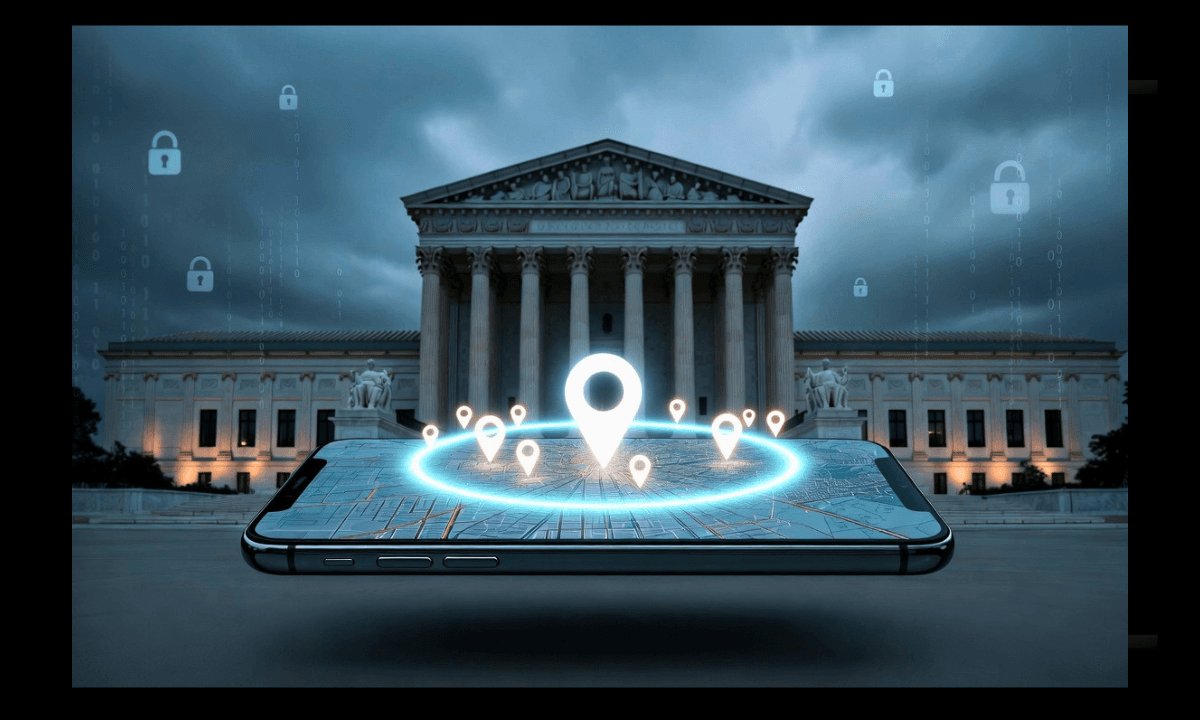
NPR framed the dispute as a choice between “Ingenious? Orwellian? Or both?” and described geofencing as a technique that lets the government draw “a virtual fence” and then require a tech company to search data to identify users within the fence.
Politico focused on whether the court would “lay out detailed criteria for so-called geofence search warrants, or avoid a ruling that would create specific rules,” and it described a majority likely to conclude that law enforcement should “almost always need a warrant” to obtain records that help figure out who was at a particular place and time.
The Hill highlighted the justices’ probing of the defendant’s contentions and the “reasonable expectation of privacy” framework, quoting Deputy Solicitor General Eric Feigin saying the petitioner was asking for “an unprecedented transformation of the Fourth Amendment into an impregnable fortress.”
TechCrunch, by contrast, emphasized the broader digital privacy implications and described the case as “Chatrie v. United States” and “the first major Fourth Amendment case that the U.S. top court has considered this decade,” while also noting that the decision could decide whether geofence warrants are legal.
SCOTUSblog provided a procedural and evidentiary timeline, including that the district judge agreed the warrant violated the Fourth Amendment but allowed evidence under good faith, and it reported that the Supreme Court agreed in January to take up the case.
Even within mainstream coverage, the technology details were presented differently: CNN described that the location data could identify a person’s location within “3 meters every two minutes,” while NPR described that “Every two minutes, on average, the location feature recorded where you were” using multiple information sources.
What comes next for law enforcement
The Supreme Court’s decision is expected to shape how law enforcement can use geofence warrants and other location-based investigative tools, with consequences for privacy and for criminal investigations.
“Your location data sits in a digital vault that police can crack with the right warrant—but the Supreme Court just wrestled with whether that’s actually constitutional”
CNN reported that the court’s decision could make it “easier for law enforcement to solve crimes” while also “expose troves of personal information to authorities,” and it quoted William McGeveran, dean of the University of Minnesota Law School, saying, “The issues involved apply to any of the digital technology that is tracking your location.”
NPR described the geofence case as the latest clash between privacy rights and law enforcement, and it quoted Michael Dreeben saying the court has “uniformly favored privacy interests rather than extending precedents that allowed government searches.”
The Hill added that geofence warrant usage “has grown rapidly in recent years,” and it stated that it “constitutes more than a quarter of all U.S. law enforcement demands” and “played a prominent role in the prosecutions against the Jan. 6, 2021, Capitol rioters.”
The Hill also reported that “Some 31 states, plus the District of Columbia, are backing the Trump administration’s defense of the tool,” and it quoted the friend-of-the-court brief saying geofence warrants have become “an important investigative tool for law enforcement.”
SCOTUSblog described how the lower courts split, noting that the Fourth Circuit upheld the denial of Chatrie’s motion to suppress in a “deeply splintered decision,” and it said the Supreme Court agreed in January to take up the case.
Several outlets also described a practical shift in Google’s policies that could affect future warrant requests, with The Hill stating that “Google in 2023 shifted its data storage policies” and “ended its ability to supply location information responsive to geofence warrants,” while CNN and others discussed that Alito said the “Google feature” at issue “doesn’t exist any longer.”
Even so, the constitutional question remains unresolved: CNN said the justices grappled with whether sweeping warrants are consistent with the Fourth Amendment’s prohibition on unreasonable searches, and Politico reported that the court’s conservatives appeared divided over how the Constitution should apply to access to location data.
More on Technology and Science

Google Grants U.S. Department of Defense Unrestricted Access to Its Classified AI After Anthropic Refusal
13 sources compared

Institute of Cancer Research And Imperial College London Find Obesity Clue Behind Rising 11 Cancers In England
15 sources compared

Lovable Launches Vibe-Coding Mobile App on iOS and Android, Extending Its No-Code AI Builder
12 sources compared

Apple Introduces Monthly App Store Subscriptions With 12-Month Commitment
10 sources compared