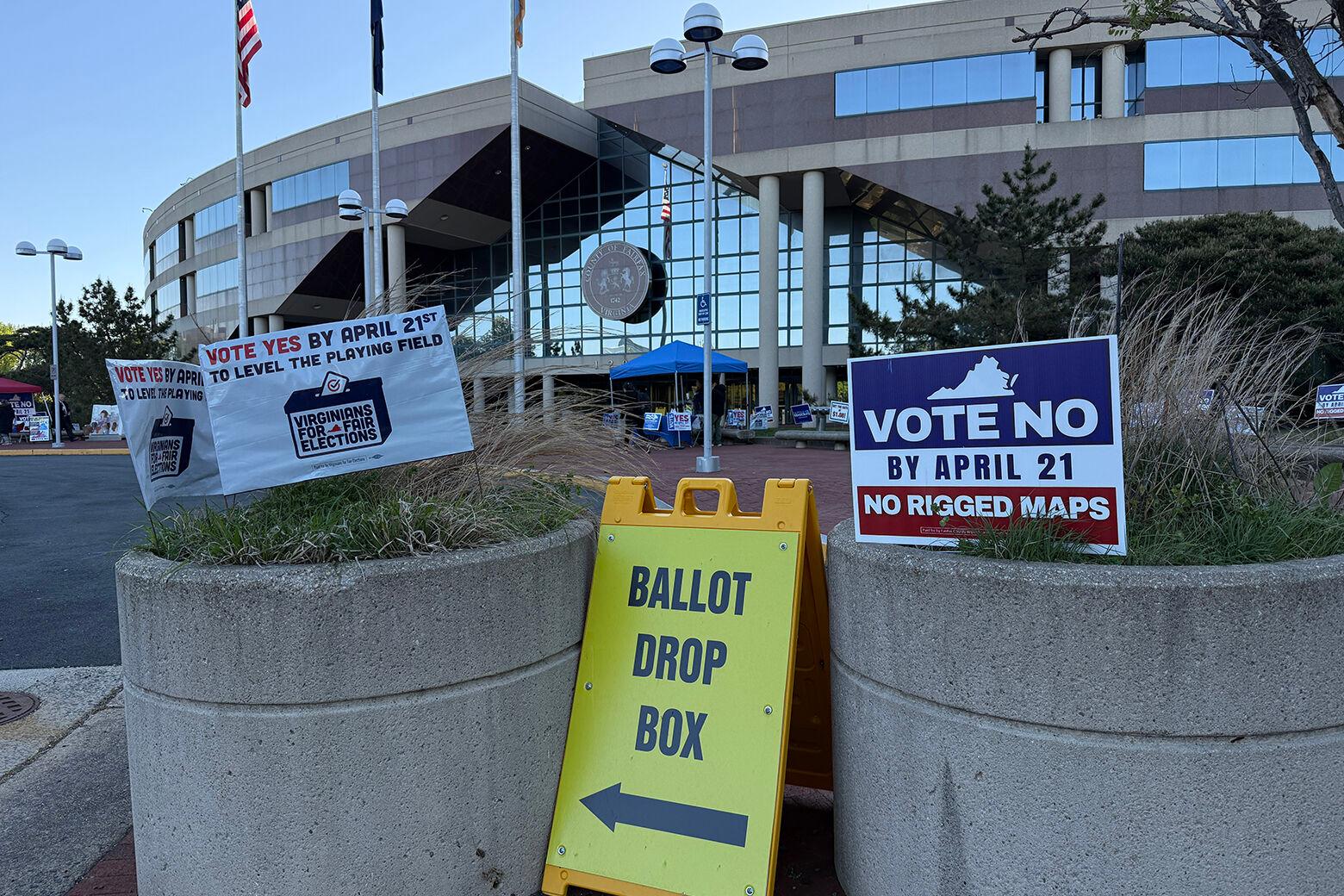
Virginia Voters Decide Tuesday On Redistricting Referendum That Could Boost Democrats’ House Seats
Key Takeaways
- Ballot measure would authorize temporary redrawing of Virginia's congressional map by the Democratic-controlled General Assembly.
- If approved, Democrats could gain up to four U.S. House seats.
- Early voting exceeded 1.3 million, signaling unusually high turnout.
Virginia votes on map
Virginia voters are set to decide Tuesday on a constitutional amendment that would temporarily allow a new congressional map, a move Democrats say could boost their position in the midterms while Republicans call it a power grab.
NBC News reports that the amendment is designed to “pave the way for a new congressional map designed to allow Democrats to pick up as many as four seats in this year’s midterm elections,” and that under the proposed map Democrats would be in position to hold “up to 10 of the state’s 11 districts.”

Politico similarly frames the stakes as a potential “10-to-1 seat advantage in Virginia,” which “amounts to a net pickup of as many as four House seats.”
Virginia Mercury describes the referendum as a “closely watched constitutional amendment that could reshape the state’s congressional map ahead of the 2026 elections,” and says it would allow the state to redraw congressional districts ahead of the 2026 elections.
WTOP adds that the ballot includes “a single yes-or-no question” asking whether the Commonwealth’s constitution should be amended to allow the General Assembly to temporarily adopt new congressional maps.
The Washington Post says the vote could “add as many as four Democratic seats to the House of Representatives,” capping an effort by Democrats to counter President Donald Trump’s push in other states.
Polling and turnout are central to how the race is expected to play out, with NBC News citing a Washington Post/George Mason University poll showing “52% of likely voters said they supported the referendum and 47% opposed it.”
How the fight escalated
The referendum is presented by supporters as a response to a broader, mid-decade redistricting battle that has unfolded across the country, with Virginia positioned as a key test of whether voters will accept a temporary break from the state’s usual redistricting process.
NBC News says the vote is part of “the latest fight in the mid-decade redistricting war that has unfolded across the country,” and notes that Democrats have framed their effort as a response to “President Donald Trump’s pressuring GOP-led states to redraw their district lines last summer.”

Virginia Mercury ties the timing to “aggressive mid-decade redistricting efforts in other states,” particularly after “President Donald Trump in Texas to secure GOP victory in this fall’s midterm elections,” and describes the amendment as a “one-time exception” to Virginia’s current framework.
WTOP similarly says Democrats argue the move is necessary, pointing to “President Donald Trump’s calls for redistricting in Republican-controlled states, including Texas,” and notes that Republicans oppose the effort and are challenging it in court.
The Washington Post and CNN both describe the vote as the latest chapter of a “rare mid-decade cartographic arms race,” with CNN saying it is “the latest front in an unprecedented coast-to-coast redistricting war.”
CBS News adds that the referendum would amend the state constitution to allow mid-decade redistricting using the Democratic-controlled Assembly’s redrawn congressional maps, and that “the maps would only be in place until the 2030 election.”
Virginia Mercury emphasizes that Virginia’s constitution, as amended in 2020, established a bipartisan redistricting commission and tied map-drawing to the decennial census, while the proposed amendment would carve out a narrow exception.
Campaign voices and quotes
The referendum has drawn prominent national and state figures to both sides, with Democrats arguing the vote is necessary to counter Trump’s redistricting push and Republicans warning it would entrench partisan advantage.
NBC News quotes Virginia Sen. Tim Kaine saying on “Fox News Sunday” that the referendum gives Virginians “a chance to vote — which Republican states have not done — about whether they want to have a congressional delegation that will stand up against Donald Trump’s tyranny if he tries to interfere with our elections.”
On the Republican side, Politico reports that Trump joined Speaker Mike Johnson for a tele-rally and that Trump told supporters, “Tomorrow, your commonwealth has an incredible, and really, an important election in every sense of the word that will have major consequences for our entire country this November,” while WTOP says former Gov. Glenn Youngkin urged voters to vote no and told WTOP, “I don’t view this as (Democrats) did, I view this as a moment for Virginians to stand up for what’s right.”
WTOP also includes a direct contrast from Democratic Congresswoman Jennifer McClellan, who said, “This is a temporary measure in response to an unprecedented event,” and added, “At no other time in American history, am I aware — definitely not in modern times — did a sitting president of the United States call state legislators controlled by his party and say, ‘find me more seats.’”
CNN quotes Delores McQuinn at a rally saying, “We can help level the playing field,” while Glenn Youngkin is quoted by CNN as saying, “What’s happening now is the most blatant power grab that has ever been demonstrated.”
NBC News also reports that Trump called into a conservative talk radio show in Virginia Monday night to urge voters to reject the “unfair” map, warning that Democrats winning control of the House would be a “disaster.”
Framing differences across outlets
Different outlets emphasize different aspects of the same referendum, from how it could shift the House to how it is being sold to voters and what legal questions remain.
NBC News focuses on the constitutional mechanics and the political messaging, describing how Democrats framed the effort as a response to Trump pressuring GOP-led states and noting that the “constitutional amendment seeks to temporarily bypass the state’s bipartisan redistricting commission” and “return mapmaking duties to the commission after the 2030 census.”

Politico foregrounds the competitiveness and the campaign strategy, quoting Democratic strategist Jared Leopold saying, “I always thought this campaign would be close [and] 24 hours out, I believe that to be the case,” and describing the referendum as a “test” of whether voters will “set aside long-standing distaste for partisan gerrymandering.”
Virginia Mercury provides a voter-facing explanation of what is on the ballot, including the ballot question language that asks whether the Constitution should be amended “to allow the General Assembly to temporarily adopt new congressional districts to restore fairness in the upcoming elections,” and it says courts allowed the wording to stand.
WTOP highlights the procedural uncertainty, saying “The Virginia Supreme Court is not expected to rule on the plan’s legality until after the election,” and it also includes the claim that former President Donald Trump urged voters to vote “no,” saying it would “save your country.”
CBS News frames the referendum as a 10-1 advantage scenario and adds turnout context, stating “As of Monday, more than 1.35 million people had voted early,” and that the referendum would give Democrats an advantage “in all but one of the state’s 11 House seats.”
CNN emphasizes the national stakes and money, saying Democrats have spent “$55 million” on advertising compared to “$23 million for Republicans,” and quoting Jeffries that “It’s gonna be close because Virginia is a purple state.”
What happens next
The consequences described by the sources extend beyond Tuesday’s vote, with multiple outlets emphasizing that the referendum could affect the House balance in November while also leaving open legal review after the election.
NBC News says the contest is “shaping up to be close” and describes how the constitutional amendment would bypass the bipartisan commission temporarily and then return mapmaking duties after the 2030 census, implying a defined window for any new districts.

Politico says that if the referendum fails, it would be “an early embarrassment for Spanberger as governor and a high-profile loss for a Democratic Party” that has cast Trump’s efforts as “election rigging,” while it also frames the vote as a test of whether Democrats can counter gains Republicans made in “Texas and elsewhere before November.”
WTOP adds that “Leaders from both parties say Tuesday’s vote could shape the fight for control of the House this fall,” and it notes that the Virginia Supreme Court is not expected to rule until after the election, meaning the vote’s immediate impact could be contested.
CBS News states that the maps would only be in place until the 2030 election and that the current map was drawn by a bipartisan commission, while the new map would be implemented through the Democratic-controlled Assembly’s redrawn congressional maps.
NBC4 Washington says the state Supreme Court is considering whether the redistricting plan is illegal in a case that could make referendum results meaningless, and it also notes that poll hours on Tuesday are “6 a.m. to 7 p.m. ET.”
CNN emphasizes that the outcome could determine which party controls Congress after fall elections, and it quotes Jeffries saying, “We’re making clear we’re not here to step back. We’re here to fight back.”
More on USA

Donald Trump Says US Navy Disabled And Seized Iranian-Flagged Ship Touska In Gulf Of Oman
13 sources compared

Reuters/Ipsos Poll Finds 36% Approve Trump’s Job Performance Amid Iran War And Pope Feud
10 sources compared
Donald Trump Urges Iran To Release Eight Women Facing Execution Ahead Of Talks In Islamabad, Pakistan
12 sources compared

Sheila Cherfilus-McCormick Resigns From U.S. House Minutes Before Ethics Sanctions Hearing
16 sources compared