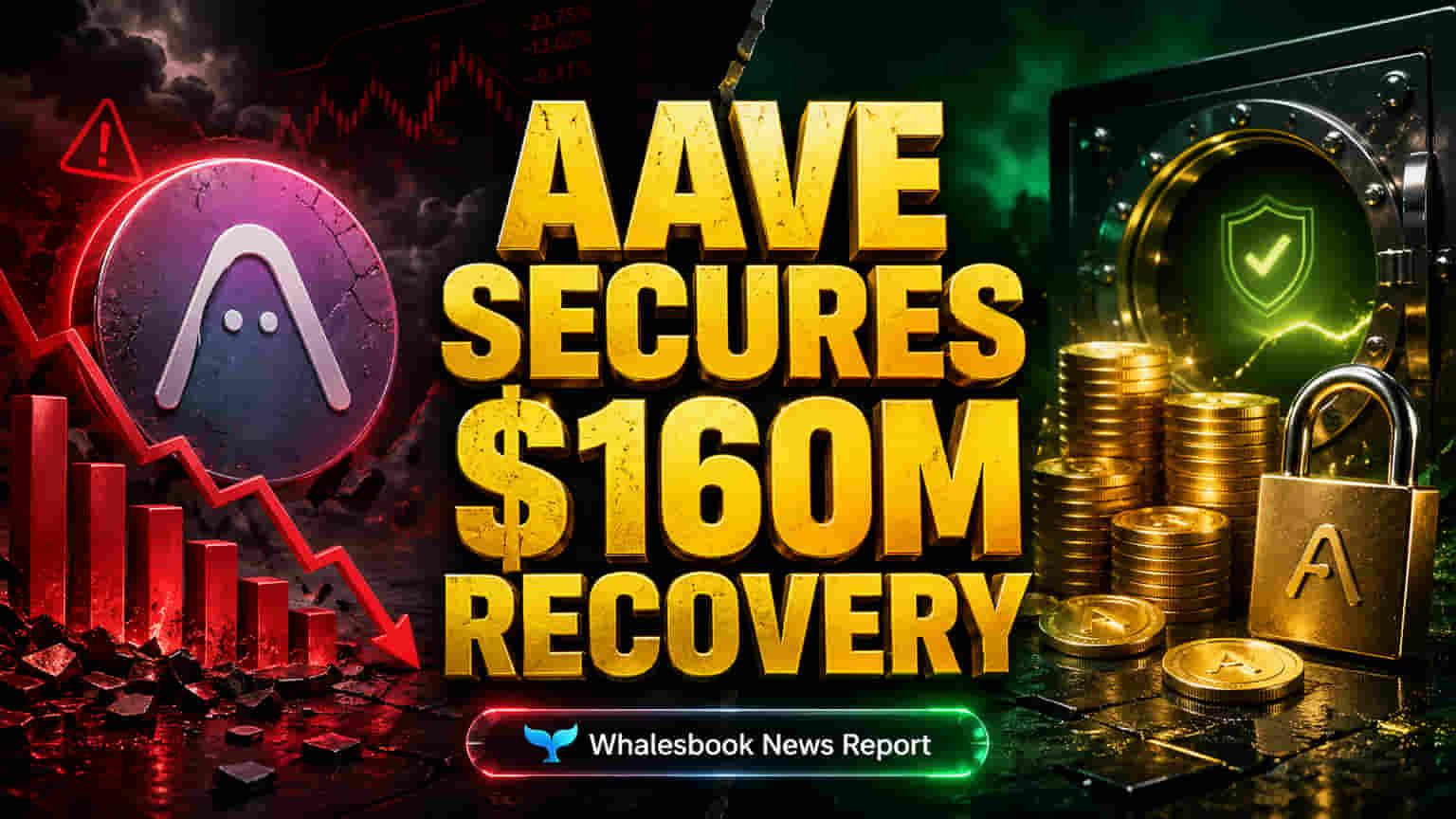
Aave Raises $160 Million to Cover Kelp DAO Exploit Bad Debt Through DeFi United
Key Takeaways
- Aave raised about $160 million toward roughly $200 million bad debt.
- Mantle and Aave DAO are the largest contributors, totaling about $127 million.
- Total bad debt estimated near $196–200 million across reports.
Aave’s $160M push
Aave has raised $160 million to cover bad debt left by the Kelp DAO exploit, with Arkham posting on X that “AAVE have so far raised $160M to cover the bad debt from the Kelp DAO Exploit, at defiunited.eth.”
“Aave raises nearly 80% of the $200 million it needs to cover bad debt left by Kelp DAO exploit Blockchain analytics platform Arkham said that the largest contributors are Mantle and Aave DAO, having raised a combined $127 million”
CoinDesk frames the effort as Aave raising “about $160 million of the roughly $200 million it needs to cover bad debt,” while Blockchain analytics platform Arkham said the largest contributors are Mantle and Aave DAO, “who together raised 55,000 ETH or $127M.”

The same CoinDesk reporting says the coordinated recovery effort is called DeFi United and is “led by Aave service providers,” with the goal to “recapitalize and restore support for rsETH.”
The Block adds that Mantle proposed a loan of up to 30,000 ETH to Aave DAO, to be used “exclusively for resolving the rsETH bad debt on Aave V3,” and says the loan would generate yield.
In parallel, bloomingbit reports that Aave DAO service providers submitted a governance proposal to allocate “25,000 ETH to the ‘DeFi United’ initiative,” and that “the total bad debt generated by the incident stands at 75,081 ETH.”
Across the coverage, the funding is explicitly tied to restoring rsETH backing and stabilizing Aave’s collateral situation after the exploit’s fallout.
How the exploit hit
The Kelp DAO exploit traced back to a KelpDAO integration vulnerability with LayerZero, where an attacker minted “116,500 unbacked rsETH tokens,” leaving Aave with impaired collateral and triggering a run on deposits, according to CoinDesk.
CoinDesk says the attacker minted 116,500 unbacked rsETH tokens and that the incident “ultimately withdrawing $10 billion,” as lenders rushed to exit.
Bitcoin News provides more operational detail, saying the exploit began at “17:35 UTC” at “Ethereum block 24,908,285,” and that attackers targeted “Kelp DAO’s Layerzero V2 bridge on the Unichain-to-Ethereum rsETH route.”
That same source says the forged packet minted “116,500 unbacked rsETH tokens,” valued at “roughly $292 million at the time,” and that about “89,567 rsETH, worth approximately $221 million” was deposited as collateral across Aave V3 markets on Ethereum and Arbitrum.
Bitcoin News also states the attacker borrowed “around 82,650 WETH, worth roughly $191 million,” plus “smaller amounts of wstETH,” and that positions were left with health factors “between 1.01 and 1.03.”
Across these accounts, the common thread is that Aave’s smart contracts were not exploited, while the bad debt originated from “unbacked external collateral,” as Bitcoin News puts it.
Freezes, pledges, and governance
After the exploit spread to Aave, the protocol and industry actors moved quickly, with Bitcoin News saying Aave’s Protocol Guardian responded within hours and that “By approximately 19:00 UTC on April 18, all rsETH and wrsETH reserves across V3 deployments were frozen.”
“Summary - Aave said a governance proposal had been submitted to provide 25,000 ETH to help address the bad debt created by fallout from the Kelp DAO hack”
Bitcoin News adds that “loan-to-value ratios were set to zero, and interest rate models were adjusted to manage liquidity pressure,” and it says Aave Labs and risk manager Llamarisk published a formal incident report on “April 20.”
CoinDesk describes the DeFi United effort as a coordinated bailout to recapitalize rsETH and mitigate losses, and it quotes Aave founder Stani Kulecho saying, “I’m personally contributing 5,000 ETH to DeFi United as we continue working together with partners.”
The Block reports that Mantle proposed up to 30,000 ETH with an indicative interest rate of “Lido staking APR plus a 1% premium,” with maturity “up to 36 months,” and it says the loan would be secured via “a multisig wallet designated by Mantle.”
It also notes that “Bybit CEO Ben Zhou wrote that the crypto exchange will support the proposal,” and includes the quote “When we got hacked, the industry got together and helped us.”
Meanwhile, bloomingbit says Aave posted on April 24 that “Aave DAO service providers had submitted a governance proposal to allocate 25,000 ETH to the “DeFi United” initiative,” and it reports that “loans and donations totaling 69,576 ETH have been pledged so far.”
Numbers don’t match
The reporting diverges on the size of Aave’s bad debt and the scale of the overall damage, even while describing the same Kelp DAO incident.
CoinDesk says Aave has raised about $160 million of the “roughly $200 million” it needs to cover bad debt, and it calls the Kelp DAO exploit “the year’s largest DeFi exploit.”
Bitcoin News says the exploit created “up to $230.1 million in bad debt,” and it also states “Other estimates placed Aave’s total exposure between $196 million and $200 million.”
Whalesbook similarly says the debt gap is “$200 million,” while Crypto Briefing frames the remaining bad debt as “$196 million in bad debt.”
bloomingbit provides a different metric, saying “the total bad debt generated by the incident stands at 75,081 ETH,” and it reports a pledged amount of “69,576 ETH” with a remaining gap of “5,505 ETH.”
These differences mean the sources present multiple figures for the same underlying problem, including $196 million, $200 million, and up to $230.1 million, alongside the ETH-denominated total of 75,081 ETH.
What comes next
The next phase of the response centers on restoring rsETH backing and clearing remaining bad debt, with multiple sources describing ongoing contributions and active governance.
“The Kelp DAO exploit drained $292 million, leaving Aave with $196 million in bad debt”
Bitcoin News says the fund targets the rsETH shortfall, initially modeled at “68,900 to over 100,000 ETH,” depending on recoveries and final bad debt figures, and it says “The fund continues to accept donations as the protocol works toward restoring full rsETH backing and clearing remaining bad debt.”
CoinDesk describes DeFi United as aiming to “recapitalize and restore support for rsETH,” and it ties the effort to stabilizing DeFi markets after a “$292 million security breach” left Aave facing a “financial crisis.”
The Block adds that governance votes on pending contributions remain active and that Lido Labs posted a proposal to allocate “up to 2,500 stETH” to reduce the rsETH shortfall, which would indirectly shrink Aave’s exposure to bad debt.
bloomingbit says the governance proposal for “25,000 ETH” is meant to “restore the collateral value of rsETH and stabilize market conditions,” and it reports that “Once additional support funds from several crypto projects are added, the entire bad-debt amount could be fully resolved.”
Crypto Briefing frames the stakes as potential regulatory attention, noting that “$196 million in bad debt on DeFi’s largest lending protocol could trigger regulatory responses that affect Ethereum directly,” even while saying “Ethereum market hasn’t moved.”
More on Crypto

Attackers Exploit Litecoin MWEB Zero-Day, Trigger 13-Block Reorganization and DoS on Mining Pools
12 sources compared

Giancarlo Lelli Breaks 15-Bit Elliptic-Curve Key With Quantum Computer, Wins Project Eleven 1 Bitcoin
12 sources compared

Metaplanet Issues $50 Million Zero-Interest Bonds to Buy More Bitcoin
12 sources compared

Iran Grants Russia Strait Of Hormuz Transit Fee Exemptions, Ambassador Kazem Jalali Says
16 sources compared