Alabama Attorney General Asks U.S. Supreme Court To Lift Injunction On Congressional Redistricting
Key Takeaways
- Alabama seeks Supreme Court relief to lift injunction on redistricting.
- Governor Ivey signed legislation enabling new primaries if redistricting proceeds.
- Republican-controlled Legislature approved plan for new primaries contingent on court action.
Alabama seeks map change
Alabama Attorney General’s Office filed motions in three separate cases seeking to lift a federal court’s injunction against the state changing congressional district lines before 2030, and used the same motion in filings with the U.S. Supreme Court.
“19:06 News Story * Government & Politics Alabama Attorney General files motions with U”
The emergency appeal asks the justices to allow Alabama to revert to a congressional map with one majority-Black district, setting up a question tied to the Voting Rights Act after Louisiana’s map was struck down.

Alabama’s request comes as Gov. Kay Ivey signed legislation Friday that would set up new primary elections if courts allow Republicans to change congressional and state Senate maps ahead of the November midterms.
NBC News reported Alabama’s primaries are set to take place under its current maps on May 19, while the legislation gives Ivey the ability to schedule separate special primary elections for affected districts if redrawn maps are put into place.
The Alabama Attorney General’s Office argued in its motion that it is “irreconcilable with Louisiana v. Callais,” and sought a stay of the injunction in place by May 14 at 10 a.m. because the justices will not have another conference until May 18.
Court fight and quotes
In its emergency appeal, Alabama told the Supreme Court that “Alabama’s case mirrors Louisiana’s, and they should end the same way: with this year’s elections run with districts based on lawful policy goals, not race.”
CNN reported that the court’s ruling in the Louisiana case said voters challenging a potentially discriminatory map must demonstrate a “strong inference” of racial motivation to bring a successful Voting Rights Act challenge.
NBC News described how Alabama Republicans asked a federal court to allow them to replace their current court-ordered congressional map, which contains two majority-minority districts represented by Democrats, with a map lawmakers approved in 2023 that has one.
NBC News also quoted Alabama Republican House Speaker Nathaniel Ledbetter celebrating the legislation, calling the current map a “racially gerrymandered disgrace” and saying it would “guarantee” the Second Congressional District is “flipped back to republican control.”
PBS reported that during debate inside the statehouse, Black lawmakers sharply criticized the Republican legislation, and Republican Sen. Greg Albritton said the special primary would happen only if the courts agree to lift an injunction that put a court-selected map in place until after the 2030 Census.
What is at stake next
The Alabama Attorney General’s Office said the remedial map that the district court ordered Alabama to use “sacrifices some of the state’s interests,” including “maintaining the Gulf Coast community of interest in one district” and “protecting incumbents.”
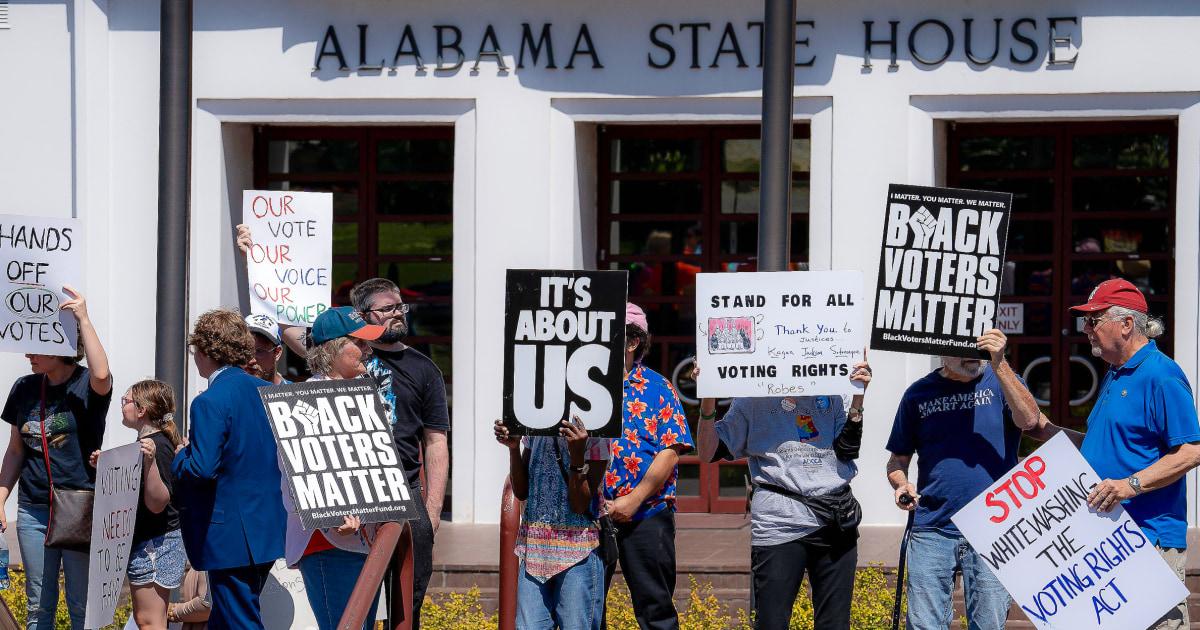
PBS reported that if courts allow Alabama to use different congressional districts in this year’s elections, the plan for new U.S. House primaries would be sent to Gov. Kay Ivey, and it described demonstrations outside the Alabama Statehouse shouting “fight for democracy” and “down with white supremacy.”
PBS also reported that the court order required a second district where Black voters are the majority or close to it, resulting in the 2024 election of Democratic Rep. Shomari Figures, and it quoted Senate Minority Leader Bobby Singleton saying Republicans are aiming to strip representation from Black voters.
In the federal cases, plaintiffs argued it is too late to use the 2023 map because the primary election is in a couple of weeks and that absentee voting has already started, and the plaintiffs said granting a stay would “unquestionably be wrong—harming voters, election officials, and all candidates.”
The Alabama Attorney General’s Office framed its position around the Supreme Court’s Louisiana decision, arguing that the remedial map incorporated race that the U.S. Supreme Court prohibited when it wrote in the majority opinion to “disentangle race from politics.”
More on USA

U.S. Fires on Iranian-Flagged Tankers in Strait of Hormuz After Exchanging Fire
11 sources compared

Pentagon Releases 161 Declassified UFO Files, Including “Football-Shaped” White Light Video
28 sources compared

Virginia Supreme Court Strikes Down Voter-Approved Democratic Redistricting Plan, Boosting Republicans
14 sources compared

Lebanese Army Accuses Israel of Ceasefire Violations as Hezbollah Bombs Israeli Soldiers Near Khiam
11 sources compared