USA17 April, 20266 min read
Analilia Mejia Wins New Jersey-11 Special Election, Defeats Joe Hathaway by Nearly 20 Points
Analilia Mejía wins the NJ-11 special election to fill Sherrill's seat. Mejía defeats Joe Hathaway by about 19-20 points.

Mejia’s NJ-11 landslide
Democrat Analilia Mejia won the New Jersey-11 special election Thursday, securing the House seat vacated by Gov. Mikie Sherrill and defeating Republican Joe Hathaway by nearly 20 points as Democrats continued their domination of special elections.
Politico reported that Mejia led Hathaway by almost 20 points with 94 percent of the vote counted, while Morristown Green said the Associated Press called the race around 8:30 p.m. with 41% of the votes in and later reported 59.5 percent for Mejia to Hathaway’s 40 percent with an estimated 95 percent of the votes tallied.

The Setonian said Mejia won by a landslide with a 41-point margin and that she would occupy the seat until Jan. 3, 2027.
Morristown Green also reported that Independent Alan Bond received 0.5 percent.
The New Jersey Globe described Mejia’s victory as “a massive landslide” and said it sent the progressive Democrat to Washington with a “clear mandate” to represent the suburban district.
In her victory remarks at the Montclair Art Museum, Mejia told jubilant supporters, “In November, when I jumped into this race, the odds were stacked against us. But you know, we did the impossible and we won!”
Turnout, timing, and the race
The special election’s outcome was shaped by turnout and timing, with multiple outlets pointing to the unusual structure of the contest and the way voters cast ballots.
Politico said the election was fueled by anger at President Donald Trump fueling Democratic turnout, and it described Mejia’s win as a sign of bigger electoral problems for Republicans in the midterms.
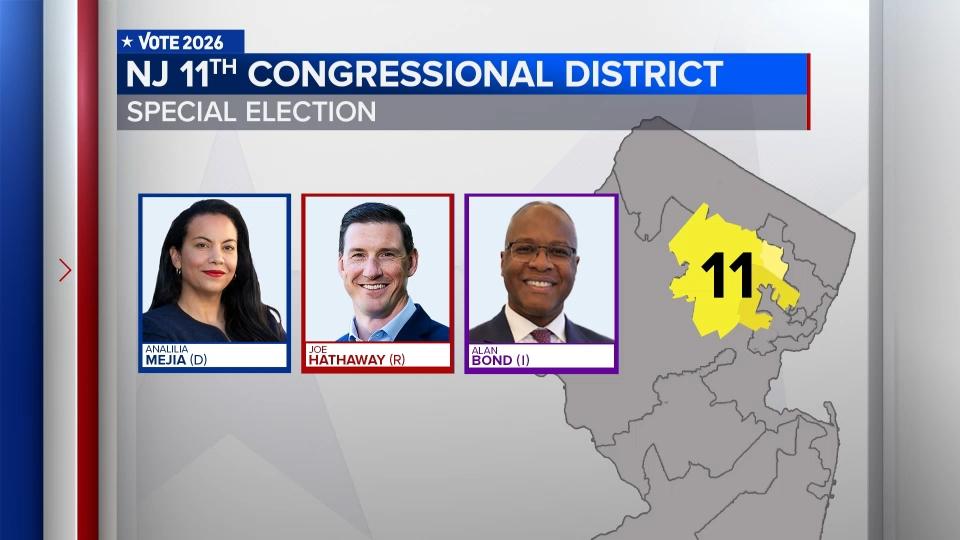
Hathaway, in a statement, argued that the “unique and, frankly, unusual election” and the “structure and timing, set by a partisan Democratic governor” produced “exactly the kind of low-turnout environment that benefits one party,” adding “We saw heavy vote-by-mail participation, limited Election Day turnout, and far too many Republican and unaffiliated voices left out of the process.”
Morristown Green reported that only 18 percent of registered voters in the district’s 27 Morris municipalities cast ballots, and it said the district’s Essex County towns were an even bigger win for Mejia.
The New Jersey Globe said registered Democrats made up more than three-fifths of the votes cast before Election Day and that Democrats were “simply much better prepared for, and enthusiastic about, a special election on a random Thursday in April.”
The Setonian added that the unexpired term runs until Jan. 3, 2027 and that the June 2 primary would be Mejia’s next challenge for a two-year term beginning Jan. 3, 2027.
Israel, “radical” labels, and reactions
The campaign’s central political clashes revolved around Israel and the “radical” label, with outlets describing how those themes played out among Jewish voters and in Mejia’s own rhetoric.
“Guess hatred of the Trump regime outweighed any concerns about her not being a moderate like Gov. Mikie Sherrill.”
Politico said Mejia’s criticism of Israel appears to have alienated a significant number of Jewish voters in the district, but it wasn’t enough to make the race close, and it quoted Mejia rejecting the “radical” label and turning it on Republicans and “ultra-wealthy titans of industry.”
In her victory speech, Mejia said, “I would say that the true radicals are Jeff Bezos, [Speaker] Mike Johnson, Palantir, Elon Musk, Donald Trump and even Joe Hathaway — radicals who are willing to upend our democracy, subvert our Constitution and act with impunity, and we must stop them,” and she added, “These radicals will watch Rome burn with all of us within, and they are simply cowards — cowards unwilling to stand up to this madness.”
Politico also reported that Mejia said she believes Israel committed genocide in Gaza and that she did not raise her hand when asked at a candidate forum if she believed Jews “have the right to self-determination in their ancestral homeland, what is commonly referred to as Zionism.”
The Daily Kos account framed the result as a rejection of concerns about Mejia’s moderation, writing that “Guess hatred of the Trump regime outweighed any concerns about her not being a moderate like Gov. Mikie Sherrill.”
Morristown Green quoted Mejia’s “WE ARE HUMANS, FIRST” message, saying, “We are humans, first. Factions, parties, ideas, ideologies — they are ephemeral. Humanity, our commitment to each other, must be permanent,” while WPG Talk Radio 95.5 FM asserted that Mejia’s platform included “ABOLISH ICE” and “UNIVERSAL HEALTHCARE — CHILDCARE FOR ALL.”
What the win means for Republicans
Politico and the New Jersey Globe both linked Mejia’s landslide to potential trouble for Republicans, but they emphasized different mechanisms for that risk.
Politico quoted New Jersey Democratic State Committee Chair LeRoy Jones saying, “I think it’s a clear sign that the MAGA movement is fading, diminishing and that democracy is at the forefront of voters’ agendas,” and it argued that the “radical” label had limited political consequence in a polarized environment.

The New Jersey Globe said the result “signals a potentially rough year for New Jersey Republicans” and described how the coexisting outcomes in Jewish towns and elsewhere were “unusual, to say the least.”
It also connected the result to Rep. Tom Kean Jr. (R-Westfield), writing that the shift could be enough to sink the two-term congressman because Trump won Kean’s 7th district by one percentage point.
Politico similarly said the question turns to what it means for Kean Jr., noting he won reelection in 2024 by 5 points and is expected to face a tough reelection in November, with four Democrats running in the June primary to take him on.
In contrast, Morristown Green reported that Dan Cassino of the FDU Poll at Fairleigh Dickinson University told it that “Republicans have yet to figure out how to mobilize Trump voters when Trump isn’t on the ballot,” framing the GOP challenge as turnout rather than ideology.
Next steps: June primary and beyond
Mejia’s victory set up immediate political deadlines, with multiple outlets describing her next contest in the June Democratic primary and the broader national stakes for Congress.
“Mejia’s next challenge is the June 2 primary, where she will compete for a seat in the House for a two-year term beginning Jan. 3, 2027.”
The Setonian said Mejia’s next challenge is the June 2 primary, where she will compete for a seat in the House for a two-year term beginning Jan. 3, 2027, and it listed three opponents for the Democratic party’s nomination: Donald Cresitello of Morristown, Joseph Lewis II of Montville, and Justin Strickland of Chatham.

Morristown Green similarly said Mejia faces challenges in June’s Democratic primary and named Donald Cresitello, Joseph Lewis, and Justin Strickland as having announced bids.
Politico said the question for Republicans is what the win means for Kean Jr., who is expected to face a tough reelection in November, and it noted that four Democrats are running in the June primary to take him on.
The Setonian also emphasized national implications by noting that Republicans hold a slim majority—218 Republicans to 213 Democrats with one Independent and four vacancies—and that even a single seat could help determine control of the chamber.
Common Dreams framed the stakes in terms of progressive momentum, saying voters “chose people over corporations” and that Mejia’s win was a sign that progressive advocates for the working class can win elections “everywhere” in the US.