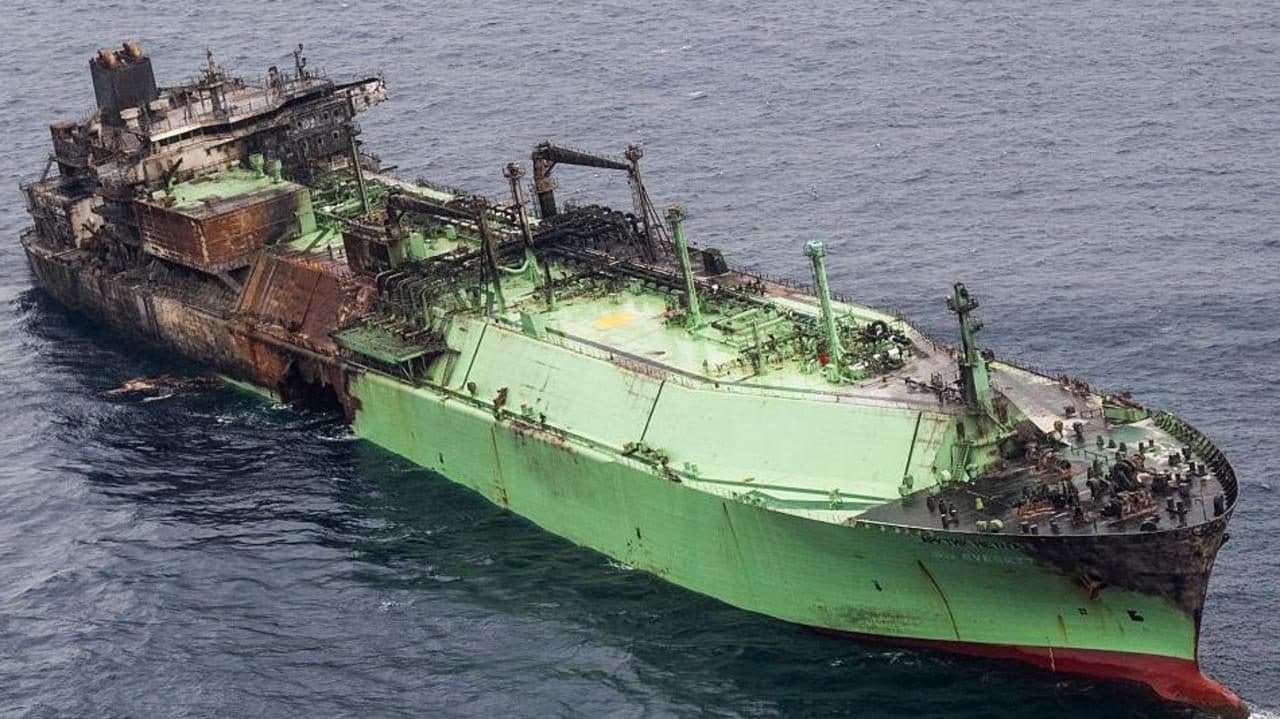
Arctic Metagaz Enters Libyan Waters as Damaged Russian LNG Tanker Drifts
Key Takeaways
- Arctic Metagaz, a damaged, crewless Russian LNG tanker, drifts uncontrollably in the Mediterranean.
- Italian authorities warn it could explode, risking a major ecological disaster.
- Nine EU nations urge the European Commission to act on the tanker crisis.
Environmental Threat Emerges
The Arctic Metagaz, a sanctioned Russian liquefied natural gas (LNG) tanker, is drifting crewless in the Mediterranean Sea after sustaining severe damage in a suspected sea drone attack earlier this month.
“A crewless, sanctioned Russian tanker carrying liquid natural gas is drifting uncontrolled through the Mediterranean Sea — and Italian officials are warning it could explode… A crewless, sanctioned Russian tanker carrying liquid natural gas is drifting uncontrolled through the Mediterranean Sea — and Italian officials are warning it couldexplode at any moment”
The vessel, described by Italian authorities as an 'environmental bomb,' has a gaping hole in its hull and poses an imminent ecological threat to one of the world's most trafficked and ecologically sensitive waterways.
European authorities including Italy, France, Spain and six other southern EU countries have issued urgent warnings to the European Commission, demanding coordinated action to address what they characterize as a major environmental emergency.
The tanker has been drifting since early March after the incident that left it without propulsion or crew, with officials warning it could 'explode at any moment' due to its volatile cargo and compromised structural integrity.
Dangerous Cargo Composition
The Arctic Metagaz carries a dangerous combination of cargo that creates extreme maritime hazards.
According to officials in Rome, the vessel is transporting 'significant quantities' of liquid natural gas along with 450 tonnes of fuel oil and 250 tonnes of diesel, making it floating potential catastrophe.

The liquid natural gas, stored under pressure and exposed through the breached hull, presents particular dangers as it can produce catastrophic explosions if ignited.
Maritime safety experts treat such conditions with extreme seriousness, noting that the combination of volatile materials, structural damage, and absence of crew creates unprecedented risks for any intervention attempt.
Environmental organizations including the World Wildlife Fund have placed the situation on 'maximum alert,' warning that any potential spill or explosion could lead to fires and long-lasting pollution in a region described as having 'exceptional ecological value,' home to numerous protected marine species.
Geopolitical Context
The incident occurs within the complex geopolitical context of Russia's war in Ukraine and the targeting of what Moscow calls its 'shadow fleet.'
“- Published A sanctioned Russian tanker loaded with liquid natural gas is drifting out of control in the Mediterranean with no crew on board and a gaping hole in one side, prompting warnings of a "serious risk of a major ecological disaster"”
The Arctic Metagaz is part of Russia's so-called shadow fleet—a network of vessels used to transport sanctioned Russian oil and gas around Western export restrictions, typically operating with minimal transparency and often switching off tracking systems.
Russian President Vladimir Putin has blamed Ukraine for what he called a 'terrorist attack,' though Kyiv has not commented on the allegation.
Ukraine has, however, consistently maintained that such 'shadow fleet' vessels are legitimate targets, arguing they operate with transponders turned off to evade Western sanctions and generate revenue that supports Russia's ongoing war effort.
Russia's Transport Ministry earlier this month claimed the tanker was attacked by Ukrainian naval drones launched from the Libyan coast, but this assertion remains unconfirmed by independent sources.
Shifting Trajectory complicates Response
The tanker's trajectory has shifted towards Libyan waters, significantly altering the response calculus for international authorities.
As of Tuesday afternoon, the vessel was approximately 45 nautical miles from Italian territorial waters and 25 miles from Libya's designated search-and-rescue zone, moving south away from Italian waters and the island of Lampedusa.
This geographical shift means that Italy's civil protection agency now states any intervention on the tanker would fall under Libyan authority due to its location in Libyan search and rescue waters.
The EU has identified the vessel as part of Russia's 'shadow fleet' used to circumvent sanctions imposed after Russia's 2022 full-scale invasion of Ukraine.
Russia's Foreign Ministry has acknowledged that the vessel was adrift in the Mediterranean and said Moscow's involvement in resolving the situation depended on 'concrete circumstances.'
The changing location complicates international coordination efforts, as multiple EU member states have written a joint letter urging the European Commission to step in with a coordinated response rather than leaving coastal states to manage the situation independently.
Fractured International Response
International response to the unfolding crisis remains fragmented despite the clear and present danger posed by the drifting tanker.
“Published by Global Banking & Finance Review® Posted on March 18, 2026 2 min readLast updated: March 18, 2026 Published by Global Banking & Finance Review® Posted on March 18, 2026 2 min readLast updated: March 18, 2026 The Russian LNG tanker Arctic Metagaz, long adrift in the Mediterranean, has now entered Libyan search‑and‑rescue waters”
Nine EU member states have collectively appealed to the European Commission for urgent coordinated action, recognizing that monitoring a drifting explosive tanker and actually stopping it are two very different challenges.
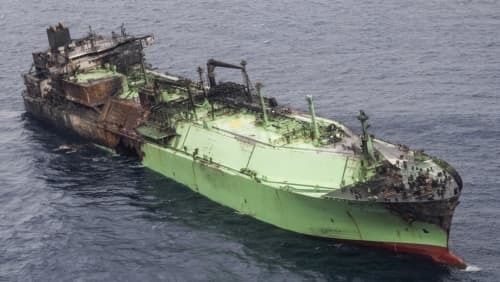
Italian and Maltese officials continue to track the vessel's movement, but no confirmed intervention operation has been announced, leaving the situation unresolved as the clock ticks.
Boarding a vessel carrying volatile LNG with a damaged hull is extraordinarily dangerous, and towing it requires getting close enough to attach lines—creating significant risk for any rescue team.
Environmental experts emphasize that what is clear is that a vessel loaded with volatile gas, sitting in international waters with a hole in its side and nobody steering it, is not a problem that resolves itself.
The Arctic Metagaz situation represents a stark intersection of maritime safety, environmental protection, and geopolitical tensions that requires immediate international cooperation to prevent what could become one of the Mediterranean's worst ecological disasters.
More on Russia
Muslim group claims responsibility for Amsterdam Jewish school explosion, mayor calls it attack on Jews
23 sources compared

Trump lifts sanctions on Russian oil, letting Moscow sell at sea
110 sources compared

President Trump issues 60-day Jones Act waiver to curb oil prices amid Iran war
14 sources compared

UK Government Boycotts Opening Ceremony After IPC Allows Russian, Belarusian Flags
13 sources compared