Gaza Genocide · 09 April, 2026 · 1 min read
Asian Development Bank Warns Middle East Conflict Will Slow Asia-Pacific Growth
ADB projects Asia-Pacific growth around 5.1% for 2026–27, slowed by Middle East conflict. Prolonged disruptions could reduce regional growth and lift inflation, depending on duration.
Geographic scope of the story (regional vs country-specific focus).
5 of 6 outlets skipped it: the Strait of Hormuz typically handles around one-fifth of global oil trade..
6outlets compared
Same story, two versions
tap a side to read it in full
GGlobal Times News
“Middle East conflict challenges Asia-Pacific resilience: ADB The ongoing conflict in the Middle East has amplified global geopolitical risks and intensified downside risks for economic growth of developing Asia and the Pacific, according to a new report released by the Asian Development Bank (ADB) on Friday.”Read the original ↗
Asian Development Bank
“Economic growth in Maldives is expected to slow sharply in 2026 as the conflict in the Middle East weighs on tourism, energy prices, and fiscal and external buffers, according to the Asian Development Outlook (ADO) April 2026, released today by the Asian Development Bank (ADB).”Read the original ↗
Shows a contrast in scale: a broad regional framing in the Global Times versus a country-specific focus (Maldives) highlighting country vulnerability to the same Middle East shock.
Asia-Pacific Growth Slows
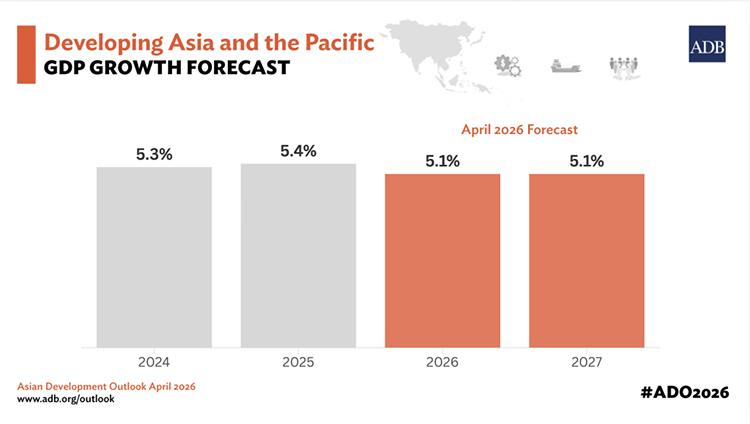
The Asian Development Bank warned that the Middle East conflict has intensified downside risks for economic growth in developing Asia and the Pacific.
“The ongoing conflict in the Middle East has amplified global geopolitical risks and intensified downside risks for economic growth of developing Asia and the Pacific”
Regional growth is expected to moderate to 5.1 percent in both 2026 and 2027, down from 5.4 percent in 2025.

If disruptions last through the third quarter of 2026, growth could slow to 4.7 percent in 2026 and 4.8 percent in 2027.
Inflation is projected at 3.6 percent in 2026 under early stabilization, but would rise to 5.6 percent if tensions last through Q3.
ADB Chief Economist Albert Park said, "Higher energy prices will raise production costs and consumer prices."
Developing Asia and the Pacific is highly vulnerable to spillovers transmitted through global energy markets, trade and transport networks, and financial conditions.
Sectoral and Regional Impacts
Growth in China is forecast to decline to 4.6 percent in 2026, down from 5 percent in 2025.
India is forecast to ease to 6.9 percent in 2026 from 7.6 percent in 2025.
Economies in the Pacific are expected to experience the sharpest slowdown.
The Maldives is forecast to slow sharply to 1.0 percent in 2026, down from 5.4 percent in 2025.
Inflationary pressures are expected to hit the region hard.
Policy Challenges and Responses
The ADB emphasized that the current environment represents a major test for Asia's growth model.
“The persistence of elevated energy prices and supply uncertainty is already tightening financial conditions and weighing on business and consumer confidence”
Policymakers are being urged to prioritize inflation containment and financial stability.
Domestic consumption is expected to remain largely resilient through 2026.
A prolonged conflict could place stagflationary pressure on regional economies.
The warning comes against a backdrop of a fragile ceasefire and ongoing uncertainty around energy flows.