
Asia · 18 April, 2026 · 7 min read
Australia And Japan Sign A$10 Billion Deal For First Three Mogami Frigates In Melbourne
Australia and Japan sign contract for three Mogami-class frigates. First three frigates to be built in Japan; remaining eight in Western Australia.
Framing of Japan's postwar pacifism/defense exports and strategic shift.
8 of 9 outlets skipped it: the claim that the recruitment and job-creation impact is significant in Western Australia (thousands of jobs) as part of the industrial transfer..
9outlets compared
Same story, two versions
tap a side to read it in full
Global Times
“Mitsubishi Heavy Industries is to supply the Royal Australian Navy with three upgraded Mogami-class multi-role frigates built in Japan from 2029.”Read the original ↗
Taipei Times
“Mitsubishi Heavy Industries would build the first three Mogami-class frigates in Japan, while Australia plans to build another eight in a shipyard in Western Australia state.”Read the original ↗
Shows contrasting emphasis on where the ships will be built first—Japan-built versus a plan to later build eight in Australia—affecting perceived industrial participation and domestic political implications.
Deal Signed in Melbourne
Australia and Japan signed contracts for the first three of a planned fleet of Mogami-class frigates in Melbourne, with Japanese Defense Minister Shinjiro Koizumi and Australian Defense Minister Richard Marles attending a signing ceremony aboard the Mogami-class frigate JS Kumano.
“Australia and Japan yesterday signed contracts to deliver the first three of a A$10 billion (US$7.2 billion) order of Japanese-designed warships”
The Taipei Times said the deal was “A$10 billion (US$7.2 billion)” and that the first three frigates were due for delivery in three years, while the Associated Press version described the overall fleet as “a 10 billion Australian dollar ($6.5 billion) fleet” and said the first due “in three years.”T
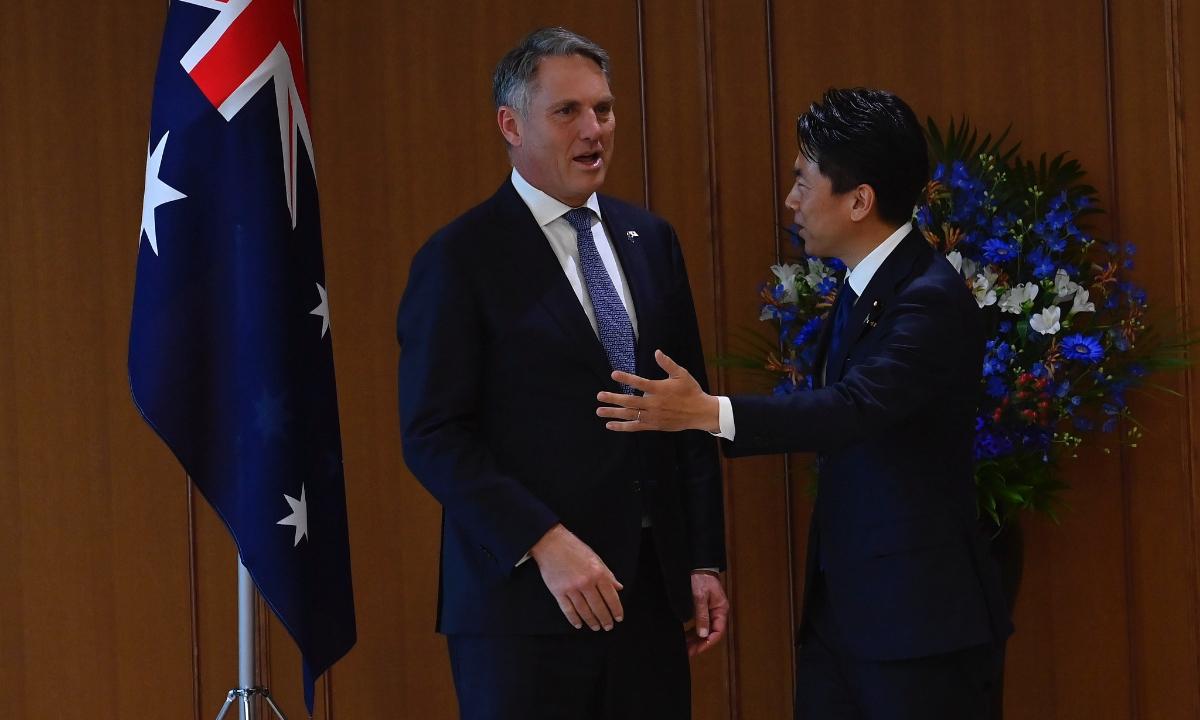
The Australian Broadcasting Corporation reported the ceremony took place aboard JS Kumano “anchored in Melbourne,” and said the memorandum was called the “Mogami Memorandum,” which “reaffirms the joint commitment to the frigates and reduces barriers to defence industry cooperation.”
Reuters was cited by Global Times as describing the sale as “Tokyo's most consequential military sale since ending a military export ban in 2014,” and as signaling Japan’s push away from postwar pacifism “to counter China.”G
The contract framework described across outlets includes Mitsubishi Heavy Industries building the first three frigates in Japan, with eight more to be built in Western Australia, and the first warship scheduled for delivery in December 2029.
The Australian Broadcasting Corporation added that the first warship is “scheduled for delivery in December 2029 and is expected to enter service in 2030,” while the South China Morning Post said the first one is scheduled for delivery in December 2029.
In the background of the signing, the Global Times and @globaltimesnews accounts also tied the ceremony to a broader bilateral defense posture, noting that Marles and Koizumi had met in Tokyo on April 8, 2026.
Industrial Build and Capabilities
Multiple outlets described how the Mogami program is structured across shipyards and what the frigates are intended to do once delivered.
The Taipei Times said Mitsubishi Heavy Industries would build the first three Mogami-class frigates in Japan, while Australia would build another eight in a shipyard in Western Australia, and it reported that the first Mogami-class frigate is due to arrive in Australia in 2029.T
The Associated Press said the first three Mogami-class frigates would be built in Japan, while “Australia plans to build another eight in a shipyard in Western Australia state,” and it described the Kumano as part of the Japan Maritime Self-Defense Forces that docked off Melbourne.
The Australian Broadcasting Corporation reported that “The first three vessels will be built in Japan, but production of the next eight frigates will shift to the Henderson shipyard in Perth, Western Australia,” where they will be constructed by Austal.
The same ABC account said the ships are equipped with “a 32-cell vertical launch system” and also “anti-ship missiles and surface-to-air missiles,” and that they require “a crew of only 90 personnel.”
The Taipei Times similarly said Australia’s Mogami-class frigates would be equipped with “surface-to-air and anti-shipping missiles,” could operate combat helicopters, and would be crewed by “92 sailors and officers.”T
The Global Times account cited Reuters to say the deal anchors Japan’s push away from postwar pacifism and that under the “three principles on transfer of defense equipment and technology,” exports of weapons with lethal capabilities are restricted but transfers are permitted for joint development and production.G
Leaders’ Statements at Signing
At the signing ceremony, both governments framed the Mogami deal as a major step in bilateral defense cooperation and as a rapid procurement timeline.
“"let's cut steel"”
The Australian Broadcasting Corporation reported that there was “a sometimes-jubilant atmosphere during the ceremony,” and it quoted the Chief of Navy and incoming Defence Force Chief Mark Hammon declaring “let's cut steel” after the two ministers signed a pact called the Mogami Memorandum.
Marles told reporters that he wanted to create a “seamless” defence industrial base with Japan, saying “There is no country in the world with whom we have a greater strategic alignment than Japan. And that in turn is underpinned by complete trust,” and he also said “The relaxation of these controls is going to be really important to developing the seamless defence industrial base we'll need to deliver the Mogami project.”
Koizumi was quoted by the ABC saying the frigates program was “a major step that was finally being being taken to elevate our defence relationship to a greater height,” and he added, “I believe there is no limitation on Australia and Japan defence cooperation.”
The Taipei Times quoted Marles saying the timeframe was “the fastest acquisition of a surface combatant into service in the Royal Australian Navy ever,” and it reported he welcomed Japan’s relaxation of export controls with “trusted partners like Australia.”T
The South China Morning Post described the ministers as signing “a document pledging close coordination to ensure the project proceeds smoothly,” and it tied the contracts to Japan’s plan to ease rules on defense equipment exports.
In the Global Times narrative, Marles and Koizumi signed a memorandum “reaffirming the Australian and Japanese governments' shared commitment to the successful delivery” of the warships, and it also quoted Japan’s ministry of defense posting on X that the ministers confirmed commitment to further strengthening Japan-Australia defense cooperation.G
Export Controls and Regional Fallout
The Mogami contracts were repeatedly linked to Japan’s evolving approach to defense exports and to concerns about regional security.
Reuters was cited by Global Times as describing the sale as “Tokyo's most consequential military sale since ending a military export ban in 2014,” and the Global Times account said it signals Japan’s push away from postwar pacifism and a move “to counter China.”G
The Global Times narrative also said Chinese experts warned the deal risks intensifying an arms race in the Asia-Pacific, adding that Japan is misjudging the situation and being overconfident in its capabilities and security environment.G
In that account, Song Zhongping, a Chinese military affairs expert, told Global Times that “It is actually Japan's ulterior motive to exporting weapons to China's neighbors to complicate regional security reality and indirectly counter China,” and it quoted him slamming Japan’s “dangerous militaristic resurgence.”G
The Global Times account also quoted Song as saying Japan is “overconfident in its capabilities of managing the situation —assuming it can expand its military role without risking domestic security,” and it said “Such misplaced confidence could lead to serious strategic misjudgment, Song added.”G
The Global Times narrative further said it is reported that the Japanese government plans to revise the implementation guidelines for the “three principles on transfer of defense equipment and technology” this month to loosen restrictions on arms export.G
It then quoted Mao Ning, spokesperson from China’s Ministry of Foreign Affairs, saying on April 7: “We urge the Japanese side to deeply reflect on its history of militarist aggression, honor its commitments and act prudently in military and security areas, and stop going further down the wrong path,” and it said China is “gravely concerned.”
Costs, Timelines, and Next Steps
The reporting also diverged on how much the program costs and how quickly it will be delivered, while still converging on a December 2029 delivery target for the first vessel.
“Australia and Japan yesterday signed contracts to deliver the first three of a A$10 billion (US$7.2 billion) order of Japanese-designed warships”
The Taipei Times said the order was “A$10 billion (US$7.2 billion)” and that the first was due for delivery in three years, while the AP described the fleet as “a 10 billion Australian dollar ($6.5 billion) fleet” and said the first due “in three years.”T

The ABC said the federal government announced in August last year that Mitsubishi won a contract to provide “the 11 warships,” and it reported that in 2024 the government said the total cost of the frigates program was “about $10 billion over the next decade,” but that last week’s defense strategy put the cost at “$20 billion.”
The ABC also said the first warship is “scheduled for delivery in December 2029 and is expected to enter service in 2030,” and it described the remaining eight shifting to the Henderson shipyard in Perth.
The South China Morning Post said the ministers previously met in Tokyo on April 8 and that they signed a document pledging close coordination, while the Global Times account said Japan’s ministry of defense posted on X that the ministers confirmed commitment to further strengthening Japan-Australia defense cooperation.G
In terms of what comes next, the Global Times narrative said it is reported that Japan plans to revise the implementation guidelines for the “three principles on transfer of defense equipment and technology” this month to loosen restrictions on arms export, and it quoted Mao Ning’s April 7 warning.G
The ABC and AP accounts, meanwhile, emphasized that the Mogami Memorandum reduces barriers to defense industry cooperation and that Marles wanted a “seamless” defense industrial base, with Koizumi saying there is “no limitation” on cooperation.