
Bernie Sanders’ Effort Fails as U.S. Senate Blocks Israel Arms Sales
Key Takeaways
- Sanders' bid to block US arms sales to Israel fails in Senate
- Forty Democrats voted to block, signaling a major shift in party stance
- The blocked packages included $295 million bulldozers and $151.8 million bombs
Senate blocks Israel arms
The U.S. Senate on Wednesday blocked an effort by Sen. Bernie Sanders, I-Vt., to halt new weapons transfers to Israel, voting down two joint resolutions that would have disapproved specific sales of bulldozers and bombs.
“A vote in the United States Senate to block military equipment for Israel this week ended in defeat”
Roll Call figures in the source show the Senate defeated motions to discharge the measures by 40-59 for the bulldozers and 36-63 for the bombs, with the votes described as “largely along party lines.”
The Intercept also frames the outcome as a “watershed moment” in the Senate, noting that Sanders “forced a vote on Wednesday to block the sales of bombs and bulldozers to Israel” and that the resolutions “failed mostly along party lines.”
The Times of Israel reports the Senate “voted down a pair of resolutions to prevent sales of weapons and bulldozers to Israel,” emphasizing that “Forty out of 47 Senate Democrats voted in favor” of blocking the $295 million bulldozer sale while “Fifty-nine senators — mostly Republicans — voted against blocking the sale.”
For the bombs, The Times of Israel says “Thirty-six Democrats backed another resolution aimed at blocking a $152 million sale of 1,000-pound bombs,” while “Sixty-three senators voted against blocking the sale.”
The Middle East Online account adds that “The Republicans and a number of Democrats voted against two resolutions to halt the sale of bombs and bulldozers worth about $450 million,” and it notes that “Eleven Democrats joined all Republicans to block the measure, 63 to 36.”
Across the sources, the central dispute is whether Congress should use its “only formal mechanism” to stop the transfers, as Anadolu Ajansı describes Sanders saying, “I am offering today two joint resolutions of disapproval, the only formal mechanism Congress has to block an arms sale.”
What the resolutions targeted
Sanders’ two resolutions targeted distinct categories of equipment and were tied in the sources to Israel’s conduct in Gaza, Lebanon, and the West Bank.
Roll Call says the first joint resolution would have disapproved a $295 million sale of D9R and D9T Caterpillar bulldozers, while the second would have disapproved a $151.8 million sale of 12,000 general purpose 1,000-pound gravity bombs and related support services.

The New York Times similarly describes the Senate blocking “the sale of bulldozers and 12,000 bombs,” and it frames the vote as part of a widening Democratic divide driven by concerns over the Iran war.
Anadolu Ajansı provides Sanders’ floor description of the same two disapprovals, saying “The first resolution would block the sale of $151 million in 1,000-pound bombs” and “The second would block $295 million in bulldozers, the machines used to demolish homes in the West Bank and Gaza and make a Palestinian state physically impossible.”
The Times of Israel gives slightly different bomb-sale framing, saying the second resolution aimed at “blocking a $152 million sale of 1,000-pound bombs to the IDF,” while also describing the bulldozers as a $295 million sale.
Common Dreams and The Intercept both connect the bulldozers to demolitions and the bombs to attacks in Gaza, with Common Dreams quoting Sanders’ post-vote framing that “Today, more than 80% of the Democratic caucus stood with the American people and voted to block U.S. military aid to [Israeli Prime Minister Benjamin] Netanyahu and his horrific, illegal wars.”
In the same vein, Roll Call reports Sanders’ argument that “The bulldozers, he argued, were the same vehicles Israel used to demolish homes in Palestine, raze refugee camps and build “settler-only roads that make a Palestinian state physically impossible.”
The Intercept’s account also emphasizes that Sanders “forced a vote on Wednesday to block the sales of bombs and bulldozers to Israel,” and it notes that the resolutions failed “mostly along party lines” with “a handful of defections to the Republican side.”
Voices inside the vote
The sources portray a sharp split among lawmakers, with Sanders and some Democrats arguing the transfers would deepen U.S. involvement in conflicts, while Republicans and other Democrats warn that blocking sales would weaken Israel and U.S. reliability.
“Senator Sanders moves to block US arms sales to Israel, forcing Senate votes American people do not want US to continue spending billions of dollars in support of 'illegal, horrific and expansionist war policies' of Israel, lawmaker says Diyar Guldogan 16 April 2026•Update: 16 April 2026 WASHINGTON US Sen”
Sanders is quoted in Roll Call panning Israel’s war in Gaza and saying, “The time is long overdue for members of the U.S. Senate to start listening to the American people and not to AIPAC,” and he adds, “The time is now to end all U.S. military aid to the extremist Netanyahu government, and a yes vote is an important way forward.”
Roll Call also quotes Sen. Jeff Merkley, D-Ore., saying, “Make no mistake: A vote to approve arms sales to Israel at this time would be seen as a message of approval for Trump and Netanyahu’s disastrous war against Iran. I will not send that message,” and it includes Sen. Mark Kelly’s statement that “The United States and Israel are fighting a war against Iran without a clear strategy or goal.”
On the other side, Roll Call quotes Senate Foreign Relations Chairman Jim Risch, R-Idaho, saying, “That is unacceptable,” after arguing that refusing to sell Israel the weapons would send the message that the U.S. was ready to abandon a key ally.
The Times of Israel adds another set of voices, including Sen. Elissa Slotkin saying, “But being pro-Israel today is not about simply supporting the political or military agenda of Prime Minister Netanyahu,” and it quotes Slotkin’s warning that “being pro-American should not be equated with loyalty to President Trump.”
The Middle East Online account quotes Sanders’ leverage argument directly: “The United States must use the leverage we have—military weapons and tens of billions in military aid—to press Israel to stop these crimes.”
It also reports that supporters of arms sales argue Israel is an “important ally the United States should sell military equipment to,” while the Intercept quotes former Sanders foreign policy adviser Matt Duss describing a “watershed moment” and pointing to a “hawkish faction” in the Democratic Party.
Together, the sources show the vote as not only procedural but also a referendum on how lawmakers interpret the Iran war and Israel’s operations in Gaza and Lebanon.
How outlets frame the same vote
While the vote arithmetic is consistent across many accounts, the sources frame its meaning differently, emphasizing either Democratic discontent, the limits of congressional power, or the implications for the Iran war.
Al Jazeera calls the result an “inflection point” and says the vote shows “massive cracks” in U.S. support for Israel, quoting Hassan el-Tayyab saying, “This was not only a vote about arms sales, but a vote against further escalation, including a wider war with Iran.”

It also quotes Beth Miller saying, “Last night was an inflection point,” and it describes her view that the vote forced senators to answer “the very simple question: Do you really want to keep arming the Israeli military, yes or no?”
In contrast, Punchbowl News highlights internal Democratic rifts and leadership dynamics, saying “Two Senate resolutions authored by Sen. Bernie Sanders (I-Vt.) got an unprecedented level of support from the Democratic Caucus even as their leader, Chuck Schumer (D-N.Y.), voted against both.”
Punchbowl also quotes Sanders hailing the results as “a sign of Democratic discontent “with Netanyahu and his horrific, illegal wars.”
The New York Times frames the same vote as a deepening Democratic divide tied to the Iran war, saying “Supported by Concerns over the Iran war led several Democratic senators who had rejected past bids to curb weapons transfers to Israel to vote to block the sale of bulldozers and bombs.”
The Times of Israel emphasizes the scale of Democratic support, describing “an unprecedentedly overwhelming majority of Democrats” and noting “Forty out of 47 Senate Democrats voted in favor” of blocking bulldozers.
The Intercept, meanwhile, uses the vote to argue about anti-war candidates and presidential power, quoting Matt Duss that there is “a real constituency here for this message” and describing a “foreign policy establishment” “addicted to militarism.”
Common Dreams frames the vote as a “new high water mark” and includes Sanders’ post-vote claim that “When we started this effort there were just 11 votes, now there are 40.”
Even JNS.org, which is strongly pro-Israel, frames the outcome as “Nearly all Senate Democrats vote to block Israel arms sales,” while listing which Democrats voted against both measures and noting that “Every Republican who voted opposed the motions.”
What happens next
The sources describe the vote as part of a broader legislative and political struggle over U.S. authorization, war powers, and future arms transfers, with multiple accounts pointing to Congress’s limited ability to cancel sales without further action.
The Middle East Online account says the U.S. House “endorsed the military campaign by Trump against Iran,” and it reports the War Powers resolution was defeated “by 214 votes to 213 in the House,” after the Senate rejected a similar resolution the day before.
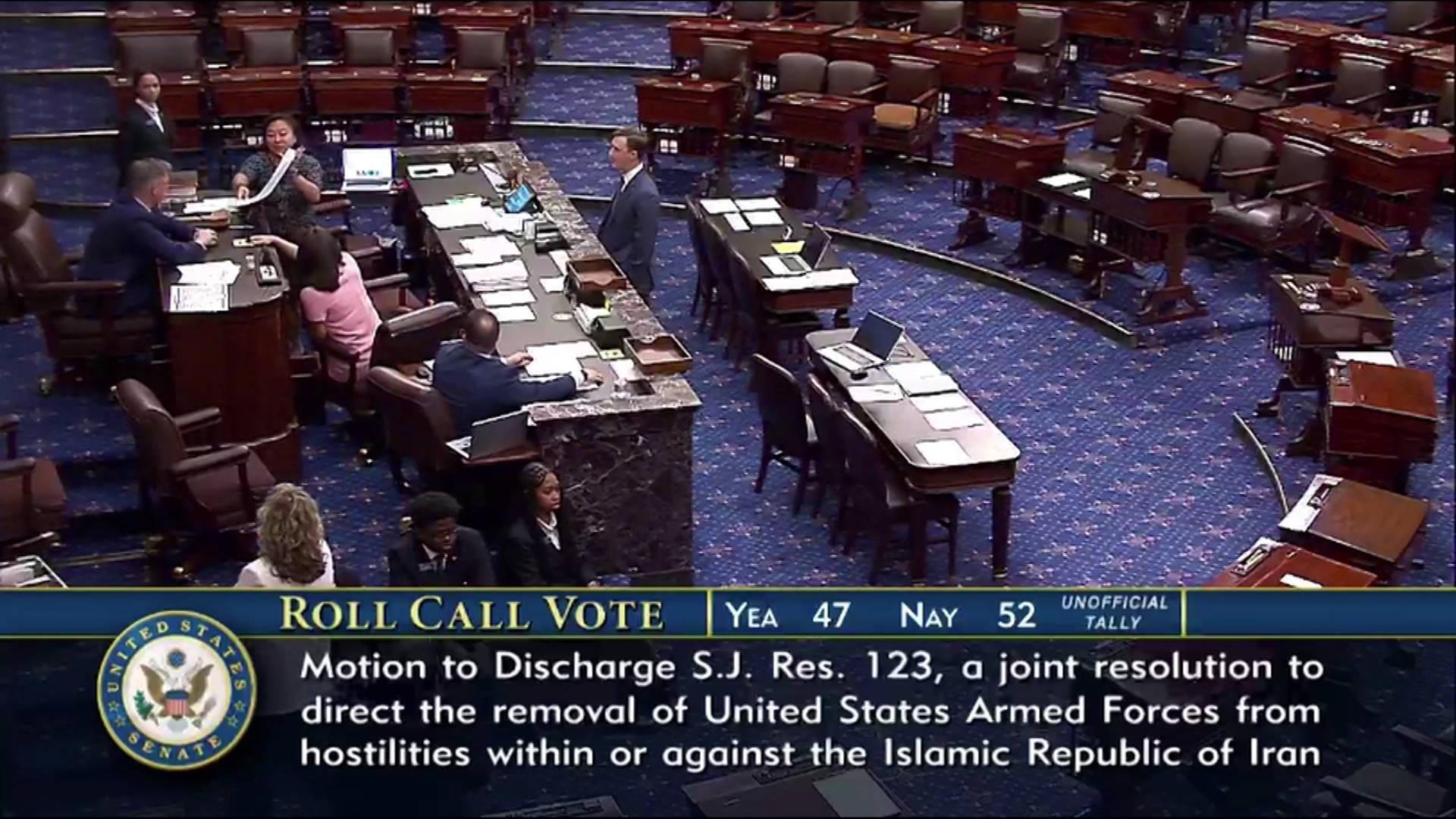
It also says Democrats urged the president to return to Congress to obtain authorization, noting that “the U.S. Constitution states that it is Congress, not the president, that has the power to declare war.”
The Times of Israel explains the procedural constraint, stating that “Congress has the power to cancel weapons transfers proposed by the administration, but only if both chambers pass disapproval resolutions and the president signs them, or supermajorities override his veto.”
Roll Call similarly situates the vote within a pattern of failed attempts, noting that “During a similar vote last July, just 23 Democrats voted with Sanders,” and it adds that “Since 1974, when Congress amended the Foreign Military Sales Act, only one joint resolution of disapproval (out of 127 filed) has been enacted into law.”
Al Jazeera adds that the vote occurred “amid growing anger over the conflict with Iran,” and it quotes Sanders saying in a statement that “Americans, whether they are Democrats, Republicans or independents, want to see our tax money invested in improving lives here at home — not used to kill innocent women and children in the Middle East.”
Looking ahead, the sources also include the idea that the issue could shape future Democratic politics and candidate positioning, with The Times of Israel saying “Every Senate Democrat rumored to have presidential ambitions voted to block both arms sales,” and it lists names including Mark Kelly and others.
In the immediate legislative pipeline, the sources do not describe a new vote date, but they do emphasize that the next steps depend on whether both chambers can pass disapproval resolutions and whether the president signs them or a supermajority overrides a veto.
More on Gaza Genocide

Israel Detains Jerusalem Grand Mufti Sheikh Muhammad Hussein, Bans Him From Al-Aqsa for One Week
15 sources compared

Israeli Security Forces Kill Four Bani Odeh Family Members Near Tubas in West Bank
14 sources compared

Haley Stevens And Abdul El-Sayed Clash In Michigan Senate Debate Over Israel And Gaza Policy
12 sources compared

Settlers Attack Hawara, Injuring 13 Palestinians South of Nablus
13 sources compared