
Bernie Sanders’ Senate Effort Fails to Block Israel Weapons Sales as Democrats Split
Key Takeaways
- Sanders-led efforts to block Israel arms sales failed in the Senate.
- Forty Democratic senators supported blocking the sale, signaling a party split.
- The bid targeted armored bulldozers and heavy bombs.
Democrats split on Israel arms
In a vote that multiple outlets described as a major shift, the U.S. Senate rejected efforts led by Vermont independent and progressive leader Bernie Sanders to block weapons sales to Israel, even as a record number of Senate Democrats supported the disapproval resolutions.
“A vote in the United States Senate to block military equipment for Israel this week ended in defeat”
South African Jewish Report said “Now, 40 senators ‒ all but seven Democrats ‒ voted for at least one of the two resolutions they faced on Wednesday,” while The Guardian reported that “40 senators backed a resolution brought by Sanders” to prevent the sale of bulldozers and “36 members voted for a second resolution” to halt bombs.

The Times of Israel likewise said “Forty out of 47 Senate Democrats voted in favor” of blocking a “$295 million sale of bulldozers,” and “Thirty-six Democrats backed another resolution aimed at blocking a $152 million sale of 1,000-pound bombs.”
The vote totals also differed by outlet in how they framed the final outcome: Legis1 said the motion to discharge “S.J.Res. 138” “failed in the Senate on Wednesday, April 16,” with “The final tally: 36 in favor, 63 opposed,” while Al Jazeera described the bulldozer measure as ending in defeat with a “40-59 vote.”
The Guardian characterized the moment as a growing appetite among Democrats to impose limits, writing that “the votes revealed a growing appetite among Democrats to impose limits on US weapons transfers to a longtime US ally.”
Across the coverage, Republicans voted as a bloc against the disapproval resolutions, and the Senate’s Republican majority ensured the measures did not pass.
What the resolutions targeted
The disapproval votes were tied to specific arms packages and specific Senate procedures, with outlets describing both the equipment and the legal mechanism.
The Guardian said Sanders’ resolution would have prevented “the sale of $295m in bulldozers,” and a second resolution would have halted “a $151.8m sale of 12,000 1,000lb bombs.”

ynetnews said the deals were “valued at $446.8 million” and included “D9 bulldozers worth $295 million and 12,000 heavy bombs,” with each bomb “weighing 450 kilograms,” and i24NEWS described the targeted components as “a $300 million deal for bulldozers and a $150 million deal for 1,000-pound bombs.”
Legis1 provided the most procedural detail, saying the motion to discharge “S.J.Res. 138” would have blocked a “$151.8 million sale of 1,000-pound gravity bombs to Israel,” and that it targeted “12,000 BLU-110A/B ‘dumb’ gravity bombs sold via emergency authority that bypassed the standard congressional notification process.”
Legis1 also explained the Arms Export Control Act pathway, stating that Congress can block such transfers “but only if both chambers pass disapproval resolutions and the president either signs them or is overridden by a supermajority.”
The Times of Israel framed Sanders’ claims about intended use, saying the bulldozers would be used “to demolish homes in the West Bank, Gaza and Lebanon,” and that the bombs would be used “in Gaza and Lebanon.”
Quotes from senators and advocates
The debate around the Senate votes was carried through direct statements from senators and advocacy groups, with multiple outlets quoting the same central arguments about Israel policy and the Trump administration’s role.
“← Back to News Senate Blocks Effort to Stop Israel Arms Sale as Democrats Split as GOP Stands Firm By Legis1 Editorial · Legis1 News Thursday, April 16, 2026”
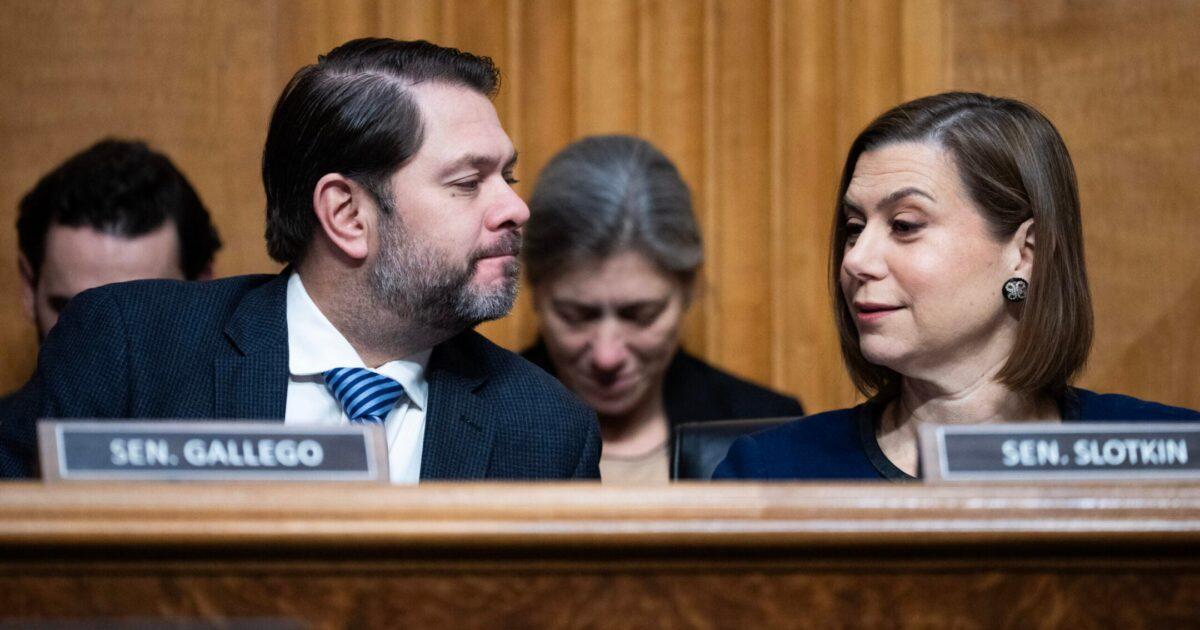
South African Jewish Report quoted Sen. Elissa Slotkin of Michigan saying, “I have struggled with these Joint Resolutions of Disapproval as much as any vote since I joined Congress,” and she added that being pro-Israel “is not about simply supporting the political or military agenda of Prime Minister Netanyahu.”
That same outlet quoted Mark Kelly of Arizona saying he “cannot and will never abandon Israel” but was voting to stop the weapons transfers because he opposes “the reckless decisions being made by Prime Minister Netanyahu and President Trump.”
The Times of Israel quoted Sanders urging leverage, saying, “The United States must use the leverage we have — tens of billions in arms and military aid — to demand that Israel ends these atrocities,” and it also quoted Sanders after the vote: “It’s clear that Democrats are beginning to listen to the average American who is sick and tired of spending billions of dollars to support Netanyahu’s horrific wars when people in this country can’t afford housing or health care.”
Al Jazeera included quotes from rights advocates, with Hassan el-Tayyab saying the vote made clear “a majority of Senate Democrats now oppose unconditional aid to Israel,” and Beth Miller calling it “shameful” that lawmakers continue to vote to arm Israel while praising the “inflection point” framing.
On the opposition side, Al Jazeera quoted Republican Senator Rick Scott accusing Democrats who voted yes of siding “with terrorism,” and it also quoted Jim Risch warning the resolutions could embolden Iran and “send the message that the United States is prepared to leave our ally Israel vulnerable.”
Different outlets, different frames
While the underlying vote results were broadly consistent, outlets diverged in how they framed what the Senate action meant for U.S. politics and Israel policy.
The Guardian emphasized that the votes “revealed a growing appetite among Democrats to impose limits on US weapons transfers,” and it described the moment as the “fourth time Sanders… had forced consideration” of similar resolutions.

Al Jazeera framed the same outcome as “massive cracks” and called the result an “inflection point,” quoting Beth Miller saying the 40 votes “shows massive cracks in the political pillar that upholds the US-Israel alliance.”
Punchbowl News highlighted the internal party rebellion by noting “Two Senate resolutions authored by Sen. Bernie Sanders (I-Vt.) got an unprecedented level of support from the Democratic Caucus,” and it stressed that “Schumer — strongly pro-Israel but anti Netanyahu — is the highest-ranking Jewish elected official in U.S. history.”
South African Jewish Report foregrounded the scale of Democratic support, writing “Now, 40 senators ‒ all but seven Democrats ‒ voted for at least one of the two resolutions,” and it tied the shift to a “survey released this week” finding “80% of Democratic voters hold an unfavourable view of Israel.”
Legis1, by contrast, focused on the mechanics and the math, describing the discharge motion as failing because “The discharge motion needed 51 votes. It got 36,” and it explained that the sale was initiated under “emergency authority” that “bypassed the standard congressional notification process.”
What happens next
The reporting connected the Senate vote to immediate political pressure and longer-term questions about how Congress can constrain executive arms sales.
“Democrats and Israel”
South African Jewish Report said Jewish Voice for Peace Action’s Morriah Kaplan warned that “Establishment Jewish institutions will spend the next week writing angry letters to the senators who voted ‘yes’ and trying to convince US Jews that these politicians are putting our community in danger,” while also quoting Kaplan’s argument that “our community is no longer falling for the disastrous lie that our safety will come through bombs, bulldozers, walls, or repression.”
It also noted that the American Jewish Committee’s response was limited to a tweet: “Thank you to the senators who continue to stand by Israel as it continues to face ongoing terror threats on multiple fronts.”
Al Jazeera described the political stakes in terms of escalation and Iran, quoting Hassan el-Tayyab that the vote was “a vote against further escalation, including a wider war with Iran,” and it quoted Sanders saying “Americans… want to see our tax money invested in improving lives here at home — not used to kill innocent women and children in the Middle East.”
Legis1 emphasized that the broader question “remains unresolved,” adding that “Sanders has now forced multiple such votes, and multiple times the outcome has been the same,” but that “what’s changed is the size of the Democratic defection.”
In the background of the vote, ynetnews said the Trump administration declared a “state of emergency to bypass Congress and expedite the transfer of the bombs to Israel,” and it quoted Chris Van Hollen saying, “If we want to rein in a Trump administration that launched an illegal war against Iran, we should also rein the Netanyahu administration that's doing exactly the same thing with American taxpayer dollars.”
More on USA

Donald Trump Sends U.S. Delegation to Pakistan for Iran Talks, Threatens Power Plants and Bridges
47 sources compared

Shooting Near University of Iowa Campus Leaves Five Injured, Including Three Students
22 sources compared

United Flight 2092 Diverted to Pittsburgh After Crew Reported Possible Security Issue
12 sources compared

Pope Leo XIV Defuses Tensions With Donald Trump During Africa Tour
20 sources compared