Technology and Science02 May, 20265 min read
China’s EV Price War Turns Into AI Arms Race at Beijing Auto Show
This article is an automated aggregation of coverage from news outlets. Our editorials offer in-depth analysis curated by the NewsCord team.
Beijing Auto Show underscores Chinese EVs' tech leadership and innovative features. BYD, Xiaomi, and Xpeng headline the display, signaling domestic dominance in EVs.
AI features replace price cuts
At the Beijing auto show, China’s electric-vehicle price war is turning into an “AI arms race” as automakers add more in-car artificial intelligence features while trying to survive a prolonged slide in margins. CNBC reports that electric carmakers in China have shifted competition from “extending battery range” and “rolling out driver-assist systems” toward “a suite of in-car AI features.” The same CNBC account says “More than 50 car brands now use ByteDance's Doubao AI model,” and that Volcano Engine announced at the show that Doubao is in “145 car models and over 7 million vehicles.”
CNBC also links the rollout to remote software updates, quoting Audi and SAIC Cooperation Project CEO Fermín Soneira: “We will keep on integrating new features faster,” and noting that automakers can deploy tech updates “over-the-air.” The article adds that Volcano Engine’s auto show booth included demos of “Chinese-language and English-language AI systems for cars,” positioning the technology as a cockpit upgrade rather than a standalone app. CNBC further frames the competitive pressure as persistent, quoting Soneira that “It's going to remain tough, because the capacity is there,” and that “This price war is not going to really stop in the next month.”
Doubao and Qwen enter the cabin
Beyond Doubao, CNBC reports that Alibaba’s Qwen artificial intelligence model is also being integrated into vehicles, expanding the number of voice-driven tasks that can run through the car’s interface. CNBC says Alibaba announced Friday that Qwen will be integrated into vehicles from automakers including BYD and “a local joint venture of Volkswagen.” The system is described as allowing drivers to “order food delivery, book hotels, buy tickets to attractions and track packages, among other features, through voice commands.”
CNBC adds that the model “will run on Nvidia's automotive chip system” and is “designed to function even with limited network connectivity.” The same CNBC article ties this to consumer expectations for connected features, stating that the shift toward AI reflects demand for “Huawei-smartphone-compatible interfaces or voice-based assistants such as Doubao.” It also includes a caution from Tu Le, founder and managing director at consultancy Sino Auto Insights, who told CNBC’s Eunice Yoon that “AI should run in the background to support the user experience, not necessarily be a feature of a vehicle.”

Show scale and the race for luxury
Multiple outlets describe the Beijing auto show as a massive stage for Chinese EV and AI demonstrations, with the event’s scale and the number of vehicles on display used to underline how quickly technology is being showcased. Europe 1 says the show covers “380,000 square meters — equivalent to more than 50 soccer fields,” and that “More than 1,400 vehicles from hundreds of foreign and Chinese manufacturers will be shown to the public from April 28 to May 3.” Zonebourse similarly says the show “spans 380,000 square meters — the equivalent of more than 50 football fields,” and that “More than 1,400 vehicles from hundreds of foreign and Chinese automakers will be on public display from April 28 through May 3.”
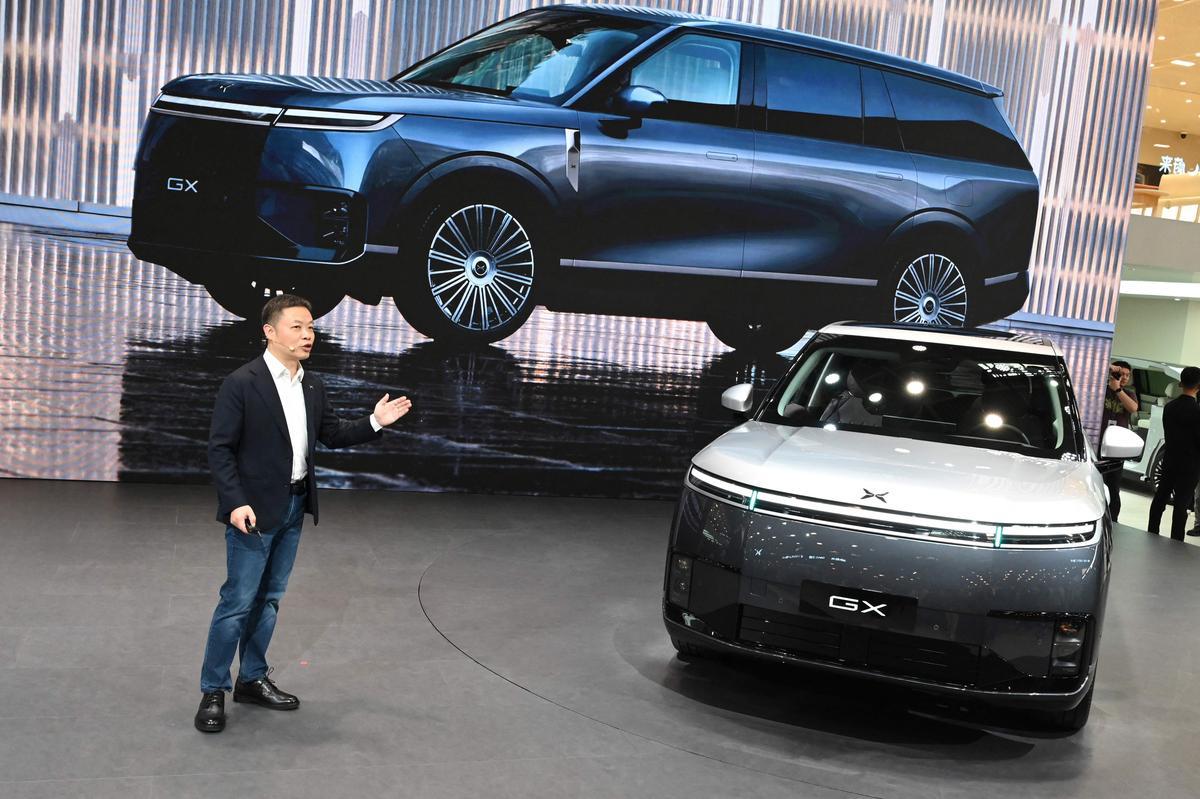
Sud Ouest adds that the show opened “on Friday” and repeats that it covers “380,000 square meters, the equivalent of more than 50 football fields,” while also describing “hyper-energized managers” trying to woo buyers. Within that environment, the competition is portrayed as moving upmarket, with luxury-oriented models and premium features emphasized across the coverage. Europe 1 highlights XPeng’s GX as a “large six-seat SUV that integrates AI technologies and targets the luxury market,” and says it will be followed by “humanoid robots” and then “flying cars” that XPeng hopes to begin mass production next year.
Charging, batteries, and software-defined cars
While the show’s AI features draw attention, other reporting emphasizes the infrastructure and battery speed that make EVs practical at scale. Sud Ouest says Economy Minister Roland Lescure announced “a plan for a massive deployment of charging stations in condominiums thanks to funding from France’s Caisse des dépôts,” linking policy and infrastructure to the broader EV push. Le Grand Continent reports that on Tuesday the 21st, ahead of the show’s opening, CATL unveiled a new battery capable of charging “from 10% to 98% in just six and a half minutes,” and it contrasts that with nickel-manganese-cobalt batteries that can go “from 10 to 80% in 18 minutes.”
The same Le Grand Continent analysis says Audi CEO Gernot Döllner told an interview that the brand had “underestimated the complexity of the shift toward vehicles defined primarily by software, and not just by quality or design.” Ars Technica, meanwhile, frames the debate around whether the hype is justified and ties the US policy environment to Chinese EV adoption, quoting that President Joe Biden levied a “100 percent tariff on Chinese EVs.” Ars Technica adds that “more than 70 Democratic representatives called for maintaining barriers to Chinese cars for both national security and economic reasons.”

Brand audits, partnerships, and what’s next
The show coverage also highlights how foreign automakers are responding through partnerships and how Chinese companies are pushing into new segments. Europe 1 says foreign manufacturers are expanding collaborations with Chinese companies to avoid lagging, citing that “BMW has for example partnered with CATL, the Chinese battery giant,” that “Audi uses Huawei's driving assistance systems,” and that “Volkswagen develops electric vehicles with Xpeng.” Sud Ouest repeats the same partnership pattern, stating “BMW has for example partnered with the Chinese battery giant CATL,” “Audi uses Huawei’s driving-assistance systems,” and “Volkswagen is developing electric vehicles with Xpeng.”
Zonebourse similarly says “BMW, for example, has partnered with CATL,” that “Audi uses Huawei's driver-assistance systems,” and that “Volkswagen is developing electric vehicles with Xpeng,” while adding that Xpeng’s Brian Gu said companies are leveraging strengths to collaborate “in China as well as abroad.” The CNBC report adds that the AI feature race is not only about differentiation but about speed of deployment, quoting Stephen Dyer that “technology, they're going to have to race and keep racing, because it disseminates so quickly that you're never going to be able to sustain a differentiated technology for long.” Finally, the Le Guide de l'auto account describes how some concepts are being positioned for production, saying BYD plans to start production and marketing of the Formula X “next year,” and it notes that the IONIQ V is “ready for production as the first IONIQ model dedicated to the Chinese market.”