
Donald Trump Blames JD Vance as Iran Deal Faces Questions Over Nuclear Program
Key Takeaways
- Trump announced a deal with Iran; JD Vance is vice president and lead negotiator.
- Administration doubts Iran will fulfill its commitments.
- Deal aims to end the war and reopen the Strait of Hormuz.
Deal announced, blame shifts
On Sunday, Donald Trump ceremoniously announced that a deal with the Islamic Republic had been reached to end the war, and he wrote in a Truth Social post on his 80th birthday, “Ships of the World, start your engines. Let the oil flow!”
“Rubio lets Vance take the fall as Iran deal questions mount - Rubio has remained effectively mum since a preliminary peace deal was announced by the administration on Sunday”
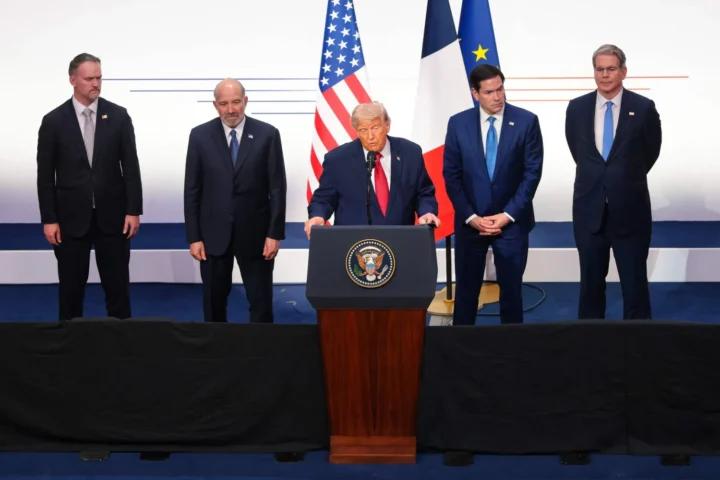
The Los Angeles Times said Secretary of State Marco Rubio stood “silent and stone-faced” behind Trump on Wednesday as the president joked of passing the buck if the Iran deal ultimately falls apart.

Trump said, “If it doesn’t work out, I’m blaming JD,” as JD Vance, who led the negotiations toward a memorandum of understanding with Iran, was set to sign the agreement this week in Switzerland.
The New Republic reported that Iran has agreed to return to its prewar position of allowing the free movement of trade through the Strait of Hormuz and pledging not to produce or acquire a nuclear weapon, while the deal offers a $300 billion investment fund, sanctions relief, and the potential to implement tolls in the strait after just 60 days.
The Independent added that early reports on the provisional deal suggest Iran has agreed to never develop nuclear weapons, maintain its ongoing programme at the current restricted level, prevent further enrichment of uranium and stop the expansion of its nuclear facilities.
Doubts inside Trump team
The Independent reported that even key members of Donald Trump’s administration have cast doubt over his peace deal with Iran and think Tehran won’t stick to its side of the bargain, citing a report based on discussions involving secretary of state Marco Rubio, hawkish defense secretary Pete Hegseth and CIA director John Ratcliffe.
Axios quoted in The Independent said Ratcliffe gathered evidence by U.S. intelligence officials that casts doubts about Iran’s willingness to make the nuclear concessions, with one source saying, “The intelligence reflects that the Iranian intentions are not in line with their commitments under the deal.”

The New Republic described Rubio as “remained eerily quiet throughout the process,” while it said Vance has become the face for the controversial deal and is carrying the political liability as critics call it a complete surrender.
The Independent also said a White House official responded that “This MOU (Memorandum of Understanding) meets all of the redlines” by ensuring that Iran can never possess a nuclear weapon, cannot keep its highly enriched uranium, and cannot hold the world's energy supply hostage.
The New Republic added that Trump joked at the G7 Summit Wednesday, “If it doesn’t work out, I’m blaming JD. You better be careful, JD!”
Unresolved questions ahead
وكالة شهاب الإخبارية said Axios revealed eight questions it described as “unresolved” for the agreement announced by U.S. President Donald Trump with Iran to end the war, with senior administration officials telling reporters on Monday that the U.S.–Iran deal was signed electronically on Sunday by Trump, Vice President J.D. Vance, and Iranian Parliament Speaker Mohammad Bagher Ghalibaf.
“It seems that Vice President JD Vance has been chosen to carry the can for Donald Trump’s nascent peace deal with Iran”
The same report said the 60-day ceasefire extension has taken effect immediately, but “the opening of the Strait of Hormuz is not expected to begin until the formal signing ceremony on Friday in Geneva,” setting up a near-term test of whether the temporary pause can become a broader settlement.
It added that Axios quoted American officials saying the deal calls for shipping volumes through the Strait to return to pre-war levels within 30 days, while Iranian officials told official media that the Strait would not simply return to 'pre-war' conditions and that Iran would retain a certain level of control.
The Independent said other reported elements of the deal include unfettered toll-free access for commercial ships through the Strait of Hormuz, a cessation of all Israeli military action in Lebanon, and relief from economic sanctions, while a joint statement released on Monday said Britain, Germany, France and Italy would be prepared to lift sanctions on Iran in response to “clear, verifiable steps” to limit its nuclear program.
The Los Angeles Times reported that the deal delays highly technical discussions over the mechanics of unwinding Iran’s nuclear program while granting Tehran immediate relief, including lifting a U.S. naval blockade of Iranian ports that will allow Iranian imports and exports to resume.
More on Iran

Trump Signs Iran MOU, Lifts Blockade, Reopens Strait of Hormuz for 60-Day Talks
14 sources compared
Donald Trump and Masoud Pezeshkian Sign U.S.-Iran MOU to Halt Fighting and Reopen Strait of Hormuz
15 sources compared
US Lifts Naval Blockade of Iranian Ports as JD Vance Says Oil Flows Through Strait of Hormuz
18 sources compared

Iran’s Supreme National Security Council Exempts Hormuz Transit Fees for 60 Days
28 sources compared