USA22 May, 20263 min read
Donald Trump Faces Senate Resistance Over $1.776 Billion Jan. 6 Fund And $70 Billion Budget
This article is an automated aggregation of coverage from news outlets. Our editorials offer in-depth analysis curated by the NewsCord team.
Senate rejected Trump's demands, marking notable Republican defiance. Demands included a $1.776 billion fund for Jan. 6 rioters.

Senate rejects Trump demands
U.S. President Donald Trump’s push for a $1.776 billion fund for Jan. 6 rioters and others he believes were wrongly prosecuted met resistance in the Senate, where angry Republican senators refused and postponed a vote on a roughly $70 billion budget package that would fuel Trump’s immigration and deportation operations into 2029.
The voting was postponed until Congress resumes next month, blowing Trump’s June 1 deadline to have the package on his desk, and Trump responded when asked during an event at the Oval Office if he was losing control of the Senate by saying, “I really don't know.”
The dispute unfolded after Trump swept midterm primary elections, taking down Sen. Bill Cassidy in Louisiana and Rep. Thomas Massie in Kentucky, and endorsing the challenger to Sen. John Cornyn in Texas.
In the Republican-led House, enough GOP lawmakers broke ranks to signal support for a war powers resolution from Democrats designed to halt Trump’s military action in Iran, and House Speaker Mike Johnson postponed voting until he could ensure an outcome that avoids confronting the president.
The immediate flashpoint also included Trump’s nearly $1.8 billion “anti-weaponization” fund, which the Senate rejected as too toxic for the chamber to bear, leaving Acting Attorney General Todd Blanche to meet behind closed doors with senators and leave without a resolution.
Tillis and McConnell react
Sen. Thom Tillis, R-N.C., attacked the White House plan for restitution tied to Trump’s “anti-weaponization” fund, asking, “Under what circumstances would it ever makes sense to provide restitution for people who were either pled guilty or were found guilty in a court of law?”
Tillis derided the White House move as “stupid on stilts” and a “payout for punks,” while GOP Sen. Mitch McConnell of Kentucky said, “So the nation's top law enforcement official is asking for a slush fund to pay people who assault cops? Utterly stupid, morally wrong — Take your pick,” after the closed-door talks ended without a resolution.

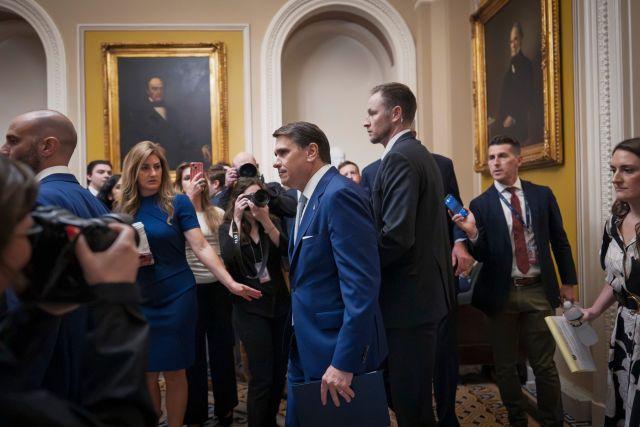
Senate Majority Leader John Thune, R-S.D., said the discussion likely left the administration’s team with “an appreciation for the depth of feeling on the issue,” as senators weighed what they had to gain or lose by appeasing Trump.
The political fallout was framed around the narrow margin in the Senate, where Republicans hold 53 seats in the 100-member chamber, meaning the party can lose votes if just four senators refuse to toe the party line.
In the House, Republicans also faced internal pressure as centrist members joined Democrats to force a vote on a three-year extension of Affordable Care Act subsidies, with New York’s House Minority Leader Hakeem Jeffries needing 218 signatures and Republicans Brian Fitzpatrick, Robert Bresnahan, Ryan Mackenzie, and Mike Lawler signing the petition.
What’s at stake next
The standoff left Trump and the GOP exposed as the Senate postponed action on the roughly $70 billion budget package, and the delay pushed the decision beyond Trump’s June 1 deadline while Congress resumes next month.
The budget fight was tied directly to Trump’s immigration and deportation operations for the remainder of his presidential term into 2029, while the same week also raised questions about his $1 billion ask for security enhancements to his new White House ballroom.
Sen. Bill Cassidy of Louisiana, after losing his primary to a Trump-backed challenger, voted with Democrats for the first time on a resolution seeking to halt further military action in Iran without congressional approval, and his vote helped advance the measure to the next stage in Congress.
Cassidy also said he would not support funding for the White House ballroom, telling reporters, “People are concerned about making their own ends meet, not about putting a slush fund together without a legal precedent. We're a nation of laws,” as the dispute over the “anti-weaponization” fund continued under scrutiny.
Beyond Capitol Hill, the same political calendar was described as affecting federal operations in Puerto Rico, where PRFAA executive director Gabriella Boffelli said a partial shutdown due to lack of consensus would not affect essential programs and benefits for citizens on the island, and she said, “What we face starting from January 30 at midnight will be a partial shutdown of the federal government.”