Europe19 April, 20269 min read
Exit Polls Show Rumen Radev’s Progressive Bulgaria Set to Win Bulgaria Election
Exit polls show Progressive Bulgaria led by Radev poised to win Bulgaria's parliamentary election. This is Bulgaria's eighth general election in five years, underscoring prolonged political instability.

Radev’s Exit Poll Lead
Bulgarians voted on Sunday for the eighth time in five years, and exit polls published hours after voting closed showed former President Rumen Radev’s Progressive Bulgaria on course to win the parliamentary election.
Al Jazeera said an exit poll conducted by Sofia-based Alpha Research projected Progressive Bulgaria winning 38.1 percent of the vote, with former Prime Minister Boyko Borissov’s GERB trailing in second place with 15.9 percent and the reformist We Continue the Change-Democratic Bulgaria (PP-DB) coalition projected to finish third with 14.1 percent.
BBC reported exit polls putting Progressive Bulgaria on 37%, more than double GERB’s 16%, with three or four other parties expected to cross the 4% threshold.
DW described early exit polls as showing Progressive Bulgaria gathering some 38%-39% support, with GERB at around 15% and PP-DB hovering between 13% and 14%.
AP said a Trend research group exit poll suggested Radev’s Progressive Bulgaria would earn 39.2% support, edging out GERB at 15.1%, and predicted voter turnout of 43.4% and that six parties could pass the 4% threshold.
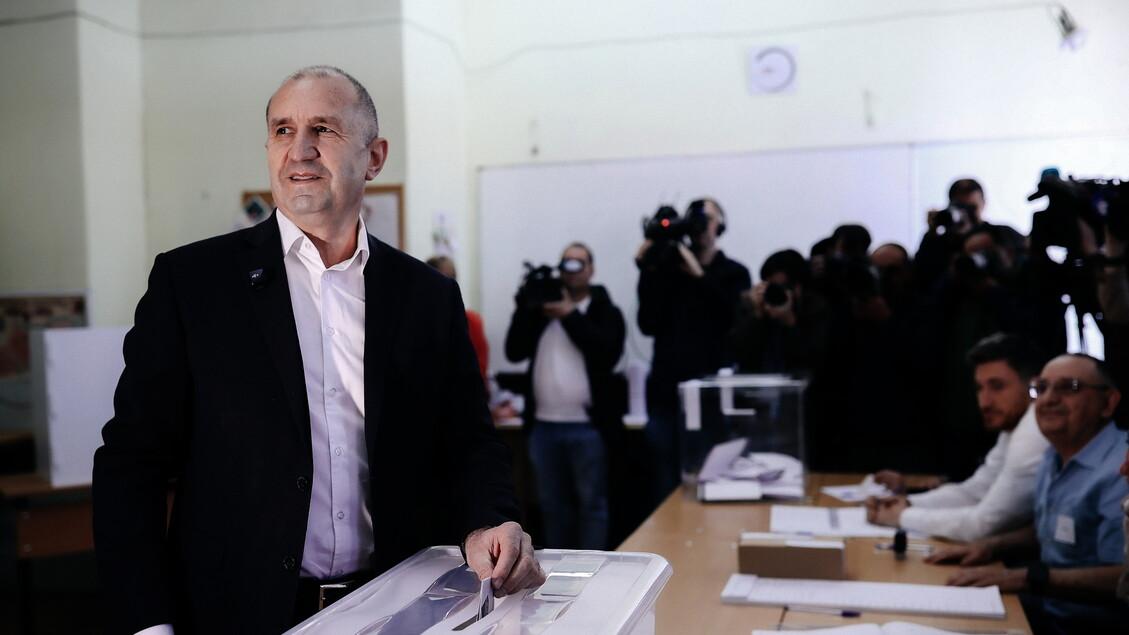
In his victory speech, Radev told voters, “People rejected the self-satisfaction and arrogance of old parties and did not fall prey to lies and manipulation. I thank them for their trust,” and he promised to build “a strong Bulgaria in a strong Europe.”
Why the Vote Happened
The election was called after the previous government tried to push through a controversial budget last December, prompting mass demonstrations that Radev, as president, supported.
BBC said the snap vote followed the previous government’s attempt to push through a controversial budget last December, and it described the election as “the eighth general election in five years.”

DW similarly said the snap vote followed the resignation of a conservative-led government amid nationwide anti-corruption protests last December, and it placed the vote in the context of Bulgaria’s political crisis since 2021.
Euronews reported that since 2021 Bulgaria has been through a spate of governments after large anti-graft rallies brought an end to the conservative government of long-time leader Boyko Borissov.
BFM framed the broader setting as voter fatigue and endemic corruption, saying Bulgaria holds its eighth parliamentary election since 2021 on April 19, 2026, and that Radev’s Progressive Bulgaria coalition leads polls amid euro adoption pains and corruption.
Multiple outlets also tied the vote to Bulgaria’s anti-corruption protests and the removal of the previous conservative government in December, with Al Jazeera saying mass protests led to the removal of the previous conservative government in December.
The campaign also unfolded against Bulgaria’s European integration milestones, with Al Jazeera saying Bulgaria joined the European Union in 2007 and adopted the euro as its currency in January this year, and DW noting Bulgaria joined the eurozone on January 1 and entered the border-free Schengen travel area shortly after.
In the middle of this political turbulence, Radev warned against another election, telling reporters, “We will do everything possible not to allow us to go [to elections] again. It is ruinous for Bulgaria,” and he added, “We are ready to consider different options so that Bulgaria can have a regular and stable government.”
Radev, Borissov, and Coalition Math
As exit polls pointed to a Progressive Bulgaria lead, the central political question became whether Radev could govern alone or would need coalition partners in a fragmented parliament.
DW said Radev told reporters he was willing to work with the PP-DB camp to obtain a majority, but was also open to a minority government, quoting him: “We are ready to consider different options so that Bulgaria can have a regular and stable government.”
Al Jazeera said Radev would be willing to work with them, but “a minority government was also an option,” and it reported that Borissov wrote on Facebook, “Elections decide who comes first, but negotiations will decide who governs.”
Euronews described Radev’s bloc as an anti-corruption candidate and former president’s “anti-corruption bloc leading in polls,” while also quoting voters who framed the election as a choice about corruption and governance.
Decho Kostadinov, 57, told reporters after casting his ballot at a polling station in the capital, Sofia, “I'm voting for change,” and said corrupt politicians “should leave -- they should take whatever they’ve stolen and get out of Bulgaria”.
Another voter, Elena, an accountant of about 60, said, “I'm voting to preserve what we have. We are a democratic country, we live well,” after casting her vote in Sofia.
AP reported that Radev’s coalition was unlikely to garner enough votes to rule alone and that he would face the uphill task of looking for partners to govern, while also quoting his warning that “It (new election) will be a disaster for Bulgaria.”
In the coalition arithmetic, POLITICO.eu said the key question was whether Radev would need to build coalition and whether he would choose allies from the pro-EU or pro-Moscow camp, and it laid out possible partners including pro-European liberal reformists and a combination involving the Socialist party and nationalists.
Europe’s Security and Arms Industry
Radev’s campaign and the election’s stakes were closely tied to Bulgaria’s role in European security and its support channels for Ukraine. BBC said Bulgaria is an important supplier of ammunition and explosives to Ukraine, through third countries, especially neighbouring Romania, and it described the VMZ factory in Sopot producing explosives and NATO-grade 155 mm artillery shells. BBC added that in October 2025 the German arms company Rheinmetall announced a €1bn joint venture with VMZ to produce up to 100,000 155mm shells a year, with a separate gunpowder factory also to be built in Sopot and Rheinmetall having a 51% share.
BBC also reported that Radev opposes Bulgarian military support for Ukraine, and it said he criticised EU sanctions and called for constructive dialogue with the Kremlin. Yet BBC also noted that while he opposes military supplies to Ukraine, Radev took credit for inviting Rheinmetall CEO Armin Papperger to Bulgaria in March 2025, and it quoted Radev saying, “Bulgaria is becoming part of the European defence ecosystem,” on a visit to Rheinmetall headquarters in Unterluss, Germany, in August 2025. Al Jazeera said Radev has called for renewing ties with Moscow and criticised supplying Ukraine with weapons to fend off Russia’s invasion, and it said he opposed the 10-year defence agreement signed between Bulgaria and Ukraine in March.

Euronews similarly said Radev denounced a 10-year defence agreement between Bulgaria and Ukraine signed last month, drawing accusations from opponents of being too soft on Moscow. DW said Radev officially denounced Russia’s invasion and said he would not use his country’s veto to block EU aid to Kyiv if elected.
Diverging Frames on Influence
While most outlets agreed on the exit-poll picture and the corruption-driven context, they diverged in how they framed the geopolitical meaning of a Radev-led outcome.
The Guardian described the result as a “Party of Bulgaria’s pro-Russian former president ahead in exit polls,” and it quoted Radev saying, “we will do our best to prevent having to go to the polls” again and warning, “It (a new election) will be a disaster for Bulgaria.”
The Washington Post framed the election as a Kremlin opportunity after Viktor Orban’s defeat in Hungary, saying Moscow sought to “rebuild toeholds of support within the European Union,” and it reported TikTok accounts plugging rumenradev proliferated more than 60 times as fast as those promoting GERB and garnered more than 5.5 million views between January and March 17.
The Washington Post also quoted Ilian Vassilev saying, “It is more than a possibility” that the Russians are hoping Bulgaria can help fill the void, and it quoted Martin Vladimirov: “We have strong concerns about Radev’s social media groups acting as an organized Russian influence campaign,” while noting there was “no clear evidence” it was synchronized or paid in a systematic way.
In contrast, POLITICO.eu emphasized coalition uncertainty and the choice between pro-EU and pro-Moscow camps, saying Radev’s Progressive Bulgaria was on track to secure around 40 percent and that he might ally with pro-European liberal reformists or form a pro-Moscow bloc with the Socialist party and nationalists.
AP and Euronews emphasized domestic anti-corruption and turnout concerns, with AP highlighting that the election could prolong a yearslong political deadlock and quoting Radev’s warning that another election would be a disaster.
Euronews also included a specific voter complaint about the “problem is that there is no one to vote for,” quoting taxi driver Miglena Boyadjieva saying, “You vote for one person and get others. The system has to change,” and it reported police seized more than one million euros in raids against vote buying.
Across these frames, the outlets still converged on the same immediate political consequence: preliminary results were expected on Monday, and the exit-poll projections implied a fragmented parliament where coalition negotiations would decide who governs.
What Comes Next
The immediate next step after Sunday’s vote was the release of preliminary results on Monday, but multiple outlets stressed that the path to government would depend on coalition negotiations in a parliament likely to be fragmented. AP said preliminary results were expected on Monday and that the exit poll suggested Radev’s coalition was unlikely to rule alone, which could prolong the political deadlock. BBC said preliminary results were expected on Monday as well, and it described the election as the eighth general election in five years, with coalitions failing to last more than a year since 2021.
Al Jazeera said official results were not expected until Monday and that the exit poll was published hours after voting closed, while also reporting that Radev said he would be willing to work with others and that a minority government was also an option. DW said preliminary results were expected on Monday and described voting hours, reporting that polling stations opened at 7 a.m. local time (0400 GMT) and closed at 8 p.m local time (1700 GMT). Euronews reported that voting would close at 1700 GMT, with exit polls expected immediately afterwards and preliminary results expected on Monday, and it said Radev aimed for an absolute majority in the 240-seat parliament.
The stakes were also framed through the lens of corruption and vote-buying enforcement, with BFM saying police seized more than one million euros intended to persuade voters and that hundreds of people had been detained. Whether Radev’s coalition can translate an exit-poll lead into stable governance, therefore, hinges on coalition-building, turnout, and the outcome of official results expected on Monday.